
Wooden Game Pieces: Meeples to Pawns
 By Hersh Glueck
Wooden game pieces are the meeples, pawns, cubes, discs and cylinders that stand on the board and in players' hands. They are the cheapest way to give a game real 3D pieces, and almost every mid-weight hobby game uses them as workers, resources, houses or markers. Wood game pieces include wood meeples for workers, wooden pawns for players, and wooden tokens such as discs for scores and resources. This guide covers every type of wooden piece and its sizes, the four woods, the two ways they are made, how the colour and the print go on, the design rules that keep a custom shape from breaking, and what each piece costs.
Check Out Our Free Resource: Guide For Selecting Components
This guide helps board game designers select ideal components and quantities.
What Is a Meeple?
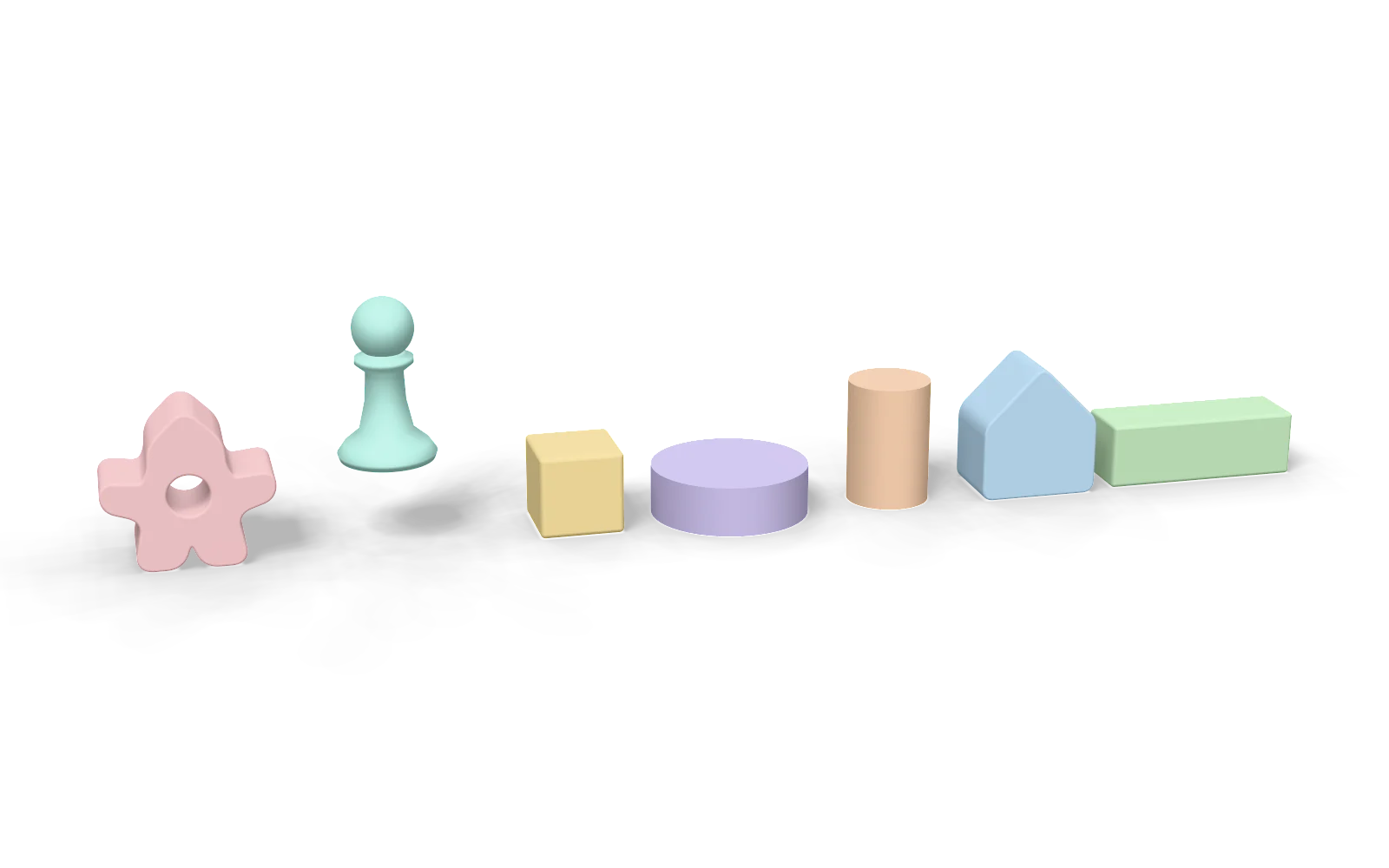
A meeple is the little wooden person that Carcassonne made famous in 2000; the name blends "my" and "people". Since then meeples have become the standard player piece of hobby games, and the word has widened to any flat wooden figure cut as a silhouette: a sheep meeple, a boat meeple, a house meeple. Wooden meeples are cut from a sheet of MDF or plywood with a laser and painted in a barrel, which is why a custom meeple shape costs the same as the classic one. The classic meeple is about 16 mm tall and 8 to 10 mm thick.
The Types of Wooden Game Pieces and Their Sizes
Wooden board game pieces fall into two families: flat silhouettes cut by laser, and 3D shapes cut by knife. The sizes below are the ones we make every week.
- Meeples. Flat figures, 6 to 8 mm MDF or 10 mm plywood. Priced by size: small up to 20 mm, medium up to 28 mm, large up to 35 mm. Standard and custom meeples cost the same, because the laser cuts any outline. Thicker than 10 mm means a knife-cut piece and a higher price.
- Discs. Flat round counters from 3 to 60 mm across; 19 mm is the standard size. 6 mm thick on the standard MDF board, or 3 mm for a thin disc. Used as markers, coins and resource tokens.
- Cubes. The cheapest piece of all, about 0.01 USD each. From 8 to 30 mm, with 10 mm and 15 mm the popular sizes. Cubes are cut from a square wooden bar that already has the cube's section, so there is no waste and the cut is simple. Board game cubes track resources, votes and influence.
- Cylinders. Short wooden cylinders up to 8 mm high are laser-cut from an MDF plate, which keeps them cheap. Taller cylinders are knife-cut from a round bar. Used as markers and as the pegs of a track.
- Pawns. The classic pawn with a round base and a head is a 3D shape, so it is knife-cut, not laser-cut. Standard mass-market pawns are cheap because the knives exist. A custom pawn is a different matter; see the 3D shapes below.
- Blocks and bars. Rectangular pieces like the roads in Catan or the blocks in a stacking game. Cut from bars like cubes: easy, cheap and strong.
- Houses and other silhouettes. A flat house, tree, ship or animal is a meeple by another name: laser-cut, same price rules. A house that stands on its own with a roof in 3D is a knife-cut piece.
- Tiles. Scrabble-style wooden tiles are laser-cut and printed.
- Custom 3D shapes. A star, a heart, a chess-style figure or any piece with a shape in the third dimension. These need a custom knife, and we quote them one by one from a CAD and STP file.
The Four Woods
- MDF. Pressed wood fibre with a smooth, grain-free surface. It takes paint very well, laser-cuts precisely and costs the least, which makes it the default for meeples and discs. The laser cuts it up to 8 mm, 6 mm being the usual board. Its weakness is water: MDF swells if it gets wet.
- Plywood. Thin layers of wood glued with the grain crossed, so it is light, stiff and shows a real wood grain. The laser cuts it up to 10 mm, which makes it the choice for thicker meeples and standees. Like MDF it dislikes moisture, and the laser can scorch its edges a little.
- Pine. A soft, affordable solid wood with a visible grain. It is not laser-cut, because the laser burns it; it is knife-cut from bars into cubes, blocks and pawns. It dents more easily than beech.
- Beech. A dense, hard, cream-coloured solid wood. It holds fine detail, resists dents and scratches and feels premium in the hand, so it is the wood for high-end pawns, custom dice and puzzles that get rough handling. It costs the most, and the laser cannot cut it; beech is always knife-cut.
A very cheap quote for wooden components usually means a softer wood and a thinner paint job: colour missing in the corners and curves of the piece, and sometimes on the flat faces too.
How Wooden Pieces Are Made: Laser and Knife
There are two processes, and the shape of your piece decides which one it gets.
Laser cutting makes the flat silhouettes. Large sheets of MDF or plywood, about 1.2 by 2.4 metres, lie on the laser bed; the laser traces every outline, and the cut pieces drop into crates under the machine. From there they go to the paint barrels. The laser gives any outline at the same price, but it only makes two-dimensional pieces: a meeple has a front and a back and nothing else.
Knife cutting makes the 3D shapes. A log is cut into long wooden bars. Each bar is fed through a runner, and at the end of the runner a set of fast-spinning knives shapes the wood to the profile of the piece, like a lathe for pawns or a slicer for cubes. Sandpaper finishes the surface. This is how pawns, cubes, blocks, tall cylinders and chess-style pieces are made, in pine or beech (MDF works too; plywood splinters). A custom shape needs its own knife, about 300 USD depending on complexity, and shaping a figure out of a bar wastes a lot of wood, easily 40 to 50 percent of the material. That is why a custom pawn costs far more than a custom meeple, and why cubes, which are exactly the shape of their bar, cost almost nothing.
How the Colour Goes On
Wooden pieces are not painted one by one. Thousands of pieces, about 15,000 meeples at a time, go into a large spinning barrel while an airbrush pushes paint into it, until every piece is coated. One base colour is included in the price of a piece. Extra colours are priced by the surface they cover, about 0.01 RMB per square centimetre of the piece, plus a setup of 100 RMB (about 15 USD) per colour. Pantone colours and metallic gold or silver cost a little more per colour.
Three rules for choosing the colour. Pick your Pantone from the uncoated set, because that is what paint on raw wood looks like. Expect the result a little darker than the swatch: wood absorbs paint and needs several layers, so aim two or three shades lighter than the colour you want. And expect a small variation between batches: a barrel holds 15,000 pieces that all have to reach the same colour, which is why an exact Pantone match on wood is harder than on paper.
Printing on Wooden Pieces
- Screen print. Ink pushed through a stencil screen onto the piece, one colour per screen. The crispest print and the standard for one-colour icons. About 70 USD per colour for the screen, then 0.02 to 0.03 USD per printed side. Screen printed meeples are the classic look of worker-placement games.
- Heat stamp. A pre-printed film pressed onto the piece with heat, for icons with several colours. About 70 USD per colour for the mould, then 0.01 to 0.05 USD per stamp depending on the surface. The ink sinks into the wood and looks like part of it, so use it when every piece carries the same design.
- UV print. Full colour printed straight onto the piece, no setup, unlimited colours. The choice for small runs. The ink sits on top of the wood and you can feel it under a finger, which some creators like and some do not.
- Laser engraving. The laser burns the design into the surface, leaving it darker and slightly recessed. Permanent and tactile, but the engraved area cannot be filled with colour, and it is the costly option, so use it only when the look needs it.
Design Rules for Custom Meeples and Shapes
Custom meeples and custom wood pieces are cut from MDF by default, which is less tough than solid wood, so the outline follows four rules:
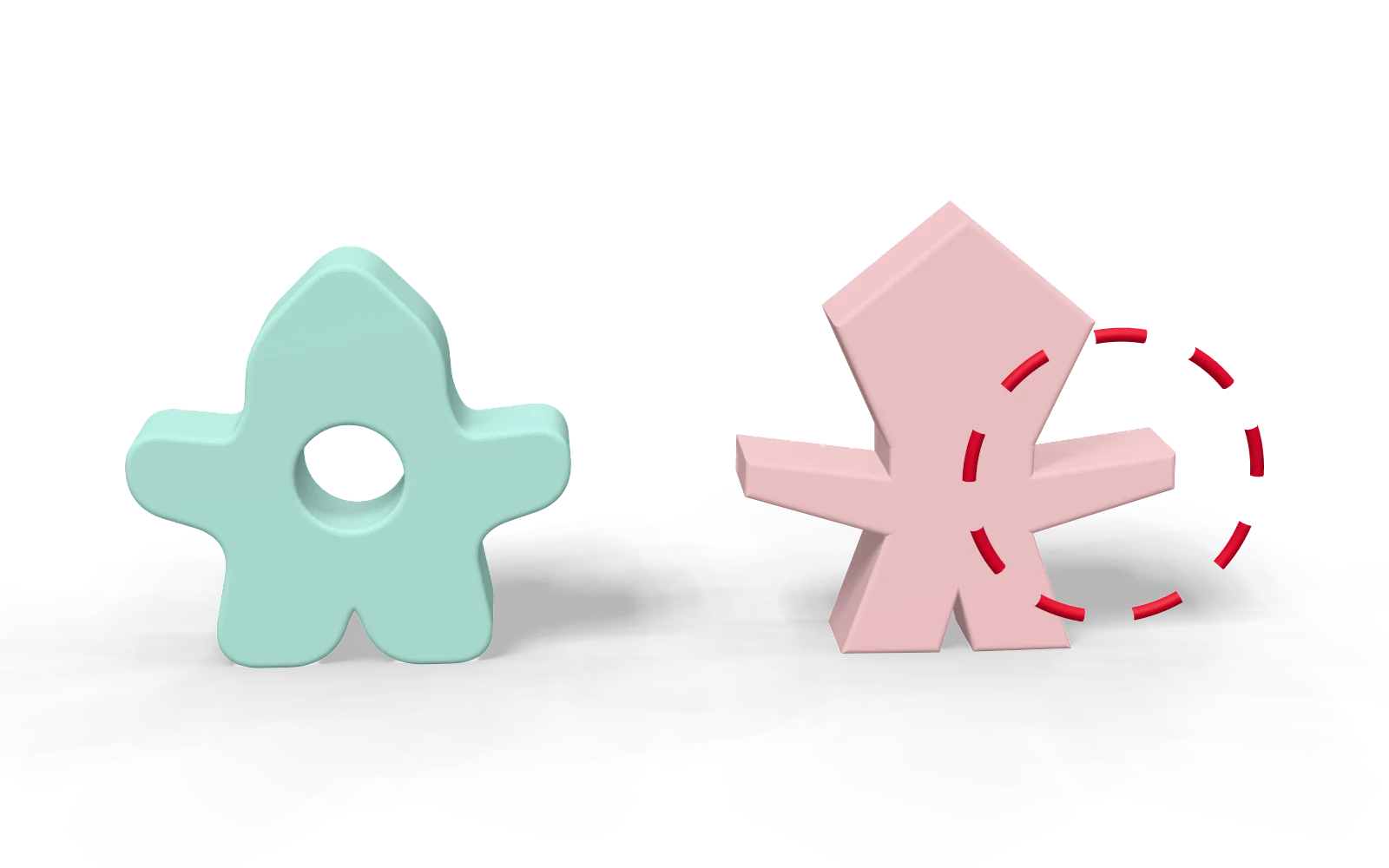
- No part narrower than 6 mm. Thin arms, legs and tails snap.
- Holes and openings at least 5 mm wide.
- No sharp points: give every corner a radius of 2 mm. Round corners also take the paint fully; sharp ones stay bare.
- Keep the thickness at 10 mm or under for a laser-cut piece; thicker means knife cutting and a higher price.
Two more rules for 3D pieces. Avoid very sharp edges and very high precision, which break and are hard to make consistently. And watch for parts that can lock into each other in the polishing barrel: a building whose base pillar is exactly as wide as the gap beside it gets stuck to its neighbours, so make one slightly wider than the other. If your design has to break a rule, we can cut it from solid wood and enlarge it a little, but that more than doubles the cost.
What Wooden Game Pieces Cost
- Cubes: about 0.01 USD each.
- Meeples and discs: priced by size, small, medium or large, with one base colour included; custom outlines cost the same as standard ones.
- Standard pawns: cheap, because the knives exist; custom pawns and 3D shapes: a knife of about 300 to 400 USD plus the wood waste, so they are priced one by one.
- Colours: one base colour included; extra colours priced by surface area, about 0.01 RMB per square centimetre, plus 15 USD setup per colour.
- Print: about 70 USD per colour for screen or heat stamp, then a few cents per side; UV print has no setup.
- Prototypes: about 1 USD per custom wood piece, with a 100 USD mould fee for up to five base colours or 200 USD for up to ten, and 150 USD for a custom print.
Large Wooden Boards
Wooden components are not only small. For a Sudoku, a Snakes and Ladders or a puzzle game we make large wooden boards from MDF, with frames, double-layer slots for recessed pieces and custom structures, and an oil polish that gives the wood a mahogany look. These need a clean CAD file for the quote and the factory.
Wood or Something Else?
Wood is the middle of the range. A cardboard standee is cheaper and prints in full colour; an acrylic piece costs more and gives a printed, glossy look; a plastic miniature costs the most and gives the most detail. Our board game pieces overview puts the four side by side. When you have your list of pieces, the board game manufacturing page shows what we make and how a quote works.
Frequently Asked Questions
What is a meeple?
What are wooden game pieces made of?
How much do wooden game pieces cost?
Can wooden pieces be printed?
How big is a standard meeple?
Talk to Our Team About Creating Your Board Game
From design to manufacturing, we can help you with every aspect of turning your game concept into reality.