
Board Game Printing Cost Explained
 By Hersh Glueck
Board game printing cost is a setup per press plus a small price per sheet. The setup for a two-sided print is about 600 RMB (85 USD) on the small press, 1,400 RMB (200 USD) on the medium press and 1,800 RMB (260 USD) on the large one, and after that each sheet costs very little. So printing 500 copies costs almost the same as printing 10,000, and the two things that move the bill are which sheet each part prints on and how many parts fit on it. This guide covers the three presses, the six standard sheets, the make-ready waste, colour (CMYK, Pantone, metallic ink), the special printing (nano printing, UV, holofoil, cold foil) and the file rules. How much does it cost to print a board game is answered sheet by sheet below. For a quote on your own parts, contact us.
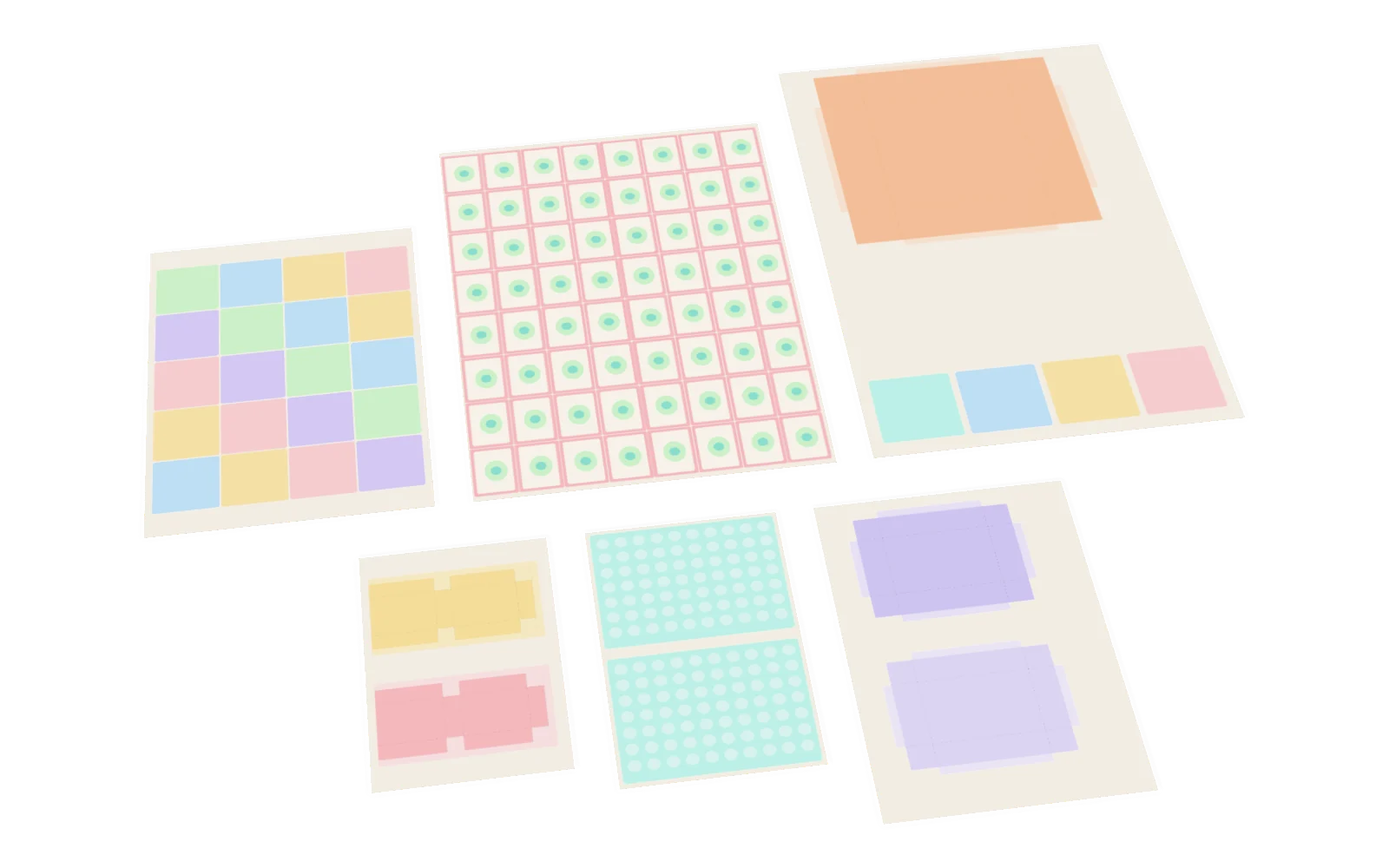
The Three Presses
We print board games on Heidelberg offset presses only, in three sizes named by the sheet they take. Offset printing (the inked image goes from a plate to a rubber blanket to the paper) is the standard for games because its colour holds across thousands of sheets and its cost per sheet falls fast with volume. That is why the offset printing cost of 500 copies is almost the offset printing cost of 5,000.
| Press | Largest print | Setup, two sides | Prints |
|---|---|---|---|
| Small press (8-opening) | 330 × 500 mm | about 600 RMB (85 USD) | token sheets, player boards, small boxes, tuck boxes, small rulebooks, reference cards |
| Medium press (4-opening) | 560 × 750 mm | about 1,400 RMB (200 USD) | playing cards, foldable boards, medium boxes, map tiles, medium rulebooks |
| Large press (2-opening) | 700 × 1,080 mm | about 1,800 RMB (260 USD) | large boxes, large rulebooks, extra-large boards |
One limit overrides the presses: we never print on a sheet larger than 580 × 890 mm, because the cutting, folding and gluing machines after the press cannot handle more without errors. A Pantone spot colour, printed from a fifth unit for exact colour matching, adds about 400 RMB (55 USD) per colour to the setup.
The Six Standard Sheets (Printing Sheet Sizes)
The master sheets from the paper mill are cut into two, four or eight, which gives six standard printing sheet sizes. Every part of a game should be designed to fit one of them with as little waste as possible, and we allow an extra 10 mm on each sheet for the machines to grip the paper.
| Sheet | Size | Used for |
|---|---|---|
| Eight Opening Small | 270 × 390 mm | small boxes, a 16-page small rulebook or a rule sheet, tuck boxes, paper money, reference cards |
| Eight Opening Large | 280 × 430 mm | small boxes, token sheets and other paper and cardboard parts |
| Four Opening Small | 370 × 530 mm | medium boxes, a 16-page medium rulebook, smaller foldable boards |
| Four Opening Large | 420 × 580 mm | medium boxes, medium paper parts, map tiles |
| Two Opening Small | 540 × 750 mm | playing cards (65 poker cards per sheet), standard-size game boards |
| Two Opening Large | 570 × 870 mm | large boxes, 16-page large rulebooks, extra-large game boards |
A two-piece box prints with its lid and base on one sheet, laid flat: a 200 × 200 × 80 mm box needs 390 × 780 mm of sheet, which only fits the Two Opening Small sheet, so it is a large box and a wasteful one. The board game box guide has the standard sizes that fit each sheet. Custom sheet sizes are possible from 2,000 sets.
Why Per-Sheet Pricing Is the Whole Game
Printing, cutting and gluing, for paper and for cardboard alike, are priced per sheet, and coating per square metre. The number of parts on each sheet is therefore the most important number in a quote. Two 210 × 280 mm token sheets fit one 8-opening sheet; a 290 × 290 mm token sheet uses the same sheet for one. A 136-card deck uses 2.1 card sheets and pays for three; a 130-card deck uses exactly two. A player board of 200 × 140 mm fits four per sheet; a slightly smaller one fits six. Design to the sheet and the printing a board game costs falls without touching the game. Our guides to token sheet cost and playing card size work the examples.
Setup, Make-Ready and Waste
- Plates and calibration. Each run needs new plates and a colour calibration. During make-ready about 300 sheets are printed and thrown away before the first good sheet. On top of that we add 3 percent wastage for the sheets pulled by the quality checks; 1.5 percent is possible if your requirements are lower, but we do not recommend it.
- Artwork setup. Laying out your files on the sheets can take an hour with print-ready assets and up to 60 hours for files that need repair. Print-ready files remove the artwork setup from the quote.
- The minimum. Our minimum is 1,000 sets, because below that the setup and the 300 sheets make each copy too dear; 500 sets cost almost the same as 1,000.
- The sheet price. After setup, the price per sheet is small, which is why a run of 2,000 is so much cheaper per copy than a run of 1,000.
Colour: CMYK, Pantone and Metallic Ink
Standard printing is four-colour CMYK (cyan, magenta, yellow, black). When a brand colour or a vivid off-CMYK colour must be exact, a 4+1 press adds a fifth unit with a pre-mixed Pantone colour, at about 400 RMB (55 USD) per colour. Metallic ink (gold, silver, bronze) works the same way: it is a fifth ink, printed where no other colour goes, with a dedicated ink bucket of about 140 USD that covers around 60,000 sheets, from 2,000 units. Two print runs never match 100 percent: with print-ready files the match is about 80 percent under 2,000 units, 90 percent from 2,000 to 20,000 and 95 percent above, and a press proof (an offset sample) is possible for large publishers moving a game to us. Files should be CMYK, 300 DPI, with the ISO Coated V2 profile for soft palettes or PSO Coated V3 for deep ones.
Special Printing: Nano Printing, UV, Holofoil and Cold Foil
- UV press. Some presses carry a unit that lays a UV coating and cures it with UV light at once. It is needed whenever ink cannot soak in: holofoil paper, PVC cards, some plastics. It adds about 1,000 RMB (140 USD) setup plus 0.12 RMB per sheet.
- Nano printing. A special ink that cures rigid and raised, so the print has a tactile relief you can feel. It runs on the UV press and adds about 700 RMB (100 USD) setup plus 0.10 RMB per sheet.
- Holofoil. Paper with a holographic layer, about 1,000 RMB (140 USD) more per ton, printed on the UV press. White ink is laid first wherever the foil should not show through.
- Cold foil. A metallic foil laid onto the sheet without heat, so it does not distort a card or show through its back: about 1,700 RMB (240 USD) setup plus 0.14 RMB per sheet for each foil colour.
- PVC. Printing on plastic cards needs the UV press and a lot of testing, so it only makes sense from about 10,000 units.
What each effect looks like, and the order they go on, is in our guide to playing card finishes.
Bleed and File Rules
- Bleed. Extend the artwork past the cut line: 1.5 mm on each side of a playing card, 3 mm on everything else. A two-piece box needs 15 mm on each side for the wrap, and so does a foldable board with a wrapped edge; a board without the wrap needs the standard 3 mm.
- Safe zone. Keep text and important art at least 3 mm inside the cut line; the cutting tolerance is 0.5 mm, and thin borders show it.
- Files. CMYK, 300 DPI at final size, text outlined, one file per component with the counts written under each card, and the back artwork mirrored to the front.
- Cards per sheet. No more than 80 cards of one deck on a sheet, or the collating machine cannot take the stack. Every card sits the same way up, in straight rows and columns: the cutter cuts the sheet in straight lines, so cards are never turned to fit more in.
- Units. Work in millimetres.
Prototype Printing Against Offset
Prototypes are printed on inkjet machines at about 270 DPI, against 800 DPI on the offset presses, so the colour can differ and solid areas may show dots; they are cut and glued by hand. They are priced per sheet (9, 12 or 18 USD by sheet size, 200 USD minimum) with no press setup, which is why they make sense up to about 20 copies and a 500-unit offset run makes sense after that.
Who Prints Board Games
If you are looking for someone to print board game parts rather than the cost of it, the printing is one step of manufacturing: the same factory prints, coats, cuts, glues and assembles the game. Our board game manufacturer page explains what we make and how a quote works, and the cost of a board game guide puts the printing line next to the others.
Frequently Asked Questions
How much does it cost to print a board game?
What sheet sizes are used to print board games?
Why is there a minimum order for printing a board game?
Talk to Our Team About Creating Your Board Game
From design to manufacturing, we can help you with every aspect of turning your game concept into reality.