
How Much Does it Cost to Make a Card Game?
 By Hersh Glueck
How much does it cost to make a card game? Between 0.50 and 7.50 USD per copy. A simple one-deck game costs 0.50 to 1.90 USD per copy, a two-deck game like Sabobatage or Chicken Challengers 1.40 to 5 USD, and a multi-deck game like That Sound Game 2.70 to 7.50 USD. The low end is a run of 10,000 copies; the high end is our 1,000-copy minimum. Card game production is cheaper than a board game because a deck is one material, one press and one cutting line, and almost everything about the card game cost comes down to one question: how many cards fit on a printing sheet. This guide covers that maths, the paper, the box, the special effects, custom sizes and the order size. For an exact quote, contact us with your card list.
What You Pay For in a Card Game
- Paper. Bought by the ton; the grade sets the price (below).
- Printing. A press setup per sheet type, then a small price per sheet. Cards print on the medium press: about 1,400 RMB (200 USD) for a two-sided setup.
- Finish. Poker oil on both sides is the standard and is priced per square metre; a linen finish adds about 0.10 USD per deck.
- Cutting and collating. Per deck, by machine, up to 80 cards per deck from one sheet.
- The box. A tuck box for one deck, a two-piece box for more.
- Assembly. Shrink-wrapping the deck, boxing and sealing, by hand.
The Sheet Maths: Game Card Production Costs Per Sheet
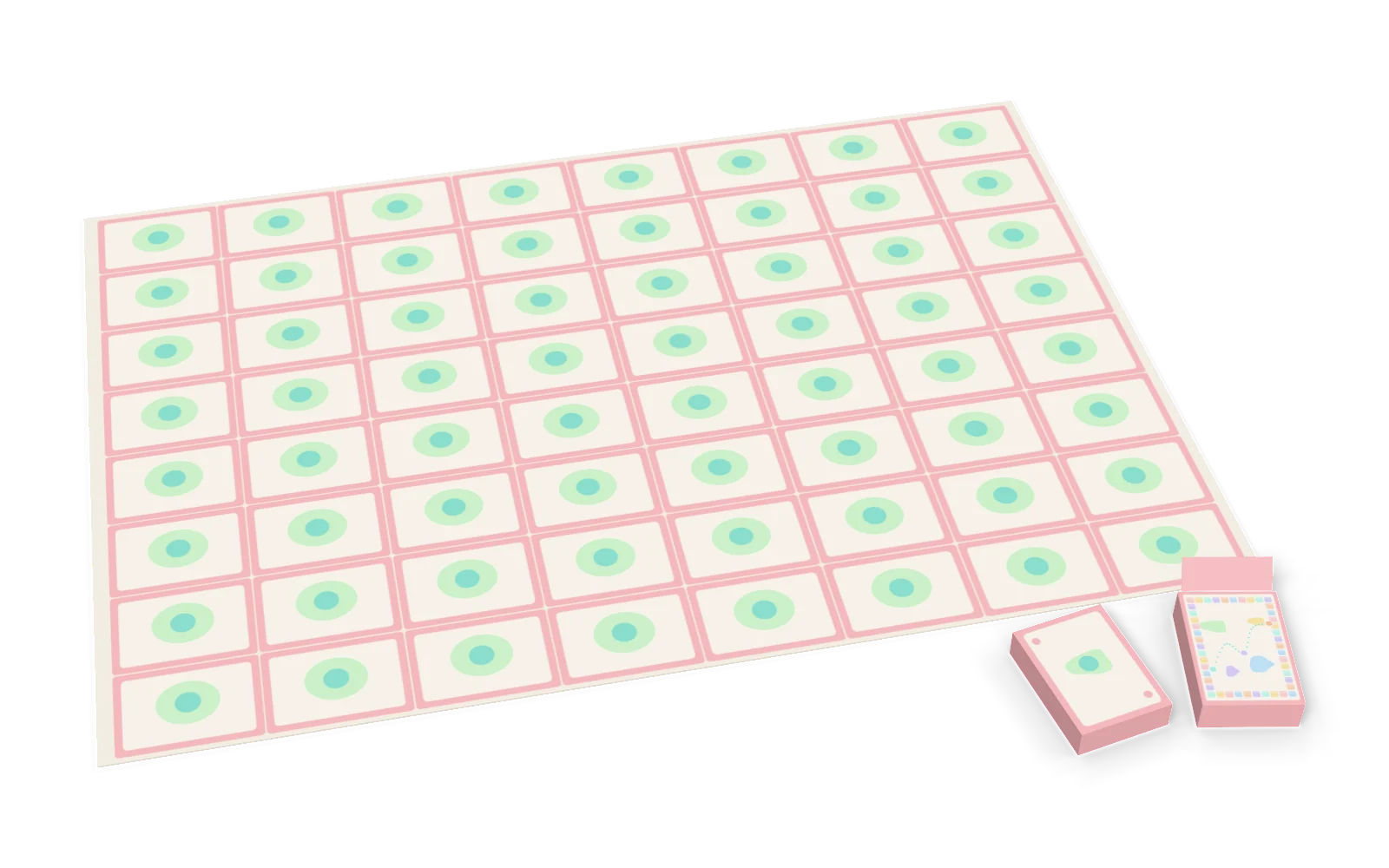
Cards print on a 540 × 750 mm sheet, and 65 poker-size cards fit on it. Printing, coating and cutting are all priced per sheet, so the game card printing costs of a deck are really the cost of the sheets it uses. A deck of 65 cards uses one sheet; a deck of 70 uses two sheets, for seven more cards. The collating machine also takes at most 80 cards per deck from one sheet. Every card on the sheet sits the same way up, in straight rows and columns, because the cutting machine cuts the whole sheet in straight lines; cards are never turned sideways to squeeze more in.
| Card size | Name | Cards per sheet |
|---|---|---|
| 63 × 88 mm | poker | 65 (54 on black core paper) |
| 57 × 88 mm | bridge | 71 |
| 44 × 68 mm | mini | 77 |
| 58 × 58 mm | small square | 79 |
| 63 × 63 mm | standard square | 76 |
| 68 × 68 mm | large square | 69 |
| 70 × 108 mm | small tarot | 49 |
| 70 × 120 mm | large tarot | 39 |
Design the card count to use whole sheets. A game with 136 poker cards needs 2.1 sheets, so it pays for a third sheet, a fee for splitting it and the waste; at 130 cards it uses exactly two. A game with 28 cards uses 0.43 of a sheet; at 32 cards the sheet is better used for the same price. Our playing card size guide has the full sheet logic.
The Paper
We recommend AAA white core paper at 350 gsm (0.33 mm) for most games; 300 gsm (0.31 mm) is the lighter option. The paper is bought by the ton: cheap white core about 5,500 RMB (790 USD), AAA white core about 6,500 RMB (930 USD), blue core about 8,000 RMB (1,140 USD), Chinese black core 10,000 to 12,000 RMB (1,400 to 1,700 USD) with batch-to-batch variation, and German black core, the casino paper, up to 18,000 RMB (2,600 USD) a ton. A cheaper paper lowers the price per deck and the feel of the cards with it. Black core has a one-ton minimum, about 6,000 sheets. Our guide to playing card material compares the grades.
Which Box
A single deck goes in a tuck box: one folded sheet of 300 gsm paper, the cheapest box there is, and the one a poker deck comes in. A tuck box holds up to 35 mm of cards, about 110 cards at 0.31 mm. Above that, or with a second deck, tokens or a small board, the game needs a two-piece box, which costs more and usually a paper insert. The box also sets the shelf price: a tuck-box deck retails around 9 USD, a two-piece box with cards 14.99 to 19.99 USD. Our guide to the board game box has the sizes and the cardboard.
Special Effects and What They Add
Most card games stop at poker oil and perhaps a linen finish. The premium effects each add a setup and a price per sheet:
- Holofoil cards. The paper carries a holographic layer, about 1,000 RMB (140 USD) more per ton, and because ink does not soak into foil it must print on the UV press that dries the ink instantly: about 1,000 RMB (140 USD) setup plus 0.12 RMB per sheet.
- Nano printing. A raised, rigid ink you can feel, cured by UV light: about 700 RMB (100 USD) setup plus 0.10 RMB per sheet.
- Cold foil. A metallic foil laid on the card without heat, so it does not show through the back: about 1,700 RMB (240 USD) setup plus 0.14 RMB per sheet for each colour.
- Spot UV and linen. Spot UV about 0.20 USD per unit plus a 150 USD setup; linen finish about 0.10 USD per deck, no setup.
Our guide to playing card finishes explains each one and the order they go on.
Custom Game Cards: Sizes and Shapes
Custom game cards in a size or shape of your own are possible, but they cost in two places. A new size needs a new cutting mould, and the cutting and collating become semi-automated. A circle, a hexagon or a card with a cut-out needs its own mould too. When the order is big enough, the mould is a small share of the price. When it is not, the cards are cut and collated with more hand work instead of opening a mould, and that labour is the cost. The nine standard sizes above run fully automated, which is why they are the cheapest custom playing cards cost you can get. The card game manufacturing page lists what we make.
Order Size and Prototypes
The minimum is 1,000 sets. A run starts with about 300 sheets of make-ready waste and up to 60 hours of artwork setup, so 500 sets cost almost the same as 1,000, and at about 2,000 sets the cost to make a card game drops into the 20 percent of retail price a publisher needs. A prototype deck is quoted at 18 USD per sheet, with a 200 USD minimum order and half the cost refunded on a mass order within 90 days. Our guide to the cost of a board game explains how a quote is built, the overhead and the wastage.
The Bottom Line on Card Game Cost
Count your cards against the sheet, choose a standard size, pick AAA white core at 350 gsm, put one deck in a tuck box, and make 2,000 copies if you can. That is the cheap, good card game. Add the effects where a player will notice them. When the card list is final, send it to us and we quote it at several quantities.
Frequently Asked Questions
How much does it cost to make a deck of cards?
How much do custom playing cards cost?
How much does it cost to print a deck of cards?
How much does it cost to make a trading card like a Pokémon card?
Talk to Our Team About Creating Your Board Game
From design to manufacturing, we can help you with every aspect of turning your game concept into reality.