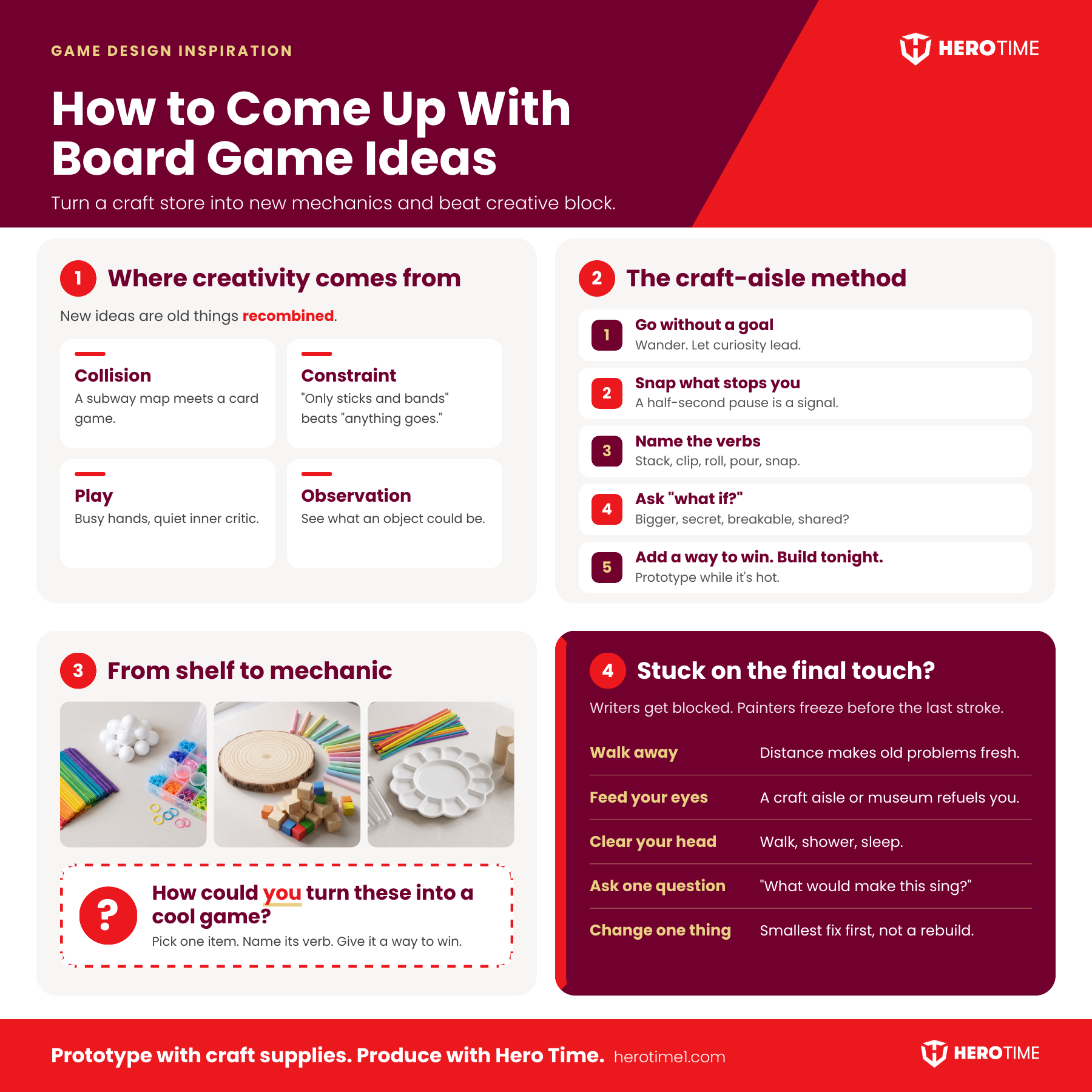
Every game designer knows the feeling: a blank page, a deadline, and a brain that refuses to cooperate.
The good news? Your next board game idea probably isn’t hiding in your head. It’s hanging on a hook in a craft store, in a bag of popsicle sticks, a bin of foam balls or a tray of test tubes.
This article shows how to come up with board game ideas on purpose: where creativity comes from, how to beat creative block, and ten board game ideas from one craft store walk. Half of them link to a published game that used the same material.
Where does creativity come from?
New ideas are almost always old things recombined. Most are two or more existing things pressed together until they feel new. You don’t need to invent from scratch; you need fresh raw material and the habit of asking “what if?”
For game creators, sparks usually come from four places:
- Collision. Two unrelated things meet, like a subway map and a card game.
- Constraint. “Only sticks and rubber bands” beats “anything goes.”
- Play. Ideas arrive when your hands are busy and your inner critic is quiet.
- Observation. Seeing what an ordinary object could be, not what it is.
Board game design inspiration: think like a concept artist
Concept artists start from something real and transform it. A creature designer takes a beetle, adds armour and swaps the legs. Game designers can do the same with mechanics: a clothespin invites clipping and releasing, so ask what a game built on those actions would feel like. Familiar objects also lower the learning curve, leaving room for your twist to surprise players.
How to overcome creative block when designing a game
Every creator hits a wall, often right before the finish line. Writers call it writer’s block: the story is nearly there, but the next sentence won’t come. Game designers feel it when the core loop works yet something small and essential is still missing.
Great artists know it too. A painter can freeze before the last few strokes, unsure where the final touch belongs. The answer rarely comes from staring harder. It comes from stepping away and returning with fresh eyes until the missing piece shows itself. This article is here to help you do exactly that:
- Walk away on purpose. A day or two of distance turns familiar problems into fresh ones.
- Feed your eyes something new. A craft aisle or a museum gives your brain material while your mind rests.
- Clear your head. A walk, a shower or a night’s sleep lets half-formed ideas surface.
- Come back with one question: “What one thing would make this sing?”
- Test the smallest change first. The missing link is usually a rule, a component or a twist, not a rebuild.
How to come up with board game ideas: the craft-aisle method
Walk slowly, photograph freely, and ask five questions of every object. An hour in a store beats a week of staring at a screen.
- Go without a goal. Wander and let curiosity lead.
- Photograph anything that makes you pause. That half-second of interest is a signal.
- Name the verbs. Stack, flick, clip, pour, roll, snap. Verbs become mechanics.
- Ask the five transformation questions.
- What if it were 10 times bigger or smaller?
- What if it could hide a secret?
- What if it could fall, break or run out?
- What if two players had to use it at once?
- What if it decided who wins?
- Tie it to a win condition and build tonight, while the idea is still hot.
Physical objects matter: something that wobbles, snaps or falls creates table drama on its own.
10 board game ideas and mechanics examples from one craft store
One walk, a few shelves, tons of ideas and mechanics. The materials are grouped into three flat-lays, and every second idea is paired with a published game that used the similar kind of material.
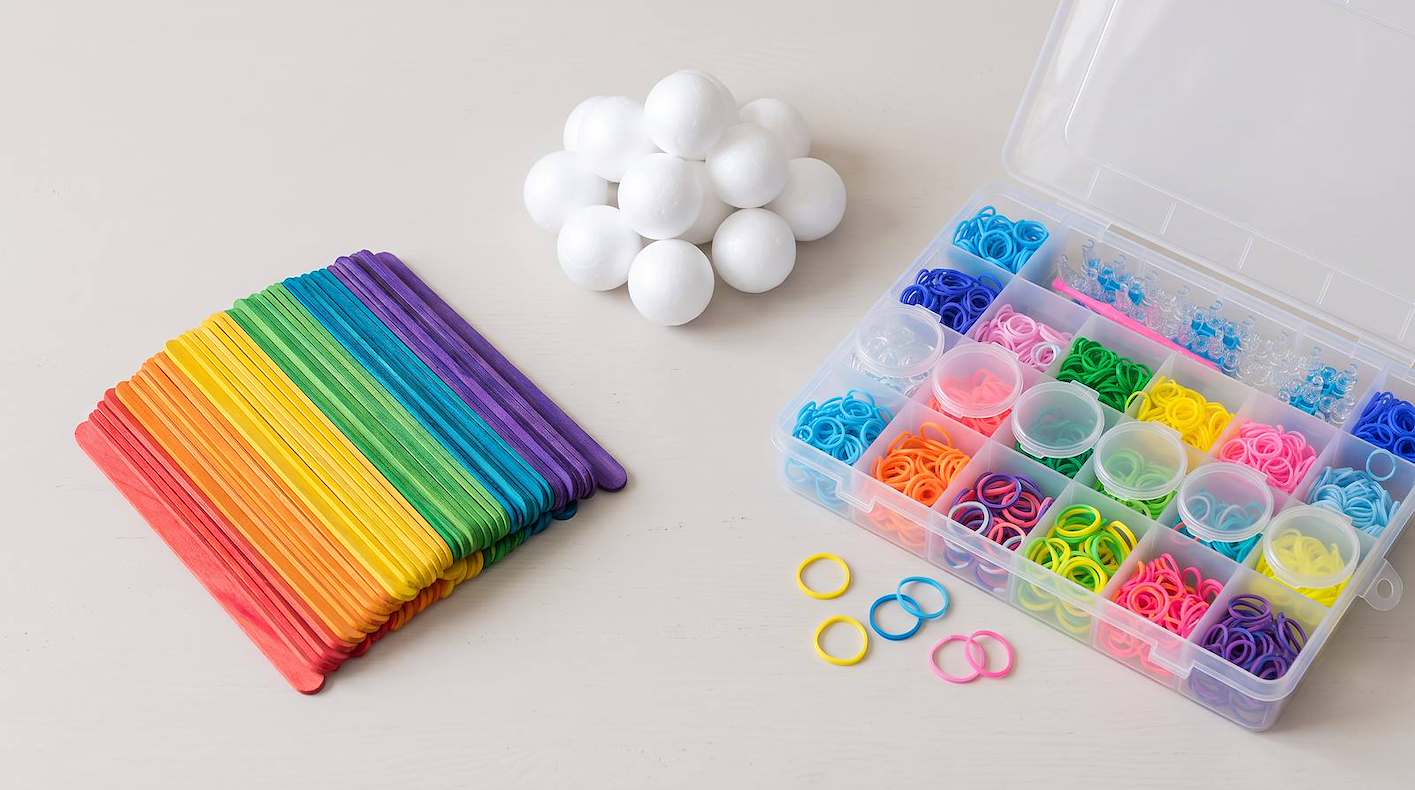
1. Popsicle sticks: Cantilever Crossing
Verbs: span, lean, balance
Race to the goal Players extend a bridge over a gap, one stick per turn, each resting only on the last. Your runner walks along it. If the bridge collapses, everyone on it falls back to the start, including you.
2. Foam spheres: Pincushion Health
Verbs: pierce, mark, roll
Last one standing Each hero is a foam sphere. Every hit pushes a coloured toothpick into it (grownups only), so damage is visible from across the table and nothing gets destroyed. Three pins of one colour and you’re out.
Published proof: Potion Explosion used 80 coloured marbles in a sloped dispenser as potion ingredients: take one, and same-coloured spheres that roll together “explode” into your hand. Same shape, completely different job.
3. Loom bands: Rubber Territory
Verbs: stretch, enclose, snap
Area control The plastic loom becomes a peg board. Players stretch bands between pegs to enclose shapes, and the space inside your bands is yours. Later bands can stretch over earlier ones to steal a corner, like a tactile cousin of Go.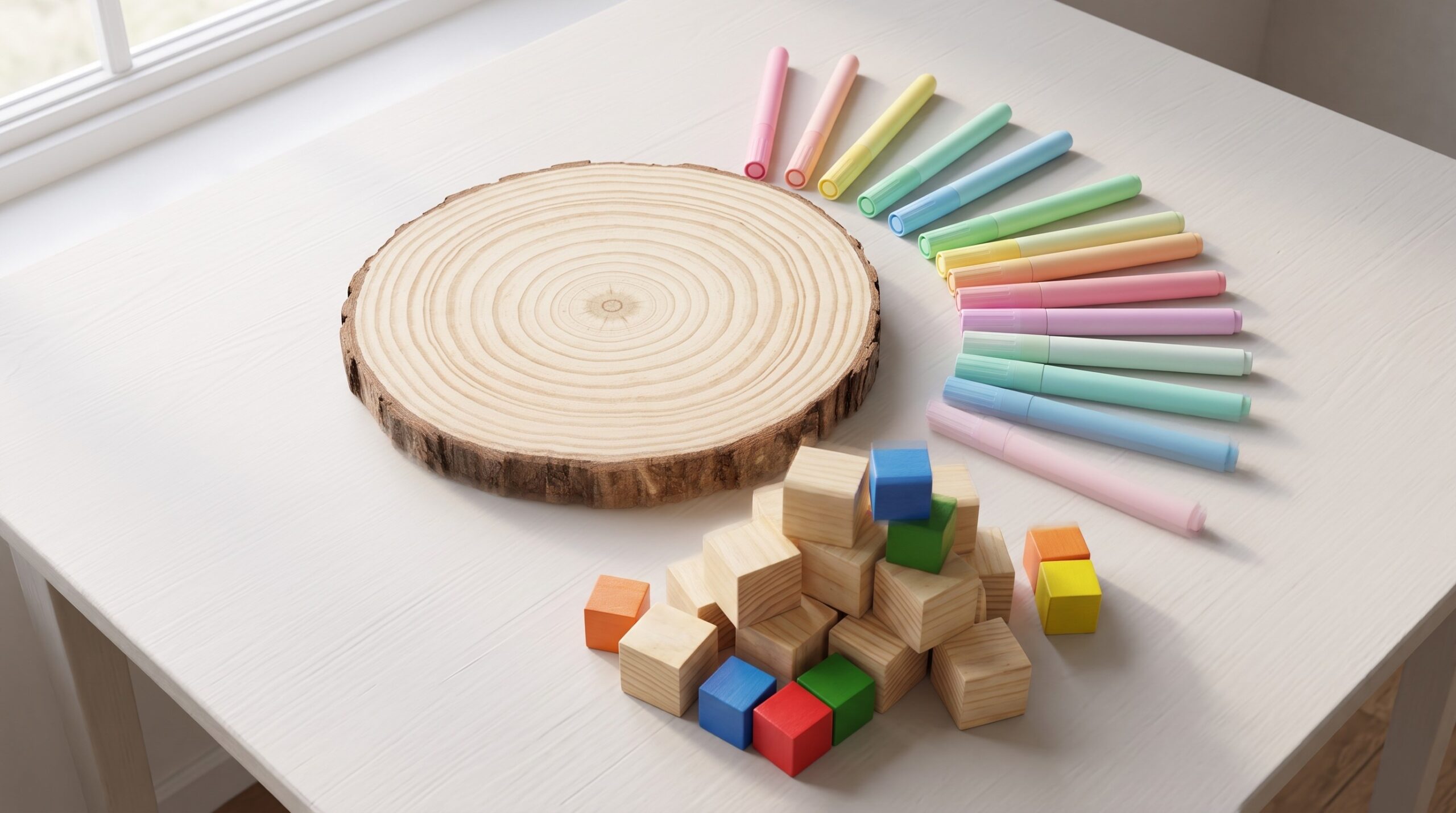
4. Tree-ring wood slice: The Heartwood Race
Verbs: spiral, age, grow
Race to the goal The rings form a spiral track from bark to core. Outer rings are long but safe; inner rings are short but full of hazards. Every turn asks: cut inward now, or play it safe?
Published proof: Photosynthesis used trees and a sun that circles the board, so trees grow, cast shadows and fight for light. Spaces near the forest centre score more, the same pull toward the core.
5. Acrylic markers: Hidden Ink
Verbs: reveal, layer, decode
Objective race Clue text is printed under red noise and only becomes readable through a cheap red decoder card. Players race to unlock hidden checkpoints first, peeking only when they spend an action.
6. Wooden cubes: Pixel Claim
Verbs: place, fill, pattern
Area control Each player holds a secret pixel pattern. Everyone places cubes into a shared 8 by 8 grid, and the first to spot their pattern in any colour mix claims it. Every cube you place might finish someone else’s picture.
Published proof: Pictures used nine coloured wooden cubes in a frame, plus shoelaces, sticks and stones, for players to recreate a secret photo. It won the 2020 Spiel des Jahres.
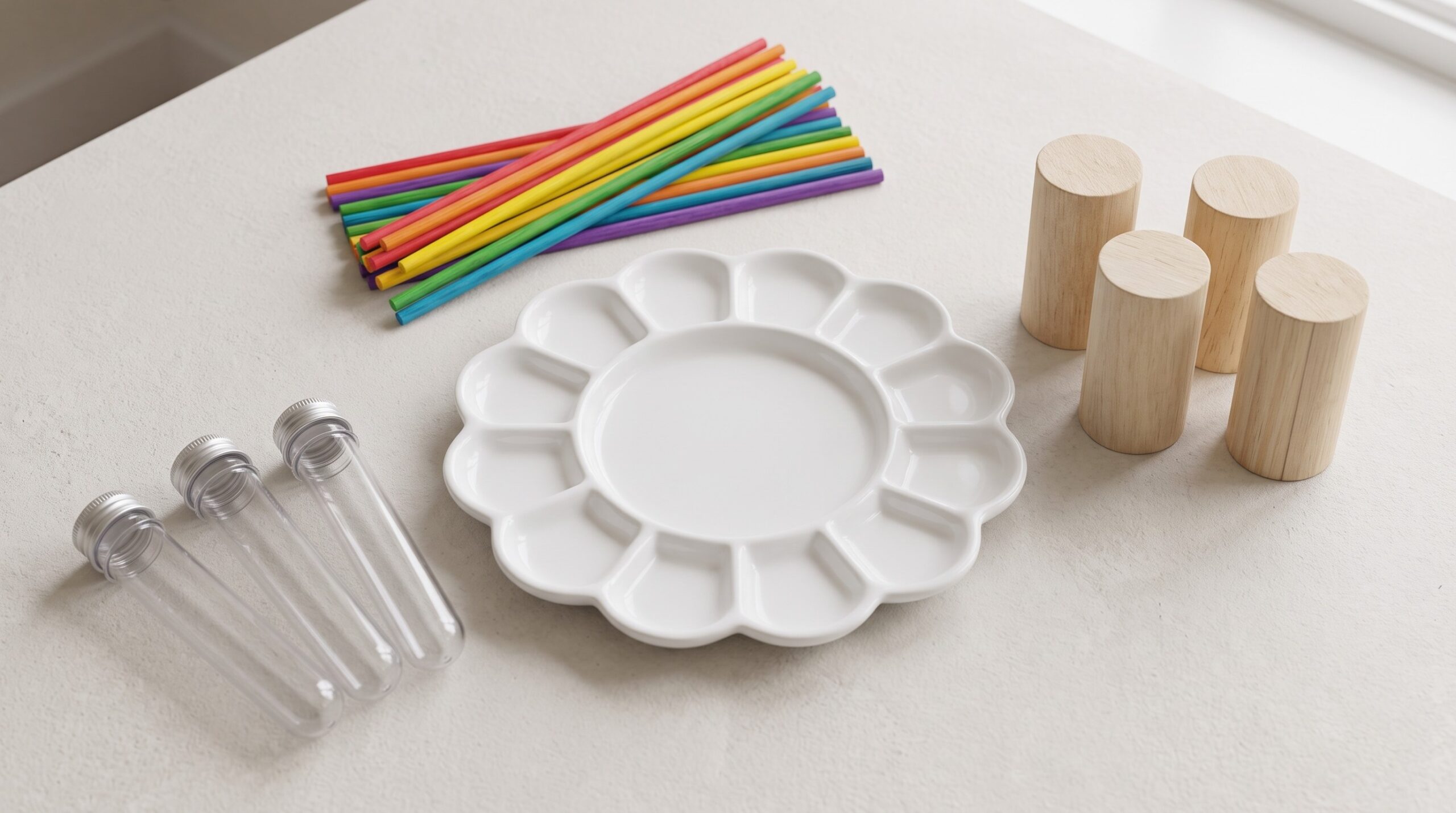
7. Flower paint palette: The Petal Rondel
Verbs: rotate, mix, share
Cooperative survival The flower-shaped palette is a ready-made rondel, a circular action track. Each petal is an action and the centre well holds the rising threat. The team shares one pawn, so every choice changes what the next player can do.
8. Test tubes: Rattle Evidence
Verbs: seal, shake, listen
Hidden role Each sealed tube holds rice, beads or sand. Nobody may open a tube, only shake it and listen, to find the one hiding the treasure. Deduction by sound is something almost no game does.
Published proof: The Quacks of Quedlinburg used a cloth bag of hidden ingredient chips that players draw blindly into a potion pot, pushing their luck before it explodes. It won the 2018 Kennerspiel des Jahres.
9. Rainbow dowels: Laser Grid
Verbs: span, cross, block
Last one standing Coloured dowels laid across blocks become laser tripwires. Units can’t pass under an enemy-coloured wire, and moving a wire costs actions, so players slowly cage each other in.
10. Wooden cylinders: Boulder Slope
Verbs: roll, crush, topple
Elimination Chunky cylinders wait at the top of a tilted board. On your turn, nudge one down a lane to knock rivals off the slope. Each boulder that rolls is gone for good, so timing is everything.
Published proof: Junk Art used about 60 oddly shaped wooden pieces for stacking contests across a dozen rule sets. One box of wood, many games.
From DIY (Do-It-Yourself) board game pieces to production with Hero Time
A craft-store prototype proves the fun; production components make it sellable. Nearly every material above has a manufacturable equivalent, and Hero Time helps creators make that jump.
| Craft-aisle material | Production equivalent |
| Wooden cubes, sticks, odd wooden shapes | Meeples, cubes, discs and custom laser-cut wooden shapes |
| Wood slice or hand-made board | Large MDF boards with frames and recessed slots, made from CAD files |
| Foam spheres | Soft polyurethane (PU) balls in custom shapes |
| Clothespins and clips | Custom plastic clips |
| Coloured beads or cubes | Plastic cubes and shapes including translucent versions |
Hero Time builds low minimum order quantity (MOQ) prototypes with production-grade materials, for playtesting, reviewer copies and crowdfunding previews. Typical production lead time is 25 to 35 days.
In the meantime, put the phone down and go for a walk down the nearest craft aisle. Photograph what makes you pause. Name the verbs. Build something ugly tonight. Then step back, come back, and keep polishing until your game truly shines. Good luck, from all of us at Hero Time.
Frequently asked questions
How do you come up with board game ideas?
Recombine things that already exist: other games, everyday objects, systems like maps, and physical materials. A craft store walk is one of the fastest ways to find new combinations. Name the actions an object invites, then tie one to a way of winning.
How do you overcome creative block when designing a game?
Step away for a day or two, feed your eyes something new, and come back with one question: what single change would make this better? Test the smallest fix first.
What can I use to make DIY (Do-It-Yourself) board game pieces?
Popsicle sticks, wooden cubes, foam spheres, clothespins, loom bands and test tubes all make fast, cheap prototype pieces. Once the game is fun, move to production-grade prototypes.