
Board Game Materials, Grade by Grade
 By Hersh Glueck
Board games are made mostly of paper and cardboard, with wood, plastic, fabric and metal for the pieces. The paper carries the print, the cardboard gives boards, tokens and boxes their strength, and the pieces add weight and feel. Each material comes in better and cheaper grades, and the grade decides how long your game lasts. This guide compares the board game materials a factory uses, with the numbers that tell a good grade from a poor one.
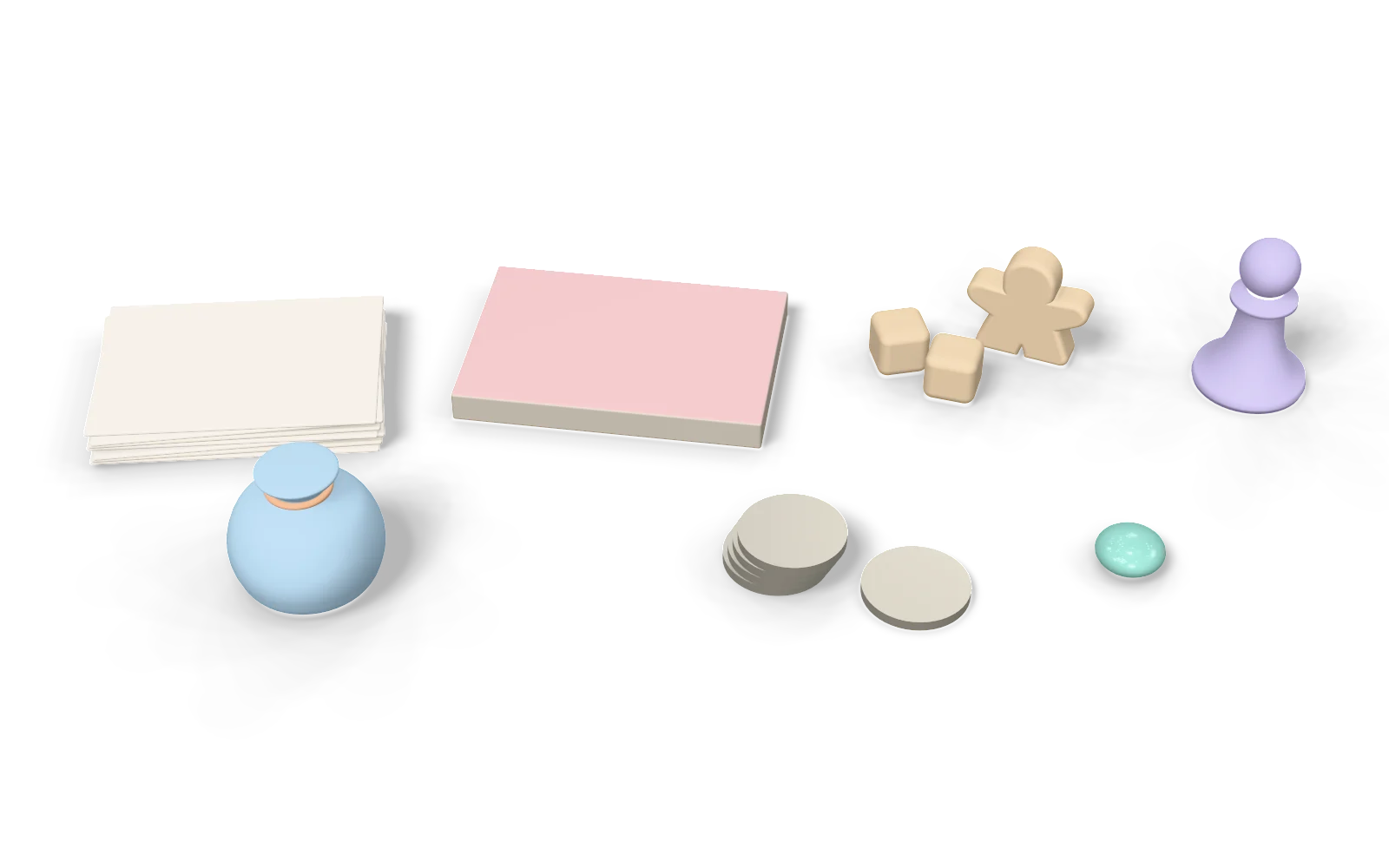
What Are Board Games Made Of?
What are board games made of? Mostly paper and cardboard. Here is which board game material goes into which part:
- Paper and card stock: the cards, the rulebook, and the printed layer on boxes, boards and tokens.
- Cardboard (greyboard): the core of the box, the game board, the player boards and the token sheets.
- Corrugated board: inserts that hold the parts in place.
- Wood: meeples, cubes, discs and other playing pieces.
- Plastic: miniatures, pawns, inserts and some cards.
- Fabric, metal, glass and acrylic: bags, play mats, coins and premium tokens.
How each one is printed, cut and glued is shown in our guide to how board games are made.
Paper: How Quality Is Measured
Paper quality is measured with five numbers, and each one shows up in the finished game:
- Weight (GSM, grams per square metre): heavier paper is thicker and stiffer.
- Burst strength: how much pressure the paper takes before it breaks, in pounds.
- Elasticity: how many times a card bends back to shape before it creases.
- Brightness: how white the paper is; brighter paper gives brighter colours.
- Opacity: how much light it blocks; low opacity lets the back of a card show through.
These are the paper types used in games, with their numbers:
- White core paper (coated art paper) is the standard card stock. A low grade bursts at 7 to 10 pounds, bends back about 2 times, has about 78% brightness and 80% opacity. A high grade bursts at 12 to 16 pounds, bends back up to 8 times, reaches 87 to 93% brightness and over 90% opacity. We recommend high-grade white core at 350 gsm for most games.
- Black core paper has a black layer inside, so it is 100% opaque and no light passes through a card. It bursts at 14 to 18 pounds. Chinese black core bends back about 8 times with 70 to 80% brightness; German black core passes 20 bends with 78 to 85% brightness, and its quality stays the same from batch to batch.
- CCNB paper (clay coated news back) is a cheaper paper made to be glued onto cardboard, for token sheets, boards and the inside of boxes.
- White art paper is coated on one side only and is about 30% thicker than white core (0.41 mm against 0.31 mm at 300 gsm). It is used for tuck boxes, paper inserts and board layers, with 70 to 80% brightness.
- Uncoated paper (notebook paper) takes a pen well but prints duller colours. It is used for score pads, notepads and paper money.
- Kraft paper has a natural brown texture: 100 to 130 gsm for envelopes, 300 to 400 gsm for cards players write on.
Card stock for cards is compared in detail in our guide to playing card material.
Cardboard: The Backbone of the Game
Cardboard, also called greyboard or chipboard, gives a game its strength. It comes from 0.8 mm (600 gsm) for tiny boxes up to 2.5 mm (1,600 gsm). Its quality is measured by compression strength: high-quality cardboard takes up to 200 pounds of pressure, while low-quality cardboard gives way at about 100 to 150 pounds. Dense cardboard also cuts cleanly without fraying at the edges and resists warping in damp air, which matters for tokens and boards. We work with three grades, standard, dense and high-density, and the high-density grade keeps a box lid flat even under a heavy game.
Corrugated board, with its wavy inner layer, is lighter and firmer than flat card and is the usual choice for inserts. Thickness choices and their costs are in our guide to board game cardboard.
Wood
Four woods are used for game pieces, and each is cut in its own way:
- MDF (medium-density fibreboard) is cheap and cuts precisely with a laser, up to 8 mm thick (6 mm is the most common). It swells if it gets wet.
- Plywood is light and strong and can be laser cut up to 10 mm thick, good for thick meeples. It can warp in damp air if it is not sealed.
- Pine is an affordable softwood with a natural look. A laser burns it, so it is shaped with knives and moulds, and it dents more easily.
- Beech is a dense hardwood with a heavy, premium feel. A laser cannot cut it, so it is also shaped with knives and moulds, and it costs more.
Shapes, sizes and design rules are in our guide to wooden game pieces.
Plastic
Plastic is used where pieces need fine detail or must not break:
- ABS is rigid and holds fine detail, so it is used for miniatures and pawns. Softer PVC is often mixed in.
- PVC is flexible and cheap, used for soft parts, mats and waterproof cards.
- PP (polypropylene) resists knocks, moisture and chemicals and is recyclable, used for trays and inserts.
- TPR is a soft, rubbery plastic that is more eco-friendly than PVC but costs about double.
- Resin is used for 3D-printed prototypes and very small runs of miniatures.
How plastic pieces are moulded is explained in board game miniatures, and our plastic game pieces service makes them.
Fabric, Metal, Glass and Acrylic
- Neoprene is a soft, cushioned rubber for play mats. It resists spills but is bulkier and costs more than a folding board.
- Cotton canvas is strong and cheaper than neoprene, used for drawstring bags and roll-up boards. It stains more easily.
- Zinc alloy gives heavy, detailed coins and tokens, usually for deluxe editions.
- Steel is stronger and heavier than zinc alloy, used for metal dice and tokens.
- Glass is used for gems and marbles. It looks beautiful but can chip.
- Acrylic is clear and strong, used for standees, overlays and premium tokens. It scratches more easily than glass.
FSC Certified Paper
FSC certified paper comes from forests managed under the Forest Stewardship Council's rules, and an FSC label on the box shows it. Two levels are possible:
- FSC Mix: paper from certified forests mixed with other controlled sources. We can make it from 5,000 sets, for about 5% more.
- Full FSC: every sheet from certified sources, from 20,000 sets.
Other ways to make a greener game are on our eco-friendly production page.
Feel the Materials Before You Choose
Numbers help, but the best test is your own hands. We send a free sample kit with our most-used materials in different grades and finishes, and you pay only the shipping. You can also buy a game we have made with parts like yours. Material names are not the same everywhere, so a sample shows exactly the quality you are being quoted for. To ask for a kit, contact us.
The Bottom Line on Board Game Materials
Board games are made of paper and cardboard first, and wood, plastic, fabric and metal second. The grade matters more than the name: a high-grade paper or a dense cardboard makes cards that last and boxes that stay flat, for a small difference in cost. Ask your manufacturer for the numbers, compare samples, and choose the grade each part needs. When you know your parts, contact us for a quote.
Frequently Asked Questions
What are board games made of?
What paper is best for board game cards?
How thick is board game cardboard?
Can a board game be made with FSC paper?
Talk to Our Team About Creating Your Board Game
From design to manufacturing, we can help you with every aspect of turning your game concept into reality.