
How Are Trading Cards Made?
 By Hersh Glueck
How are trading cards made? They are printed and finished like any playing card, then sorted by machine into booster packs so that each pack gets the right mix of common and rare cards. The hard part is not the printing but the sorting, which must follow the ratios you set for every card. This guide follows a trading card game from planning to sealed packs, and lists the limits to know before you choose among trading card manufacturers.
Step 1: Plan the Rarities
Before anything is printed, decide the rarity tiers and how often each card appears. A rare card might be printed only a few hundred times, while a common card is printed thousands of times. Write down three things for every card:
- Its rarity tier, for example common, uncommon, rare.
- How many of it are printed in the whole run.
- How many of each tier go into one booster pack, for example 6 common, 2 rare and 1 special card.
Every card's ratio must be set out clearly, because the sorting machines follow it exactly. A clear ratio sheet is the most useful thing you can send your manufacturer.
Step 2: Print and Finish the Cards
Trading cards are printed on large sheets on an offset press, coated and cut, on the same production line as other playing cards. Our guide to how board games are made shows every step of that line. Trading card games often use special materials:
- Card stock: white core for most cards, or black core for full opacity and a stronger snap. See playing card material.
- Holofoil cards: printed on a holographic paper on a separate press. A white ink layer covers the areas where the shine should not show, such as text.
- Cold foil, spot UV and gilded edges: extra effects for special cards and premium decks. See playing card finishes.
The standard trading card size is 63 x 88 mm (about 2.5 x 3.5 inches), and a mini size of 44 x 68 mm is also common. Holofoil cards feel slightly different from regular cards, so players can tell a holofoil card by touch in a shared deck.
Step 3: Sort the Cards into Booster Packs
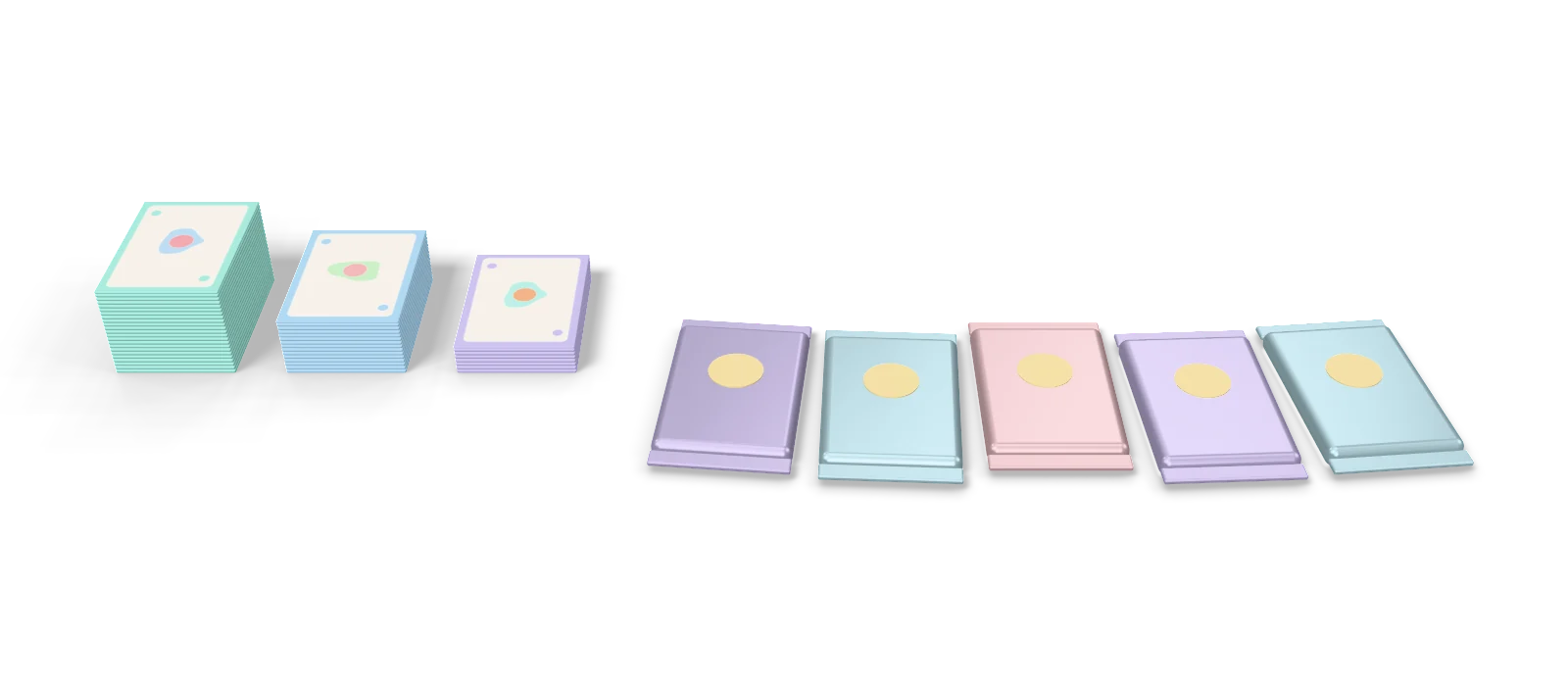
Sorting is the step that makes a trading card game. Our collating machines sort with up to 13 heads, so a booster pack can mix up to 13 card stacks in one pass; for more, the packs run through two or three times. Every card's ratio must be set out clearly, and the sorting is fully automatic. This collating keeps the rarity balance the same across the whole print run, so no box is full of rare cards and no box is missing them.
Step 4: Pack, Seal and Ship
The sorted cards go into foil booster packs. A foil bag is made to your size, and 6 to 9 cards per pack is standard; 18 is about the most. More cards than that are usually packed in a tuck box as a stand-alone deck. The packs are sealed, boxed into display boxes and cartons, and every pack is checked before shipping. Extra and misprinted cards are destroyed, never sold on: ask any trading card factory to confirm this in writing.
The Limits to Know
A few requests need a large run or a specialist, and it is better to know them early:
- Serial numbers on each card are not printed in our factory. A serial number can go on the box as a sticker, and above 100,000 sheets card serialisation can be done by an outside printing partner.
- Holofoil on black core paper needs at least 10,000 sheets, about 20,000 decks, because the foil is applied to the black core stock in a separate setup.
- Gilded edges are costly and make sense from 5,000 decks.
- Holofoil and black core prototypes are not possible; prototypes use regular card stock.
Choosing Among Trading Card Manufacturers
The right trading card manufacturer understands your rarity plan, sorts automatically by your ratios, and tells you its limits before you order. Ask each one how many card stacks it can mix per pack, how it checks the ratios, and what happens to extra cards. We make trading card games alongside board games and card games; see our card game manufacturer service, and to discuss your ratios, contact us.
The Bottom Line on How Trading Cards Are Made
Trading cards are made in four steps: plan the rarities, print and finish the cards, sort them into booster packs by machine, and pack and seal them. The printing is the same as for any card game; the sorting is what makes it a trading card game. Give your manufacturer a clear ratio for every card, check its limits early, and your packs will keep the same balance from the first box to the last.
Frequently Asked Questions
How are trading cards made?
How are booster packs randomised?
How many cards go in a booster pack?
Can trading cards have serial numbers?
Talk to Our Team About Creating Your Board Game
From design to manufacturing, we can help you with every aspect of turning your game concept into reality.