
Our Board Game Factory & Manufacturing Process
This is what actually happens to your game between approved files and a sealed box — which machines it passes through, who handles it, what we make ourselves, and what we don't.
This page is about our board game factory, our equipment, and our way of working — not a general explanation of the industry.
Our Board Game Factory in Yiwu
We're in Yiwu, Zhejiang Province — roughly 1.5 to 2.5 hours from Shanghai, which matters more than it sounds: it puts us close to both the component supply base and the port. The facility is 6,000m², with 22 in-house workers and80%+ of production happening in-house.
Since 2019 we've produced over $10 million worth of games and integrated more than 43 distinct production processes to cover what game publishers actually need.
What We Make Ourselves
Bringing Production In-House, Category by Category
Bringing a process in-house raises our overhead. We do it anyway, because it's the only way to actually control quality rather than inspect for it after the fact — and because every process we own is one fewer company handling your game and your files.

80%+ In-House Overall
Most of what your game needs happens under our own roof, on our own machines, under our own QC. What we don't do in-house is deliberate and limited: a few specialty finishes such as UV spot, metallic stamping, and rulebook binding and cutting. (The industry term for this approach is vertical integration.)

~90% of Printed Components
Everything printed — cards, boards, boxes, punchboards, rulebooks — is produced on our own presses. Printing is never outsourced. That matters for consistency, for lead time, and for keeping your artwork inside our system.

~90% of Plastic Components
In 2023 we took ownership of a plastic factory in Ningbo that was struggling during COVID. It now produces around 90% of our plastic parts — miniatures, plastic tokens, trays and inserts — which brought a whole category of components in-house that most manufacturers still broker out.
The Machines, and What Each One Decides About Your Game
Throughput numbers are easy to publish and hard to interpret, so each entry below also says what that step actually determines about the finished product.
Offset Printing — Heidelberg Speedmaster
Up to 10,000 sheets per hour. This is offset lithography: the press transfers ink via plates rather than spraying it, which is why colour stays consistent across a run of tens of thousands of sheets in a way digital printing can't match at volume. It handles everything printed in your game — boards, card sheets, box wraps, rulebooks, punchboards.
Oil Coating
Up to 4,000 sheets per hour. A protective coating layer applied to printed sheets before they're cut, giving a consistent finish and protecting the ink from scuffing during the handling still to come.
Laminating — HOQO Series
Up to 3,000 sheets per hour. Bonds the printed sheet to its backing board or applies a matte/gloss film. This step decides how your cards and boards actually feel in hand, and how well they survive being shuffled a thousand times.
Card Cutting & Collation
Up to 1,500 sheets of cards per hour at high precision. Precision matters more here than anywhere: inconsistent cutting produces cards that are subtly different sizes, which makes a shuffled deck readable from the back — a defect that ruins a game and can't be fixed after the fact.
Die-Cutting & Stamp Cutting
Punchboard tokens down to 12×12mm. A steel die is made for your specific token shapes, then stamped through the laminated board. Custom shapes need their own die, which is why unusual token shapes carry a tooling cost the first time and almost none on a reprint.
Double Assembly Line
Two parallel lines, up to 12 people per side, averaging 10,000 assembled games per day. Running two lines means we can assemble two different games simultaneously rather than queueing yours behind someone else's.
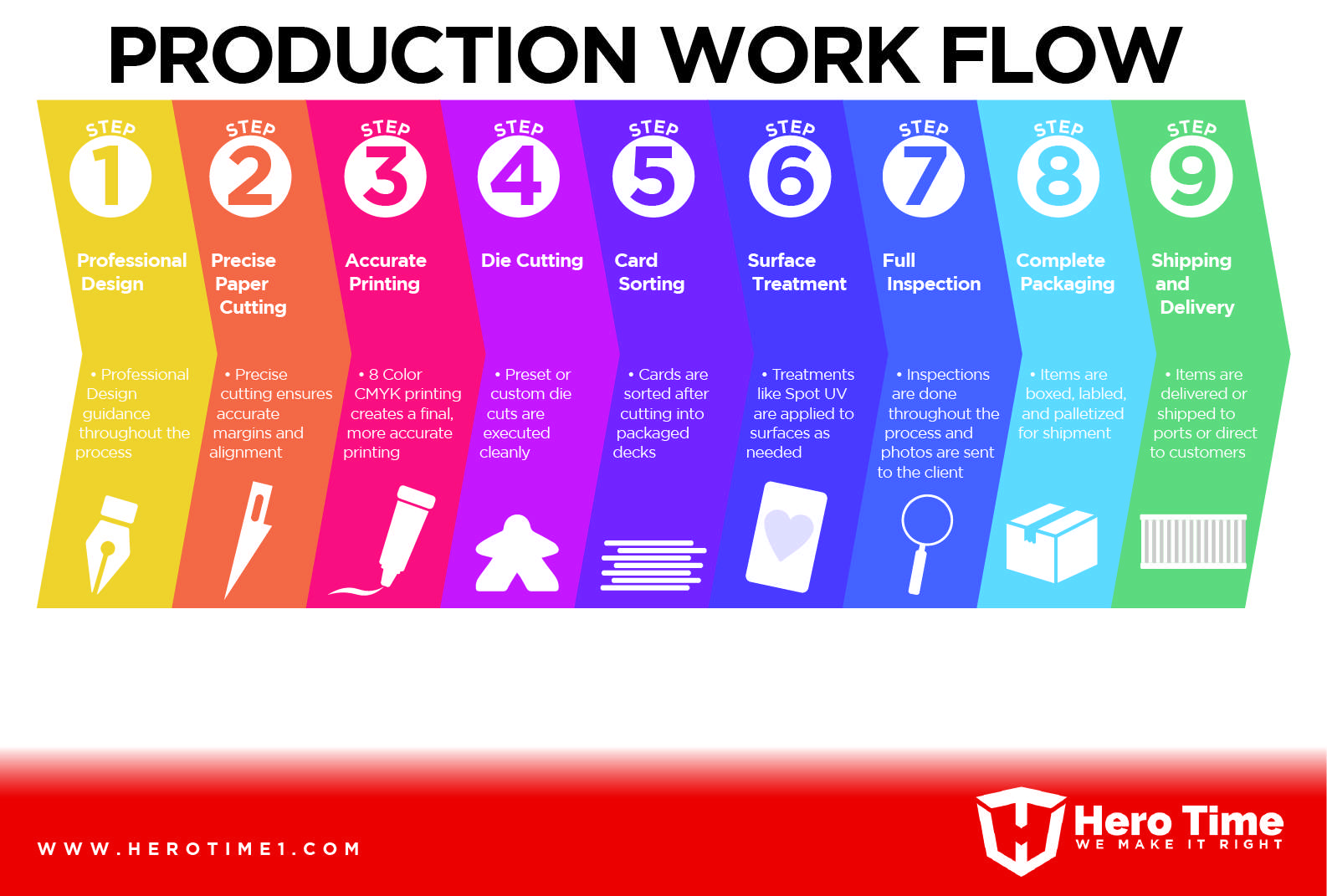
How Our Factory Floor Is Organised
Most factories group machines into departments by function — a coating department, a cutting department, a wrapping department. We group machines by the product they produce together, so two oil-coating machines, two card-cutting machines and two card-wrapping machines form one line responsible end-to-end for one finished component. The whole line owns the quality of what it produces, not one station. (This layout is known as cellular manufacturing.) Each process also ends exactly where the next begins, so the operator of the second step is naturally checking the first — building the quality check into the workflow rather than adding it on top. (In lean manufacturing this is called jidoka.)

How We Manage the Suppliers We Do Use
Where we source externally, we use a maximum of 2–3 suppliers per process and train them continuously — including investing upward in new machinery so they can reach our standard. That costs more than always taking the cheapest quote. It's a deliberate trade, modeled on Apple's sourcing approach: invest in supplier capability rather than negotiating price down and accepting whatever comes back. (The industry term is supplier development.) Stable, long-term suppliers also mean your files and tooling aren't spread across a rotating cast of unknown companies.
Quality Control Through the Line
Because no two games we make are the same product, our quality control has to be process-level rather than tuned to one item. Anything entering the factory is checked at a dedicated QC station before it reaches the floor; pre-assembly storage checks every component again before assembly; and after assembly and packing we run a further check. (These stages are known in the industry as IQC, IPQC and FQC — Incoming, In-Process and Final Quality Control.)
Our commitment on finished product is AQL General Inspection Level 2 — Critical defects under 0.6%, Major under 1.5%, Minor under 4%. The full component-level defect classification our inspectors train against is published onour quality control page.
Approved by: Disney FAMA





Where to Go Next
For the commercial side — quotes, samples, lead times, payment terms and what happens at each stage — see our quote to order process. For how your artwork is kept private through all of the above, seeIP protection.