
Board Game Artist: How to Brief One
 By Hersh Glueck
A board game artist is the illustrator who paints your game's pictures: the box cover, the characters, the card art and the board. The art is what makes a stranger pick your game up, so the artist matters. But even a great artist can only paint what you describe, and that is where most projects go wrong. This guide covers when to bring an artist in, how to find one, what a board game illustrator costs, and how to write an art brief: the short document that tells the artist the mood, the style and the level of detail you want.
Check Out Our Free Resource: Artwork Style Brief
A ten-page questionnaire that captures the visual style you want for your game, ready to send to your artist.
When to Start the Art
Start the art after the game works and the components are fixed, not before. Art is a step you do not want to jump into too early. First play the game until you are happy with the rules and the theme. Then choose the components and confirm the sizes with your manufacturer, because a standard card or board size can cost much less than a custom one. Once the art is drawn for a size, nobody wants to change it, so you would be stuck with the price. With the sizes confirmed, download the templates for each component and give them to the artist with the brief.
Find the Right Artist
The best artist for your game is one whose existing work already looks like the game you imagine. Three steps get you there:
- Make a vision board. Collect pictures that feel like your game, from other games and from art sites, into one document. Designers call it a mood board. It helps you see the look you want, and it shows the artist faster than words.
- Write to the artists you love. Look at who made the pictures on your vision board, and ask them whether they would like to work on your game.
- Send a list of every asset and ask for a quote. List each picture you need, as precisely as you can: the box cover, 40 card illustrations, 12 icons, one board. Artists price from that list.
If you want an introduction, we work with two freelancers we trust, both based in the UK: Rob Ingle, a lead artist and designer with more than 15 years in the board game industry, for 2D art and layout; and Jordan O'Neill for 3D models of miniatures and plastic pieces.
What a Board Game Artist Costs
Knowing how to commission art starts with how artists charge. Freelance board game artists charge either by the hour or by the project. As an average guide, 2D artwork and layout work costs about 60 USD an hour, and 3D modelling about 80 USD an hour. A project price is the same hours added up in advance: the artist estimates the time for each piece and quotes one fixed price for the list. For example, at 60 USD an hour, a card illustration that takes five hours costs about 300 USD.
- By the hour suits small jobs and changes you cannot predict, such as fixing files or adapting art to a new size.
- By the project suits a full asset list, because you know the total before work starts. For a long list, most artists offer a payment plan, paid in stages.
The detail level you ask for moves the price more than anything else, because it decides how many hours each picture takes. That is the third part of the brief below.
The Art Brief: Four Parts
An art brief is the document that tells the artist the look you want before they draw anything. Our art brief, the Artwork Style Brief, has four parts: genre and mood, aesthetic, detail, and examples. Fill it in before the first conversation, and the first sketches will be much closer to what you imagined.
1. Genre and Mood
Genre and mood are the overall feeling the art should give. Genre often guides the mood, but not always: a game about demons could be played for laughs, and then dark and scary is the wrong look. Tell the artist three things:
- The general category: party game, family game, card game, strategy game, Eurogame or wargame.
- The mechanics: for example deckbuilder, worker placement, area control, dungeon crawler, social deduction, roll-and-write, campaign or legacy, drafting, engine builder.
- Classic or different: is your game a classic example of its genre, or does it shake up the genre's conventions? If it is different, explain what makes it unique.
2. Aesthetic
The aesthetic is the visual style itself: painterly and dynamic like film concept art, or flat and colourful? Elegant and minimal, or wild and in-your-face? The brief shows a grid of images; you tick the ones whose look and feel you like. Choose carefully: the more you choose, the less focused the artist's understanding will be.
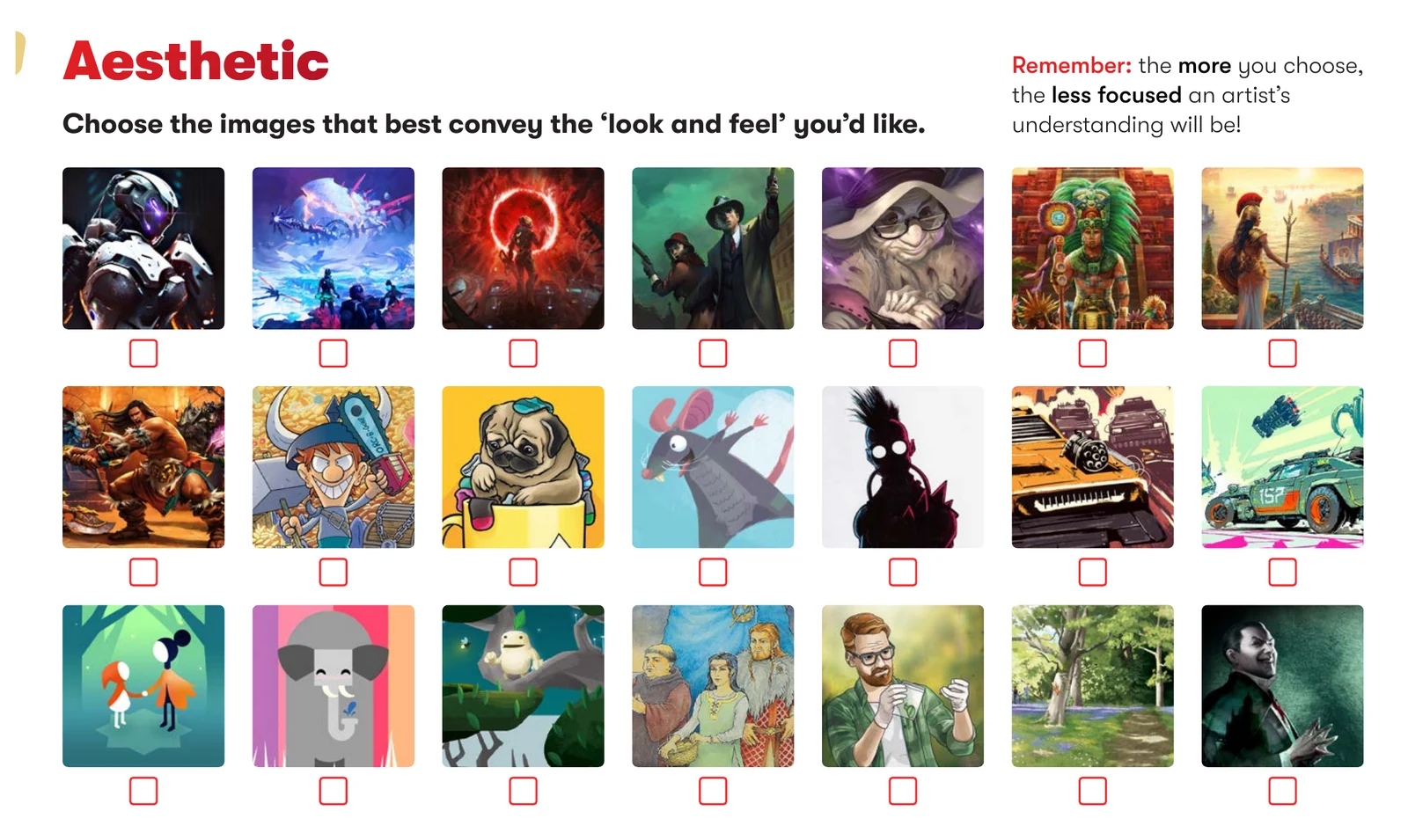
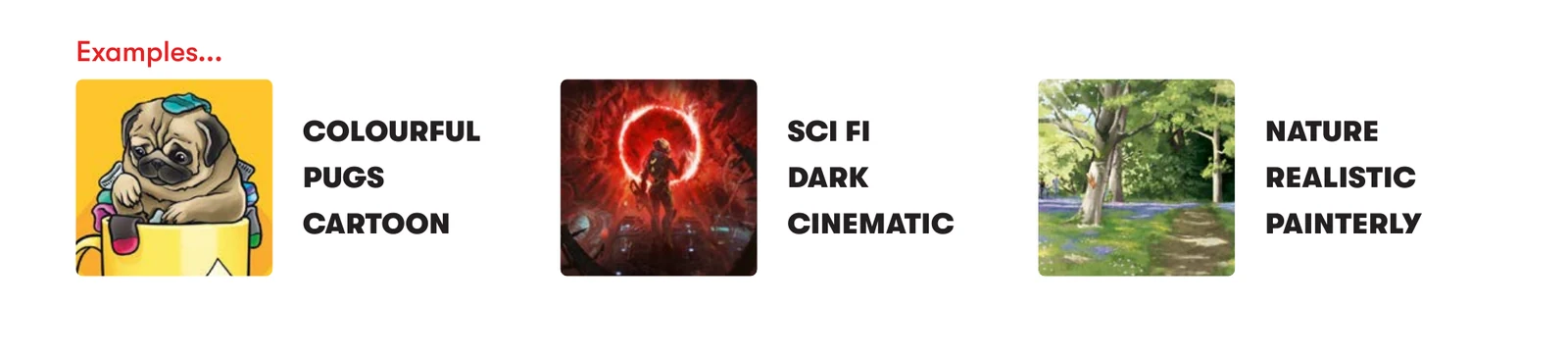
Then sum up your vision in a few sentences, and finally in just three words. Three words force a decision, and the artist can hold them in mind on every picture:
3. Detail
The level of detail and finish makes a huge difference to the time the art takes, and so to its cost. Creative work follows a simple rule: there are three ways to work, good, cheap and fast, and you can only pick two of them.
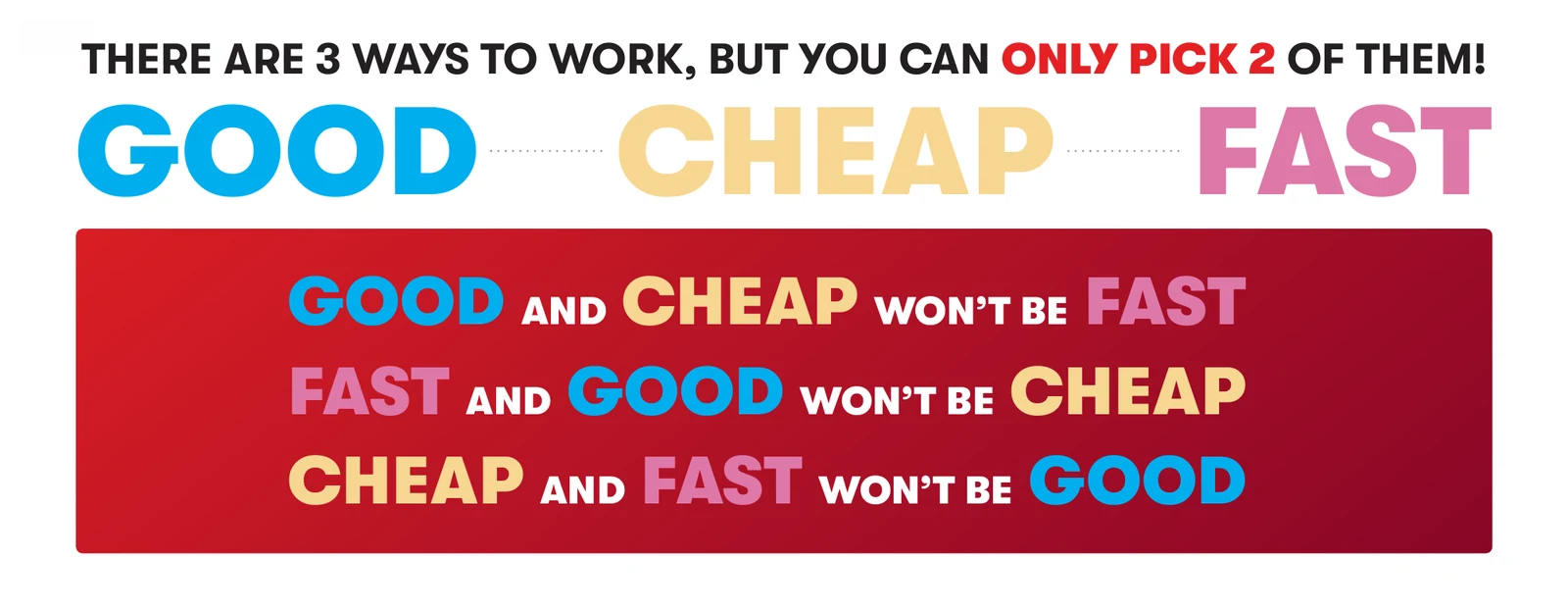
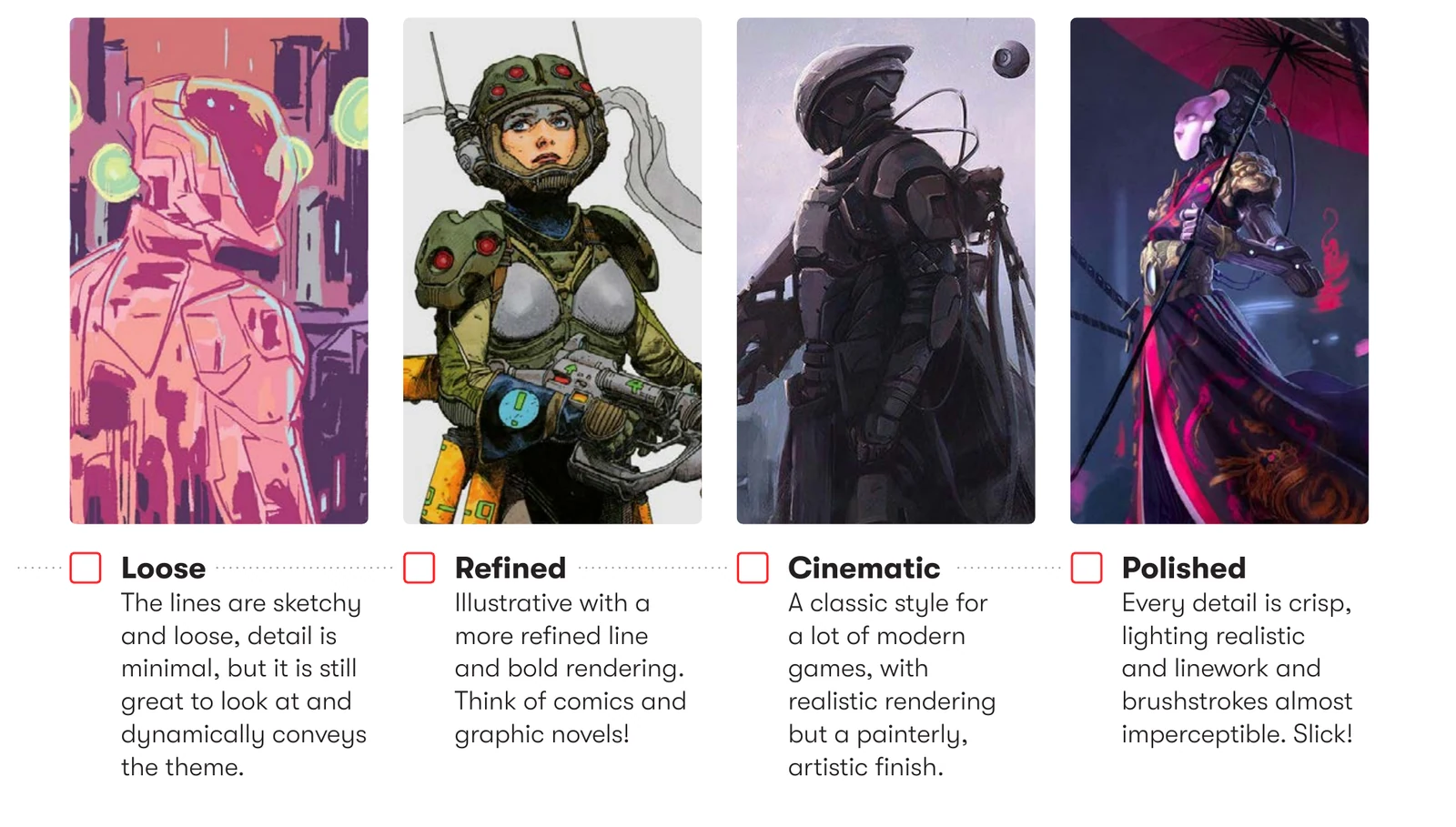
Then choose one of four detail levels:
- Loose: sketchy, loose lines and minimal detail, but still great to look at and full of the theme.
- Refined: illustration with a cleaner line and bold colour, like comics and graphic novels.
- Cinematic: the classic style of many modern games, with realistic forms and a painterly, artistic finish.
- Polished: every detail crisp, the lighting realistic, the lines and brushstrokes almost invisible. Slick, and the slowest to make.
4. Examples You Like and Dislike
Examples are the clearest way to show your vision. Add links to pictures or styles you like, and to some you dislike, and say why for each. A dislike list is as useful as a like list: it stops the artist from guessing wrong.
Board Game Art Styles to Name in Your Brief
Naming a style gives the artist a shared word for a look. These are board game art styles you will see on the shelf, with what each looks like and the games it suits. Describe any style by six things: the medium, the lines, the colour, the light, the texture and the edges.
For many more, browse Art Styles Pro, a free catalogue of more than 100 named art styles in eight groups, each with an example picture and a short definition. Pick two or three names from it, add them to your brief, and the artist knows exactly which look you mean.
- Flat vector cartoon: bold simple shapes, flat or smooth colour, friendly round forms, few outlines. Often suits family, party and children's games.
- Storybook gouache: hand-painted look, soft matte colour, feathered edges, warm palette. Often suits family and nature games, cosy themes.
- Comic and graphic novel: inked outlines, bold flat shading, strong poses (the Refined level). Often suits superhero, adventure and skirmish games.
- Painterly concept art: realistic forms, visible brushwork, dramatic light (the Cinematic level). Often suits fantasy, science fiction, campaign games.
- Realistic and polished: photo-like detail, realistic light, hidden brushstrokes. Often suits premium strategy games and collectors' editions.
- Anime and cel shading: clean lines, flat colour with hard-edged shadows, expressive faces. Often suits card games and character-driven games.
- Stylised 3D render: rounded 3D forms, soft light, matte surfaces, like an animated film. Often suits family games and toy-like games.
- Line art and cross hatching: fine ink lines, shading made of hatched lines, often one or two colours. Often suits historical, horror and puzzle games.
- Pixel art: small square pixels, limited palette, the look of old video games. Often suits retro and video-game themes.
- Period styles (Art Nouveau, woodcut): ornamental curves, or carved black-and-white lines. Often suits games set in a historical era.
Match the Style to Your Players
The right style is the one your players already love, so start from them, not from your own taste. Ask who will play the game: a parent playing with children, friends at a game night, a grandparent buying a gift. Then look at the games those people already buy, and at the art styles on them. If your art and your audience do not match, change one of them. The design work that turns the art into readable components is covered in board game graphic design.
Working With the Artist
A good collaboration is mostly about agreeing things early and in writing:
- Sketches first. Approve rough sketches before the artist paints, when changes are still cheap.
- Agree the rounds of changes. Say in advance how many rounds of feedback the price includes.
- Agree who owns the art. Put in writing that you may use the art on the game, its packaging and its marketing.
- Agree the files. Ask for layered files at the real size, in CMYK, with bleed, as described in our print-ready artwork setup guide.
If your game has shaped or moulded pieces, the artist's drawings also become production files: see what is a CAD file for cut pieces and STL vs STEP for 3D ones. When you are ready to talk about your game, contact us.
Frequently Asked Questions
How do I find an artist for my board game?
How much does a board game artist cost?
What is an art brief?
When should I hire an artist for my board game?
Should I commission art per hour or per project?
Talk to Our Team About Creating Your Board Game
From design to manufacturing, we can help you with every aspect of turning your game concept into reality.