
About Us
Our Board Game Quality Control Standards
Every component of every board game and card game we manufacture is checked against a written standard — not a vague promise. Here's why our quality control holds up against anyone else you're evaluating: what that standard actually is, and the five operational principles that let us hit it consistently.

Critical (CR)
The game is not usable. The product will need to be replaced.

Major (MA)
A significant impact on the customer, and may lead to a negative review.

Minor (MI)
No significant impact on the customer — may not even be noticed.
Our company-wide commitment on every finished product: AQL General Inspection Level 2 — Critical defects under 0.6%, Major defects under 1.5%, Minor defects under 4%.
Our QC teams are trained against a far more granular, component-by-component version of this standard — every production step, every material type, down to the millimeter.
How We Actually Hit These Numbers
Five operational principles, not a slogan.
1.We Manufacture as Much as Possible Ourselves
Bringing a process in-house can raise our overhead, but it improves quality control tremendously — we're not relying on a third party's standards, we're enforcing our own. Today, 80%+ of our production happens in-house. For printed products, 90% of the processes run on our own floor, minus a few specialty finishes like UV spot, metallic stamping, or rulebook binding and cutting. For plastic components, in 2023 we took ownership of a plastic factory in Ningbo that was struggling during COVID, and it now produces 90% of our plastic products. (The industry term for this approach is vertical integration.)
2.A Small, Trained, Invested Supplier Network — Not the Cheapest Bidder
When we do have to source externally, we use a maximum of 2-3 suppliers per process or product, and we train them continuously — including investing upward in new machinery so they can reach our standards. That costs slightly more than always choosing the cheapest supplier, but it's a deliberate trade: we modeled this on Apple's sourcing approach, particularly the practice of investing upward into supplier capability rather than just negotiating price down. (This is known industry-wide as supplier development.)
3.One Process Ends Exactly Where the Next Begins
Everything we bring in-house is streamlined according to the most recent lean manufacturing practice: one process ends exactly where the next one starts, so the person operating the second process is naturally checking the quality of the first. That creates a constant feedback loop and a real between-step QC check, built into the workflow itself rather than added on top of it. (In lean manufacturing this principle is called jidoka — building the quality check into the process itself, rather than inspecting for it afterward.)
4.Cross-Responsibility Between Machine Operators
Most factories group machines into departments by function — a coating department, a cutting department, a wrapping department. We do it differently: we group machines by the single product they produce together. Two oil-coating machines, two card-cutting machines, and two card-wrapping machines become one line, responsible end-to-end for one finished component. That's a mindset change, but it means the whole line — not just one station — is accountable for the quality of what it produces. (This layout is known as cellular manufacturing.)
5.Checked on the Way In, Before Assembly, and After Packing
Any item or component entering the factory lands first at a designated QC station, and only after it's checked does it move into the actual production floor. Pre-assembly storage runs its own QC check on every component before assembly. And after assembly and packing, we sometimes run a third check. On top of the natural step-by-step QC already built into our lean process, that's three distinct QC checkpoints. It costs more than running one or two — but for publishers who want the highest quality, it's a must. (These three stages are known in the industry as IQC, IPQC, and FQC — Incoming, In-Process, and Final Quality Control.)
What Board Game Quality Control Looks Like on the Floor
Real inspection photos from our own QC process — not stock images.
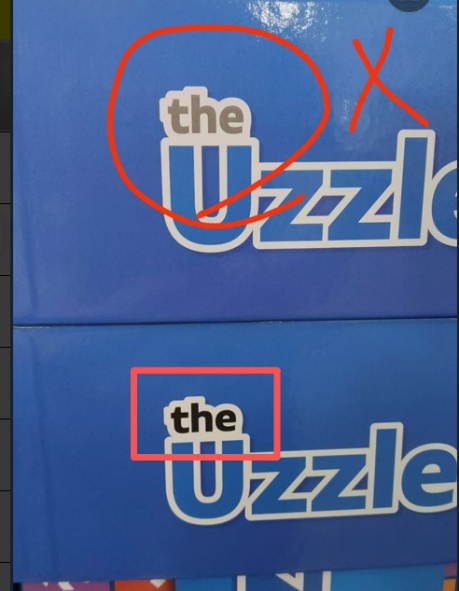
Color Consistency
Checking a print run of The Uzzle against the approved reference — even small color drift between batches gets flagged before it ships.
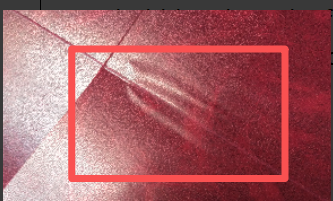
Surface Finish
A macro-level check for scratches or color spots on foil card stock — the kind of defect that's invisible at arm's length but real under inspection.
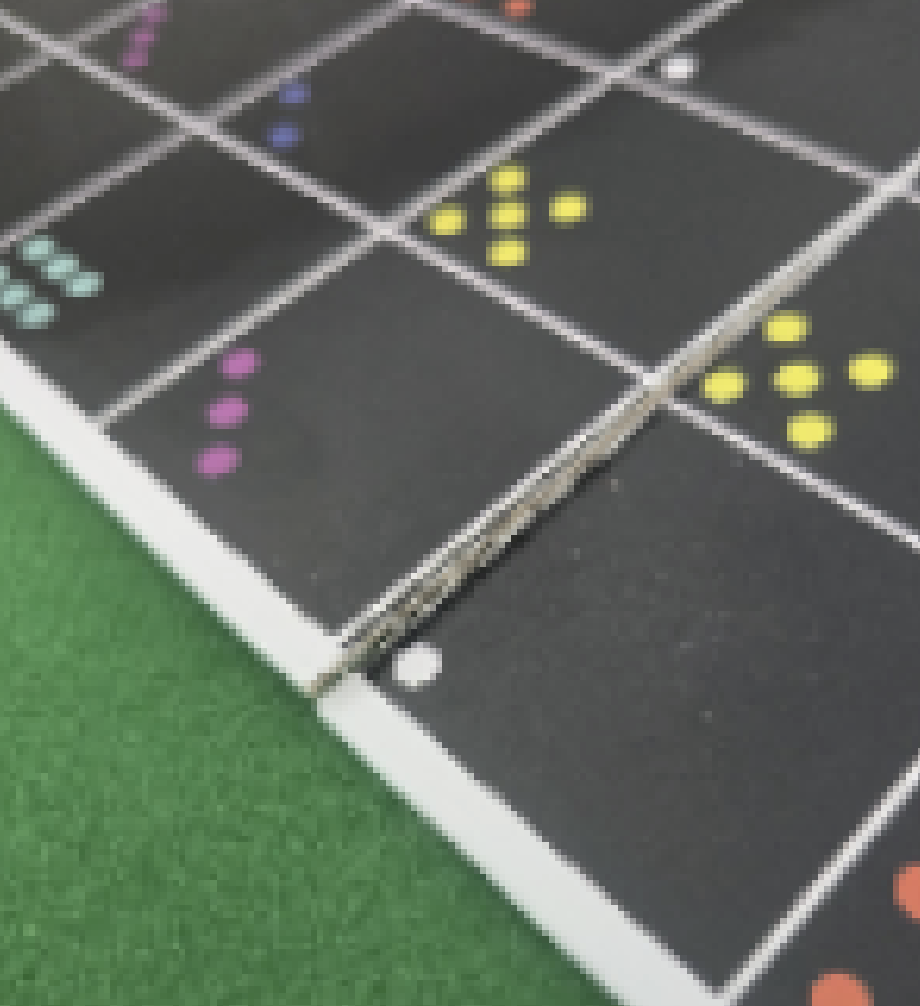
Board Fold Precision
Every fold line on a game board is checked for creasing or splitting before the board is approved for packing.