
Who Needs This Guide and Why
If you design or sell board games, compliance is not optional. Safety tests protect players, keep products legal, and ensure smooth market access. Retail giants like Amazon now enforce strict rules with zero tolerance for missing documentation. If you want your board game to succeed globally, you must understand testing, labeling, and manufacturer selection.
What Are Board Game Safety Tests?
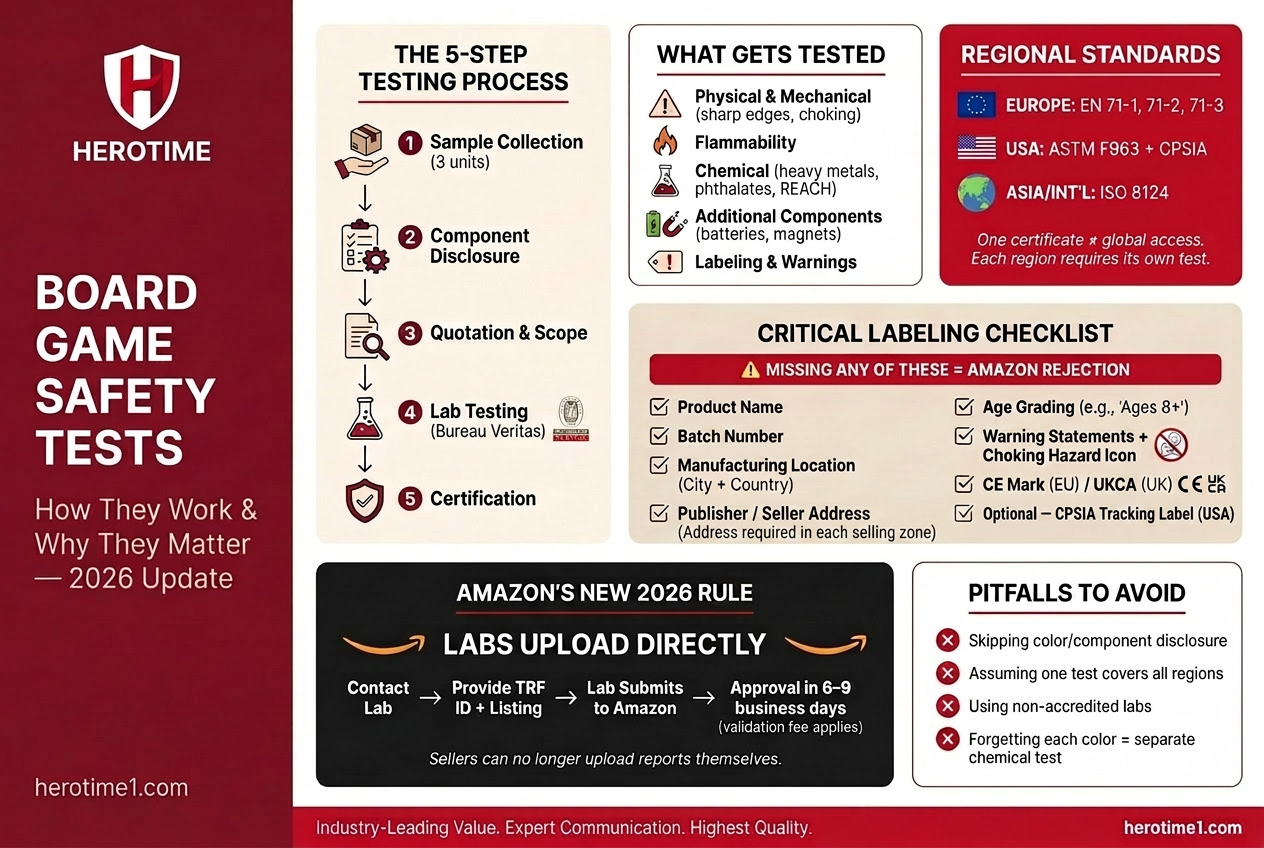
Board game safety tests verify that a product is safe for its intended audience. They check for hazards like choking risks, chemical toxicity, and flammability. The process follows international standards such as:
- EN 71 (Europe)
- ASTM F963 (United States)
- CPSIA (United States, for children’s products)
- ISO 8124 (International, often used in Asia-Pacific)
Each region enforces its own regulations, so compliance is market-specific.
How Do Safety Tests Work?
Safety testing starts after mass production is complete. Here’s the step-by-step process:
- Sample Collection: The lab collects three units from the batch.
- Component Disclosure: The manufacturer provides a full list of materials, colors, and components.
- Quotation & Compliance Scope: The lab quotes based on target markets and required standards.
- Testing: Accredited labs like Bureau Veritas run physical, chemical, and labeling tests.
- Certification: Only compliant products receive the safety certificate needed for retail and marketplaces.
Important: Tests must be configured by material and color. If you have wooden meeples in five colors, each color requires separate chemical analysis. This rule applies to all components, including plastics, inks, and coatings.
The entire process is managed by a project manager who ensures the lab has accurate data for every component, including extra parts like sand timers or markers.
What Gets Tested in a Board Game?
Testing is not just about the board and pieces. Every element counts:
| Test Type | Purpose |
| Physical & Mechanical | Avoid sharp edges, small parts, and choking hazards |
| Flammability | Ensure components do not ignite easily |
| Chemical Properties | Detect heavy metals, phthalates, and REACH-regulated substances |
| Additional Components | Batteries, magnets, liquids, powders need extra checks |
| Labeling & Warnings | Verify correct icons, batch info, and manufacturing details |
Specific Test Standards by Region
- Europe: EN 71-1 (Mechanical & Physical), EN 71-2 (Flammability), EN 71-3 (Migration of Certain Elements)
- United States: ASTM F963 (Physical, Mechanical, Chemical), CPSIA (Lead and Phthalates)
- International/Asia: ISO 8124 series (Physical, Flammability, Chemical)
Critical Labeling Rules
Failing labeling rules can cause test failure, even if the product is physically safe. Every box and component packaging must include:
- Product Name
- Batch Number
- Manufacturing Location (City and Country of Origin)
- Publisher/Seller Name and Address (local address for each sales region)
- Age Grading (e.g., “Ages 8+”)
- Warning Statements (e.g., “Not suitable for children under 36 months” with choking hazard icon)
- Tracking Label (required under CPSIA for US market)
Amazon may reject your listing if any of these are missing.
Why Choosing the Right Manufacturer Is Key
A strong manufacturer can make or break your compliance strategy:
- Compliance Expertise: They know EN 71, ASTM, CPSIA inside out.
- Lab Partnerships: They work with accredited labs like Bureau Veritas for smooth approvals.
- Market Access Guarantee: They ensure your game meets standards for every retailer and marketplace.
Choosing a weak manufacturer often means delays, failed tests, and lost revenue.
Amazon’s New 2026 Requirement
According to Amazon’s latest safety requirements, testing laboratories are now required to submit safety documentation directly to Amazon. Sellers are no longer allowed to upload safety reports themselves.
The steps:
- Contact your lab for a verification request.
- Provide Test Report Form (TRF) ID and your Amazon listing link.
- Lab uploads documents directly to Amazon.
- Approval takes 6–9 business days and includes a validation fee.
This rule prevents fake certificates and increases accountability.
Buyer Beware: Common Pitfalls
- Skipping full disclosure of colors and components.
- Assuming one test covers multiple regions (it doesn’t).
- Using non-accredited labs for “cheap” tests—Amazon will reject you.
- Forgetting that each color and material variation requires separate chemical testing.
FAQ Section
Q: Do I need a new test if I change colors?
Yes. Each color variation may need separate chemical analysis.
Q: How often should I test?
For every mass production batch intended for a new market.
Q: Can I use one safety certificate for the US and EU?
No. Each region has its own regulations and test standards.
