
How Much Does It Cost to Make a Board Game?
 By Hersh Glueck
How much does it cost to make a board game? Between about 4 and 35 USD per copy for a board game, and from 0.50 USD per copy for a card game. The cost to make a board game depends on the parts, their finishes, how well they fit the printing sheets, and above all the number of copies. There is no one price, but there are brackets, and each one follows the same rules. This guide gives the brackets, then takes a quote apart line by line: materials, printing, coating, gluing and cutting, assembly, wastage and overhead, so the board game manufacturing cost on your quote makes sense. For an exact number, contact us with your component list.
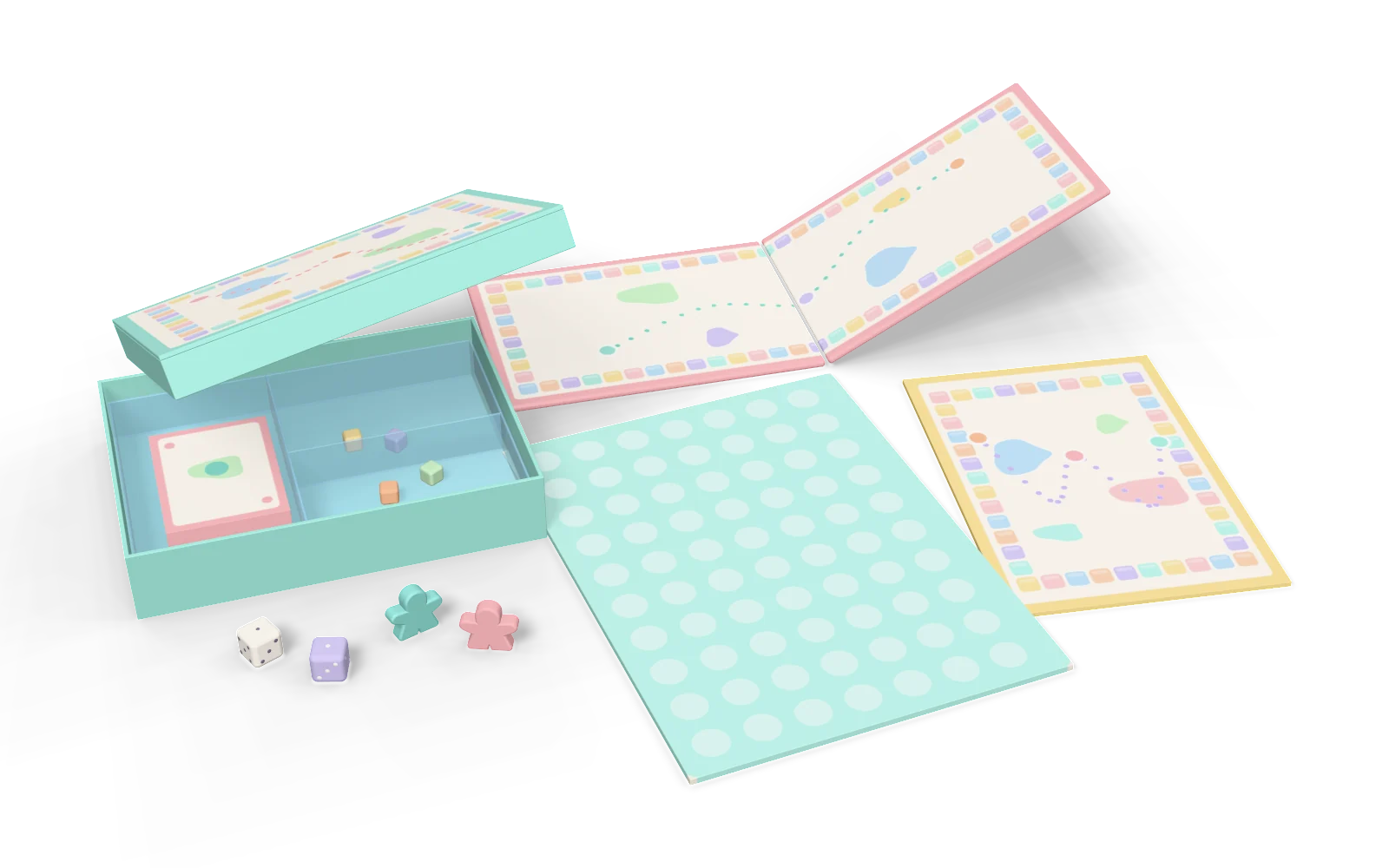
Cost Per Copy by Game Type
These are the usual brackets. The low end of each is a run of about 10,000 copies; the high end is our minimum of 1,000 copies, where the setup costs are spread over the fewest games.
- A simple one-deck card game: 0.50 to 1.90 USD per copy.
- A two-deck card game like Sabobatage or Chicken Challengers: 1.40 to 5 USD per copy.
- A multi-deck card game like That Sound Game or Made Up Movies: 2.70 to 7.50 USD per copy.
- A light board game with a few decks, tokens and other pieces, like Snack Time or Moonshell: 4 to 11 USD per copy.
- A medium-weight board game with seven to twelve components, like Sauria, Project EOS or Ahau: 7 to 20 USD per copy.
- A massive board game like Gloomhaven or Deliverance, with miniatures and many pieces: 14 to 35 USD per copy.
This is the average cost of a board game at the factory gate. The full cost of making a board game adds design, artwork, a prototype and freight on top. If you want a board game cost breakdown for your own game, send the component list and we quote it at several quantities, so you can see how much do board games cost at 1,000, 2,000 and 5,000 copies.
How a Quote Is Built
A quote has three layers. The first is the base cost: our system counts the sheets each component needs, then adds every process that sheet goes through (printing, coating, cutting, gluing, assembly) with that process's setup. The second is wastage, the sheets lost to make-ready and quality checks (below). The third is overhead.
Overhead is everything the factory needs that is not tied to one sheet: the designers who set up your files, the printing engineers, the rent, the machines, the electricity. It is normally 10 to 20 percent of the order value. It is a share, so it weighs more on a small order than on a large one: the same engineers set up a run of 1,000 and a run of 10,000. This is also why scale pays twice. When a game runs again and again, or when a line is built for it, every step is done the same way every time; the setup is known, the people are practised, the waste is lower, and the overhead per copy falls while the efficiency rises.
If a quote looks high, ask your project manager to check the sheet counts and the quantity per sheet (a wrong number there inflates everything), ask to remove the artwork setup if your files are print-ready, and ask about a slower lead time, which lowers the overhead share.
The Two Rules: Quantity and Sheet Fit
- Quantity. Every print run starts with about 300 sheets of make-ready waste to get the colour right, and the artwork setup can take up to 60 hours for one game. That is why our minimum is 1,000 sets, and why 500 sets cost almost the same as 1,000. At around 2,000 units the fixed costs are spread thin enough for the per-copy cost to fall into the 20 percent of retail price a publisher needs. Below that, every concession on components, quality and logistics gets forced on you.
- Sheet fit. Printing, cutting and gluing, for paper and for cardboard alike, are priced per sheet. Coating is priced per square metre. So the more parts fit on one sheet, the better the price: 65 poker cards on a 540 × 750 mm sheet, two 210 × 280 mm token sheets on an 8-opening sheet. Our guide to board game printing cost lists the six standard sheets. The machines set the limits too: nothing prints above 580 × 890 mm, because the cutting, folding and gluing lines cannot handle more.
Raw Materials: Paper and Cardboard
Paper and cardboard are bought by the ton, in two master sheet sizes that the mill cuts down to our standard sheets. The weight is given in gsm (grams per square metre): a card is 300 or 350 gsm, a box wrap 157 gsm, and cardboard runs from 0.8 mm (600 gsm) to 2.5 mm (1,600 gsm). Heavier is stronger and dearer. These are the usual prices per ton:
| Material | Price per ton | Used for |
|---|---|---|
| Cheap cardboard | about 2,500 RMB (360 USD) | low-cost boxes and tokens |
| High-density cardboard | about 3,800 RMB (540 USD) | our standard for boxes, boards and token sheets |
| Blue cardboard (denser still) | about 7,000 RMB (1,000 USD), Chinese or imported | premium boards and boxes |
| Cheap white core paper | about 5,500 RMB (790 USD) | low-cost cards |
| AAA white core paper | about 6,500 RMB (930 USD) | our standard card paper |
| Blue core paper | about 8,000 RMB (1,140 USD) | mass-market decks |
| Chinese black core paper | 10,000 to 12,000 RMB (1,400 to 1,700 USD) | opaque cards, batch to batch variation |
| German black core paper | up to 18,000 RMB (2,600 USD) | casino-grade cards |
The material cost of a game is the sheets it needs, including the wastage, times the price per ton of each stock. Our guide to cardboard cost goes into the cardboard grades, and playing card material into the papers.
Printing
Printing is mostly a fixed cost: making the plates and calibrating the press. The price per sheet after that is small, so a run of 500 costs almost what a run of 10,000 does. We run three press sizes, and each has its own setup for a two-sided print:
- Small press (8-opening sheets, tokens, small boxes, small rulebooks): about 600 RMB (85 USD) per two sides.
- Medium press (4-opening sheets and the card sheet, boards, medium boxes): about 1,400 RMB (200 USD) per two sides.
- Large press (2-opening sheets, large boxes, large rulebooks): about 1,800 RMB (260 USD) per two sides.
A Pantone spot colour for higher colour accuracy adds a fifth printing unit at about 400 RMB (55 USD) per colour. The full picture, with the sheet sizes and the special printing, is in our guide to board game printing cost.
Coating and Finishes
Every printed sheet gets a coating, and coating is priced by the square metre. An oil coating (oil varnish on cardboard parts, poker oil on cards) runs from about 0.6 to 1.4 RMB per square metre (0.09 to 0.20 USD), depending on the oil quality. Lamination, the plastic film on boxes and boards, runs from about 0.6 to 2.5 RMB per square metre (0.09 to 0.36 USD); matte and glossy sit at the low end, and premium films such as soft-touch and anti-scratch lamination easily cross 2 RMB. A linen finish on cards adds about 0.10 USD per deck. Spot UV and foil stamp add about 0.20 USD per unit plus a 150 USD setup each. Our guide to playing card finishes explains each finish.
Gluing and Cutting
Gluing is priced per sheet: the printed paper onto the cardboard of a box, a board or a token sheet. Cutting splits in two. Cards are cut by machine, priced per deck. Cardboard parts are cut with a cutting die (a steel-rule die): the die is a one-off of about 200 RMB for a simple shape and up to about 400 RMB for a complex one, then a price per sheet for the cutting. Dies cut best under 30 × 30 cm, so a large, detailed layout needs more than one die. Our guides to die cutting cost and token sheet cost have the details.
Assembly and Packaging: The Labour Cost
Assembly is the one step done by people, not machines: counting and shrink-wrapping the decks, placing every part in the insert, sealing the box, packing the cartons. It is priced by how many sets a worker can finish in an hour, so a game with many parts costs more to assemble than a deck in a tuck box. Labour is dear by Chinese standards: the legal minimum wage is still about 12 RMB an hour (1.7 USD), and we pay our standard workers 20 to 23 RMB an hour, nearly double, plus 50 percent on top for every overtime hour. That is why an urgent order costs more: the extra hours are overtime. Our workers are checked for fair labour practice (BSCI).
Shipping cartons are five-layer corrugated board, packed to 13 to 15.5 kg so they survive the journey and fit a 120 × 100 cm pallet. Do not save here: the freight insurance only covers damage in proper cartons. Freight itself is in our guide to board game shipping cost.
Wastage and Quality Control
Every printed component starts with 300 sheets of wastage to get the best printing performance, and we add 3 percent on top for the sheets pulled by the checks at each station. If your quality requirements are lower we can lower that to 1.5 percent, but we do not recommend it: the sheets pulled are the misprints, the glue smudges and the off-cuts that would otherwise reach a player. Workers check before and after every station, and the production manager inspects every component before assembly; our board game quality control page explains the practice.
What a Prototype Costs
A prototype is printed on inkjet machines and cut and glued by hand, so a copy costs 10 to 20 times the mass-production price. Printed parts are quoted per sheet: 9 USD for a small sheet (token sheets, player boards, tuck boxes), 12 USD for a medium sheet (medium boxes, small boards, inserts) and 18 USD for a large sheet (large boxes, cards, large rulebooks). The minimum prototype order is 200 USD, and 50 percent of the prototype cost comes back as a discount on a mass order placed within 90 days. Thirty prototypes cost about the same as a 500-unit run, so once you need more than a few review copies, compare the two. The board game prototype service page has the lead times. This is the game prototyping cost; it is not part of the per-copy brackets above.
From Cost to Retail Price
Work backwards from the shelf. These are the usual retail prices by product type, from our analysis of over 500 published games:
| Product type | Examples | Usual retail price (USD) |
|---|---|---|
| Tuck box and one deck of cards | Uno, Flip 7 | about 9 |
| Two-piece box and cards | Cards Against Humanity, Sabobatage | 14.99 to 19.99 |
| Party game or light family game | That Sound Game | 29.99 or under |
| Medium board game | Monopoly, Carcassonne | 35 to 45 |
| Large or heavy board game | Catan, Sequence Premium Edition | up to 60 |
| Extra-heavy game with miniatures | Star Wars: Rebellion | 100 and up |
The old rule of thumb is that the landed cost should be 20 percent of the retail price (the X5 rule), and the leanest publishers push it to 10 percent. Your sales channel sets the real ceiling: retail takes the biggest cut, crowdfunding the smallest. Our guide to board game pricing works it through channel by channel.
Why a Cheaper Quote Is Cheaper
A price well below ours usually comes from one of five places: a lower material grade, workers pushed for more hours without overtime pay, a longer lead time, lower wages, or less wastage and fewer quality checks. None of them show on the quote. Ask which one it is.
The Bottom Line on Board Game Production Costs
Pick the bracket your game falls into, then move inside it with the two rules: make 2,000 copies if you can, and design every part to fill its sheet. Choose the material grade and the finishes where a player will feel them, and keep the overhead down by sending print-ready files. When the component list is final, a board game manufacturer like Hero Time quotes it at several quantities, with every line explained.
Frequently Asked Questions
What is the average cost of a board game to manufacture?
How much does it cost to manufacture a board game at the minimum order?
How much does a board game prototype cost?
What does custom board game pricing depend on?
Talk to Our Team About Creating Your Board Game
From design to manufacturing, we can help you with every aspect of turning your game concept into reality.