
Board Game Pieces: Types and Names
 By Hersh Glueck
Board game pieces are everything inside the box: the cards, the board, the tokens, the wooden and plastic playing pieces, the dice, the rulebook, the insert and the box itself. Together they are also called board game components, and players call them bits. Some have names everyone knows, such as a pair of D6 dice. Others have names you may not have heard yet, such as meeples, chits and standees.
Check Out Our Free Resource: Guide For Selecting Components
This guide helps board game designers select ideal components and quantities.
This overview is a field guide to the game pieces for board games. For each type of piece it tells you what it is called, what it does in play, what it is made of, and the sizes we make. Each section links to the full guide for that piece, where the process, the costs and the design rules live.
Board game pieces names change from game to game: a meeple is a farmer in one game and a knight in another, and a token can be a coin, a wound or a resource. The manufacturing names below are the ones you will see in a quote and in a rulebook, so knowing them makes a game easier to plan and easier to play.
Board Game Boxes
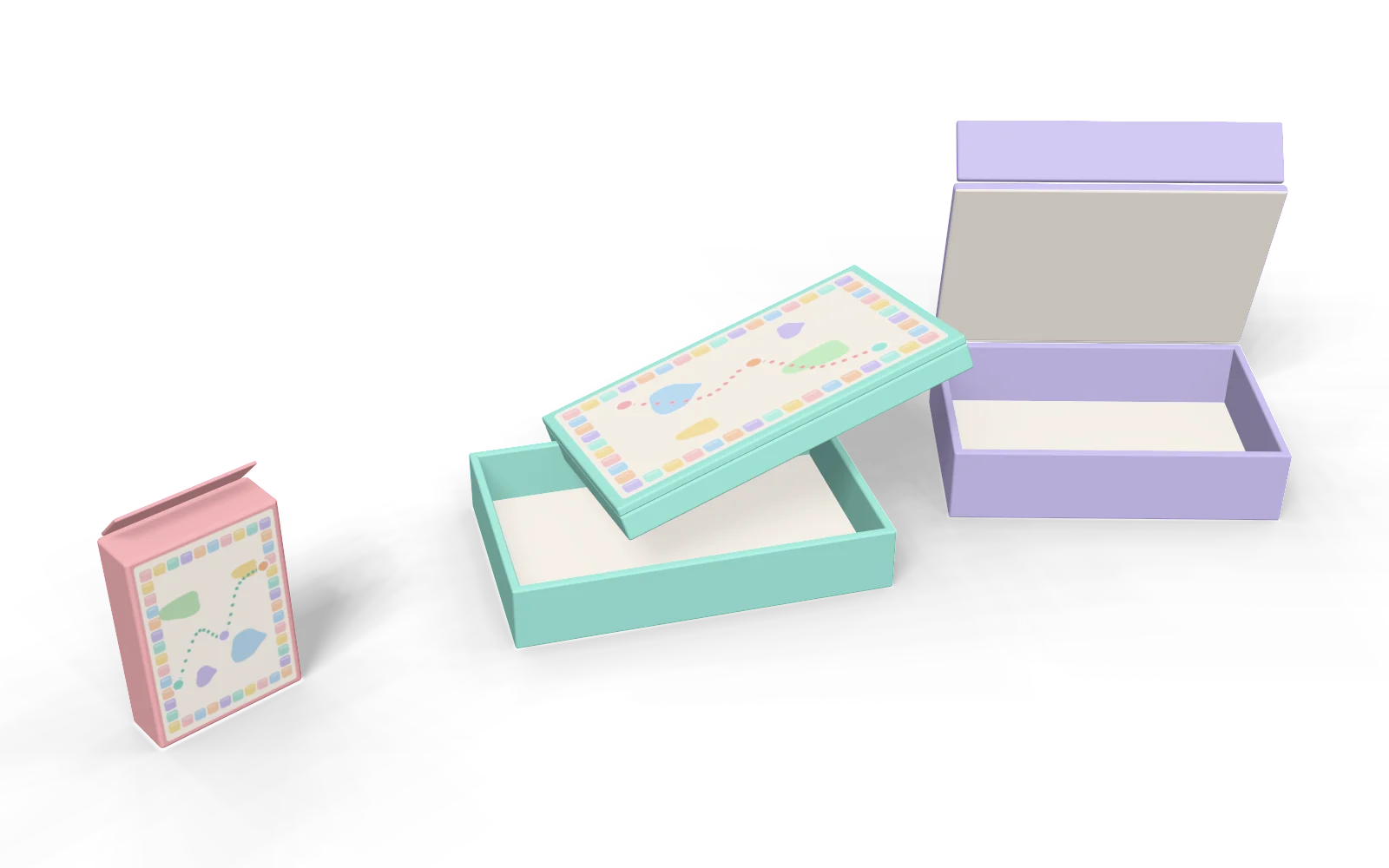
A board game box is exactly what it sounds like — the box your game will come in. A good box will protect your game, make sure the game pieces are nicely organized inside, and make use of its cover art to let potential players know what the game is actually about.
A board game box is printed paper wrapped around a cardboard core (greyboard), usually 1.5 mm thick for a small box and 2 mm for a large one. There are three standard box types: the tuck box, a folded paper box for a deck of cards; the two-piece box (also called a telescoping box), the lid-and-base box most board games come in; and the magnetic flip box, a one-piece box whose lid closes with a magnet. All three come in a range of standard sizes.
Our guide to board game boxes goes into greater detail about box designs, materials, and other information you should know about this important component of your game.
Game Boards
The game board is the shared playing surface in the middle of the table. Most game boards fold, so a board larger than the box still fits inside it: a bi-fold has one fold, a quad-fold has two, and six- and eight-fold boards fold smaller still. A board is 157 gsm printed paper glued over 2 mm high-density cardboard, with black linen paper on the back, and each fold line is cut most of the way through the board. Player boards are each player's own smaller boards, usually one flat panel that does not fold.
Our guide to the foldable game board covers the fold types, the standard sizes, the materials and how the folds are made.
Map Tiles & Tokens
Tiles are hexagonal or square pieces that are either placed directly on top of your game board, or pieced together to make a board. Many games are built around piecing tiles together, while others use tiles to denote which resources are available in specific parts of the board.
The term “token” usually refers to a smaller tile that’s used to denote game resources, such as coins, raw materials, items, or gold. These are sometimes called “chits”, counters or markers, and a token on a plastic stand is a standee. They add numbers, categories, or other variables to the gameplay.
Tokens are printed on thin paper, which is then glued to both sides of a cardboard core and stamped with punch-out lines; the sheet is called a punchboard or token sheet. The usual build is 250 gsm paper, 1.5 mm cardboard and 250 gsm paper, and tokens come in thicknesses from 1 mm to 3 mm. Tokens ship still in their sheet; large map tiles come punched out.
Our guide to board game tokens covers more about this process, as well as how we can make the ideal tokens for your game.
Cards
We’re all familiar with playing cards — small cards cut from card stock and can include anything related to your game.
For board games, cards are typically rectangular or square in shape. We make nine standard card sizes, from classic poker cards (63 × 88 mm) to mini cards (44 × 68 mm), tarot sizes and square cards. Cards are made of core paper: two printed layers around a white, blue or black middle layer. High-quality white core paper at 300 or 350 gsm is the right choice for most games, and black core paper is the premium option.
Your cards will generally play a major role in your game and players will likely touch them often, making it important to get their design, material and shape right before you start manufacturing your game.
Three guides cover cards in full: playing card size for the sizes, custom sizes and the sheet, playing card material for the paper and the thickness, and linen finish playing cards for varnish, lamination and linen.
Wood Pieces
Most games contain wood pieces — small pieces that are used to represent characters on the board or other items in your game. These are the board game playing pieces: the parts players move. The person-shaped ones are called “meeples”; the others are cubes, discs, pawns and custom shapes. In older games the same pieces are called men, stones or checkers.
Meeples are tiny game pieces shaped like humans. They’re used to represent players on top of the game board. In some board games, you might only control a single meeple, while in others, players might deploy a team of meeples strategically to fight, compete, or gather resources.
We can produce meeples and other wood pieces in a range of shapes, sizes, and colors to match the visual identity of your board game. Meeples are laser-cut from 6 to 8 mm MDF or 10 mm plywood, in small (up to 20 mm), medium (up to 28 mm) and large (up to 35 mm) sizes, and a custom shape costs the same as a standard one. Cubes are the cheapest and simplest wood piece, from 8 mm to 30 mm, with 10 mm and 15 mm the popular sizes. Pawns are shaped in 3D with a round base and a head, so they cost more than meeples. Our guide to wooden game pieces covers the shapes, the woods, the colours and the printing.
Miniatures
Miniatures are small, highly detailed models that players will use as part of your game. They’re sized to fit your game board, giving it an incredible amount of detail and making its setting feel as if it’s truly real.
Most miniatures are made of plastic by injection moulding: melted plastic is pressed into a steel mould of the figure. The plastic is mostly ABS, often with PVC or TPR mixed in so thin parts bend instead of breaking. Every shape needs its own mould, and a detailed miniature mould costs thousands of dollars, so miniatures are only used sparingly in most games. However, some games revolve entirely around collecting, painting, and using miniatures as part of gameplay. For unique board game pieces of any kind, a mould is the cost that matters, which is why standard pieces are so much cheaper.
Our guide to board game miniatures explains the plastics, how the mould is built and priced, and when 3D printing is cheaper; the manufacturing process of a board game shows where moulding fits in production.
Dice
The vast majority of board games have dice, usually as a way to add randomness. While most players are familiar with standard D6 dice (six-sided dice), dice come in a large variety of types, with the number after “D” corresponding with the number of faces.
These include D4, D8, D10, D12, and D20 dice — the large, multi-sided dice that are employed in games like Dungeons & Dragons.
We can manufacture dice out of acrylic, resin, wood or metal. Acrylic is the usual material; resin is for custom dice in small quantities; wood suits an eco-friendly D6; and metal dice (zinc alloy or iron) are the heavy, premium option. A standard D6 is 16 mm. Dice can be finished with custom printing, classic pips or numerals to match the aesthetic style of your game.
Our guide to custom dice for board games goes into more detail about types of dice, materials, finishes and other information you’ll need to make dice for your game.
Rulebooks
The rulebook is the printed booklet that explains how to play, and every game has one. A short game uses a single rule sheet; a longer one uses a stapled booklet (saddle-stitched) of 8, 12 or 16 pages, usually on 128 or 157 gsm paper. Rulebooks are their own step in making a game: board game rulebooks covers writing, layout and testing them.
Board Game Inserts
Board game inserts fit inside your box to hold your game’s pieces in place and make organizing your game components easier. There are four materials: a paper insert, folded from a die-cut 400 gsm sheet, for small boxes; a corrugated cardboard insert, sturdier and still eco-friendly; a plastic insert (thermoformed PET), moulded to the shape of each piece, which is the most common; and a foam insert for fragile pieces only. Our guide to board game inserts compares them.
Frequently Asked Questions
What are board game pieces called?
What is a meeple?
What are the most common board game pieces?
Talk to Our Team About Creating Your Board Game
From design to manufacturing, we can help you with every aspect of turning your game concept into reality.