
Board Game Cardboard: Grades and Costs
 By Hersh Glueck
Board game cardboard comes in two materials: greyboard for the box, and high-density cardboard for the game board, the token sheets, the player boards and the map tiles. Both are bought by the ton, from about 2,500 RMB (360 USD) for cheap board to about 3,800 RMB (540 USD) for high-density board. The cardboard cost of a part is the weight of its sheet, plus the gluing that puts the printed paper on it and the die cutting that turns the sheet into a box, a board or a punchboard. This guide covers the two cardboards, the grades and the cardboard price per ton, the thickness of each part, the sheet maths, the gluing routes, the cutting die, and what all of it adds per copy. For a quote on your own parts, contact us.
The Two Cardboards: Greyboard and High-Density Board
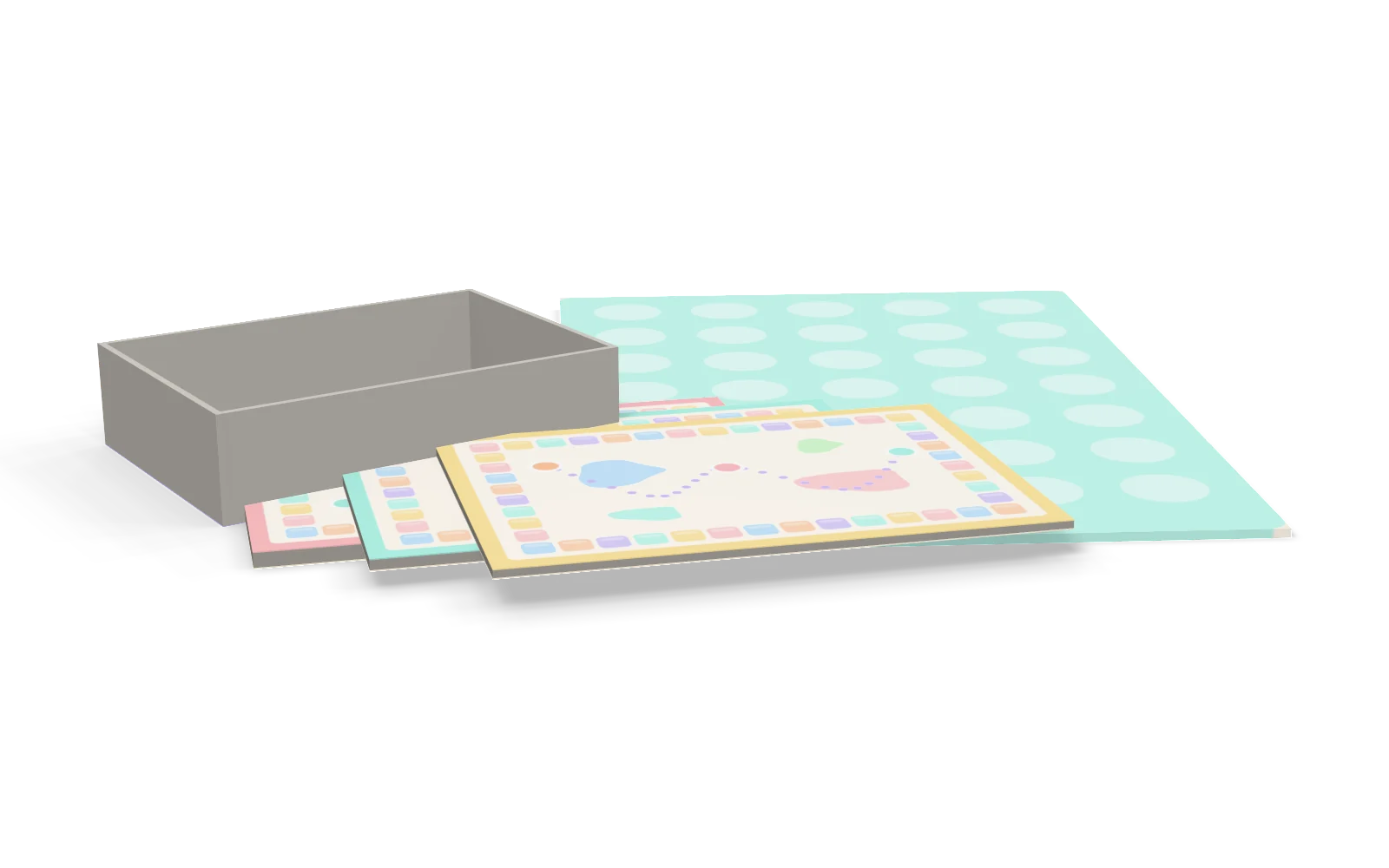
What is cardboard made of? Recycled paper pulp, pressed and dried into a rigid board. Two kinds go into a game, and they are not interchangeable. Greyboard (also called grey board or chipboard in the United States; our wiki also knows it as Pankaster, a sustainable board made from wood leftovers without dyes) is the standard core of every game box: cheap, easy to glue and wrap, and stiff enough to hold a box square. High density cardboard (usually written high-density) is pressed harder, so it is heavier for the same thickness and far stronger; it goes under the game board, the token sheets, the player boards and the map tiles. Cardboard density is the whole difference: a low-density board bellies and frays as players handle it, a high-density board stays flat. That is why the board game board material we recommend is always high-density, and why a box is never made from it: it would add weight and cost where a box does not need strength.
Cardboard is measured four ways: its weight in gsm (grams per square metre, which sets the thickness), its compression strength in pounds (high-density board takes up to 200 pounds in professional testing), its density, and its resistance to humidity. Cardboard gsm and thickness go together: 0.8 mm is about 600 gsm, 1.5 mm about 1,000 gsm, 2 mm about 1,200 gsm, 2.5 mm about 1,600 gsm and 3 mm about 2,000 gsm.
Grades and the Cardboard Price per Ton
Cardboard for board games is sold by the ton, and the grade sets the price. These are the usual numbers; they move with the price of wood pulp.
| Grade | Cardboard price per ton | Used for |
|---|---|---|
| Cheap cardboard (low density) | about 2,500 RMB (360 USD) | low-cost boxes and tokens; bellies and frays in play |
| High-density cardboard | about 3,800 RMB (540 USD) | our standard for game boards, token sheets, player boards and map tiles |
| Blue board | about 7,000 RMB (1,000 USD), Chinese or imported | jigsaw puzzles only: a 1.5 mm, 1,000 gsm board as strong as 2 mm high-density board, for very precise cuts, from about 3,000 sets |
Blue board deserves a warning. It is a puzzle material: thin, very strong and very stable, so a jigsaw cut stays exact. Board games do not use it. A game board, a token sheet or a box does not need it, and at nearly twice the price of high-density board it only makes sense for a puzzle run of about 3,000 sets and up. The chipboard cost that matters for a game is the high-density grade.
Cardboard Thickness by Part
Thickness follows the part. A box needs enough board to hold its weight; a token needs enough to feel solid in the hand. The finished thickness is the cardboard plus the paper on it: a 250 gsm sheet adds about 0.25 mm per side.
| Part | Cardboard | Recommended thickness | Cheaper option |
|---|---|---|---|
| Small two-piece box (8-opening sheet) | greyboard | 1.5 mm | 1.2 mm |
| Medium two-piece box (4-opening sheet) | greyboard | 1.8 mm | 1.5 or 1.2 mm |
| Large two-piece box (2-opening sheet) | greyboard | 2 mm | 1.5 mm |
| Extra-large box | greyboard | 2 mm minimum | none |
| Foldable game board | high-density | 2 mm | 1.5 mm |
| Token sheets and map tiles | high-density | 1.5 mm (1 to 3 mm possible; 4 mm as 1.8 + 1.8 mm) | 1.2 mm |
| Player boards | high-density | 1.5 mm | 1.2 mm, or 400 gsm paper |
| Double-layer player board | high-density | 1 mm + 1 mm | 0.8 mm bottom layer |
Our guides to token sheet thickness, the board game box and the foldable game board (with the game board sizes) go into each part.
The Sheet Maths: What a Sheet of Cardboard Costs
Cardboard is cut to the same six standard sheets as the paper, so a part should fit one of them with little waste: 270 × 390, 280 × 430, 370 × 530, 420 × 580, 540 × 750 and 570 × 870 mm. Token sheets stay on the 8-opening sheets (280 × 430 mm at most), map tiles on the 4-opening sheets. A sheet's weight is its area in square metres times the gsm, and its price is that weight times the price per ton. At 2 mm (1,200 gsm) and 3,800 RMB per ton:
| Sheet | Area | Weight at 2 mm | Cardboard cost per sheet |
|---|---|---|---|
| 270 × 390 mm | 0.105 m² | 126 g | about 0.48 RMB (0.07 USD) |
| 280 × 430 mm | 0.120 m² | 144 g | about 0.55 RMB (0.08 USD) |
| 370 × 530 mm | 0.196 m² | 235 g | about 0.89 RMB (0.13 USD) |
| 420 × 580 mm | 0.244 m² | 292 g | about 1.11 RMB (0.16 USD) |
| 540 × 750 mm | 0.405 m² | 486 g | about 1.85 RMB (0.26 USD) |
| 570 × 870 mm | 0.496 m² | 595 g | about 1.89 RMB (0.27 USD) |
Halve the weight for 1 mm board, add half for 3 mm. Every run also carries 300 sheets of make-ready waste and 3 percent for the sheets the quality checks pull, as our guide to how much it costs to make a board game explains. The cardboard itself is a small line; the paper, the printing, the gluing and the cutting on that sheet are the bigger ones.
Gluing: Paper Onto Board
Nothing is printed on raw cardboard. The artwork is printed on paper, then the paper is glued to the board (the industry term is paper over board, or lamination to greyboard): 157 gsm laminated paper on the outside of a box, 250 gsm CCNB paper on both sides of a token sheet, a map tile or a player board. Gluing is priced per sheet, and there are three ways to do it:
- Fully automated gluing. Three machines, one each for boxes, token sheets and game boards. About 7 to 10 pieces a minute with the best accuracy; it wraps a board's edges and folds boxes up to about 25 × 25 × 7 cm. The setup is about 100 USD, so it pays from about 1,500 to 2,000 sets.
- Semi-automated gluing. For flat, two-sided token sheets and pages up to about 44 × 59 cm: about 10 to 12 sheets a minute, about 50 USD to set up, no wrapped edges.
- Gluing by hand. No setup, about 4 pieces a minute per worker, any size and any shape, including boxes larger than the machine takes. Workers are paid 20 to 23 RMB an hour, so a complex box glued by hand costs more per copy than one from the machine, and the accuracy is lower.
The machines set the tolerances. A box glue line can be off by up to 0.3 mm, which shows on a thin printed border. Token sheets are glued up to 420 × 570 mm for full accuracy; the water-based glue shrinks the board slightly, which can move a later cut by up to 1.5 mm. A double-layer board needs a second, manual gluing round with its own check for alignment. A custom structure that needs extra glue sections (a fold-out box, a built-in holder) adds about 300 USD of setup and about 0.15 RMB per glued section.
Die Cutting: The Cutting Die and the Cut per Sheet
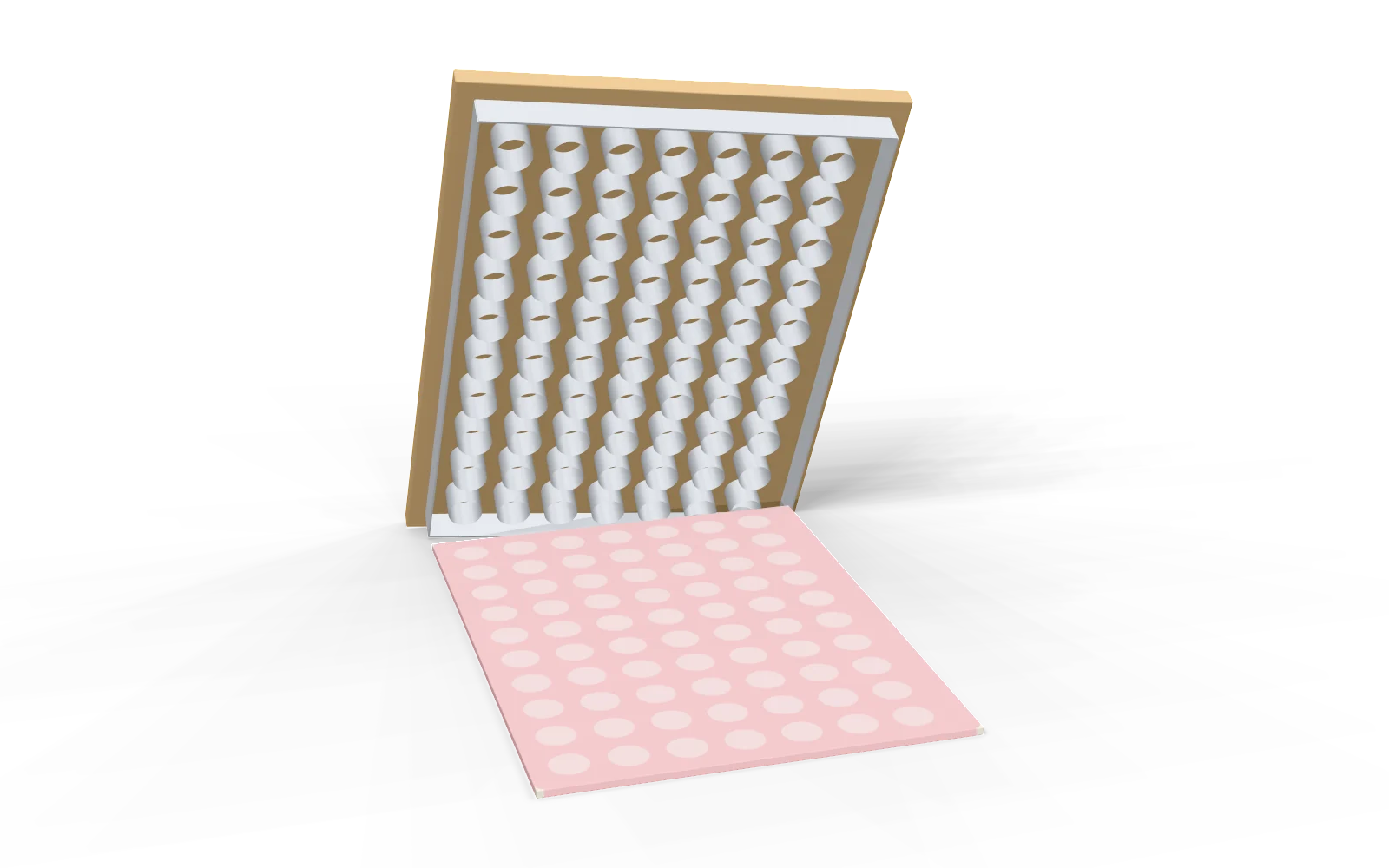
Cardboard parts are cut with a steel-rule die (the factory calls it a cutting die or a cutting mould): a wooden board with steel blades bent to the shape of the cut, pressed through the sheet by a stamp-cutting machine. The die is a one-off cost: about 200 RMB (30 USD) for a simple shape and up to about 400 RMB (55 USD) for a detailed token sheet. A die cuts best under 30 × 30 cm, so a large layout, a game board or a sheet with many small pieces needs more than one die. After the die, die cutting is priced per sheet: a machine with up to a ton of pressure cuts about 1,000 sheets an hour of large, simple tiles, while a detailed token sheet runs at about 4 to 5 sheets a minute because the operator checks the die and the cut as it goes.
Every cardboard part is cut twice. The pre-glue cut sizes the paper and the board so they align; the post-glue cut makes the functional lines: the punch-out lines on a token sheet, the fold lines (creases) on a board, the window in a box. Jigsaw pieces are different: small, interlocking pieces go through a 6-ton jigsaw press at about 120 sheets an hour that also collates the pieces, and a puzzle cutting mould costs about 1,600 RMB (230 USD); a fold line on a double-layer board adds a 400 RMB mould. The design rules that keep a cut clean: 6 mm between cutting lines, 3 mm of bleed around every token, no corner tighter than a 2 mm radius, and cutting lines as vector paths.
What Cardboard Adds per Copy
Take one 420 × 580 mm token sheet in 2 mm high-density board. The cardboard is about 1.1 RMB, the two sheets of 250 gsm CCNB paper and their printing a little more, the gluing and the two cuts a few jiao per sheet, and the die 400 RMB once. At 1,000 sets the die alone is 0.40 RMB (0.06 USD) per copy; at 3,000 sets it is 0.13 RMB (0.02 USD). So the die cutting cost of a game is small (the die cut cost per copy falls with every extra set), and the number of sheets is what moves the price: two 200 × 270 mm token sheets fill one 8-opening sheet, and a 290 × 290 mm sheet wastes a strip of it. Our guides to token sheet cost and board game printing cost work the sheet logic through, and the Costs category holds the rest of the quote.
Cardboard in the Factory: Four Videos
The Bottom Line on Board Game Cardboard
Use greyboard for the box and high-density cardboard for everything players touch, at the thickness its part needs. Fit each part to a standard sheet, because cardboard, paper, printing, gluing and cutting are all priced per sheet. Treat blue board as a puzzle material. When the component list is final, a board game manufacturer like Hero Time quotes every cardboard part with its sheet count, its gluing and its die on the quote.
Frequently Asked Questions
What cardboard is used for board games?
How much does cardboard cost per ton?
How much does die cutting cost for a board game?
What is the difference between greyboard and high-density cardboard?
Talk to Our Team About Creating Your Board Game
From design to manufacturing, we can help you with every aspect of turning your game concept into reality.