
Board Game Print Run: How Many to Print
 By Hersh Glueck
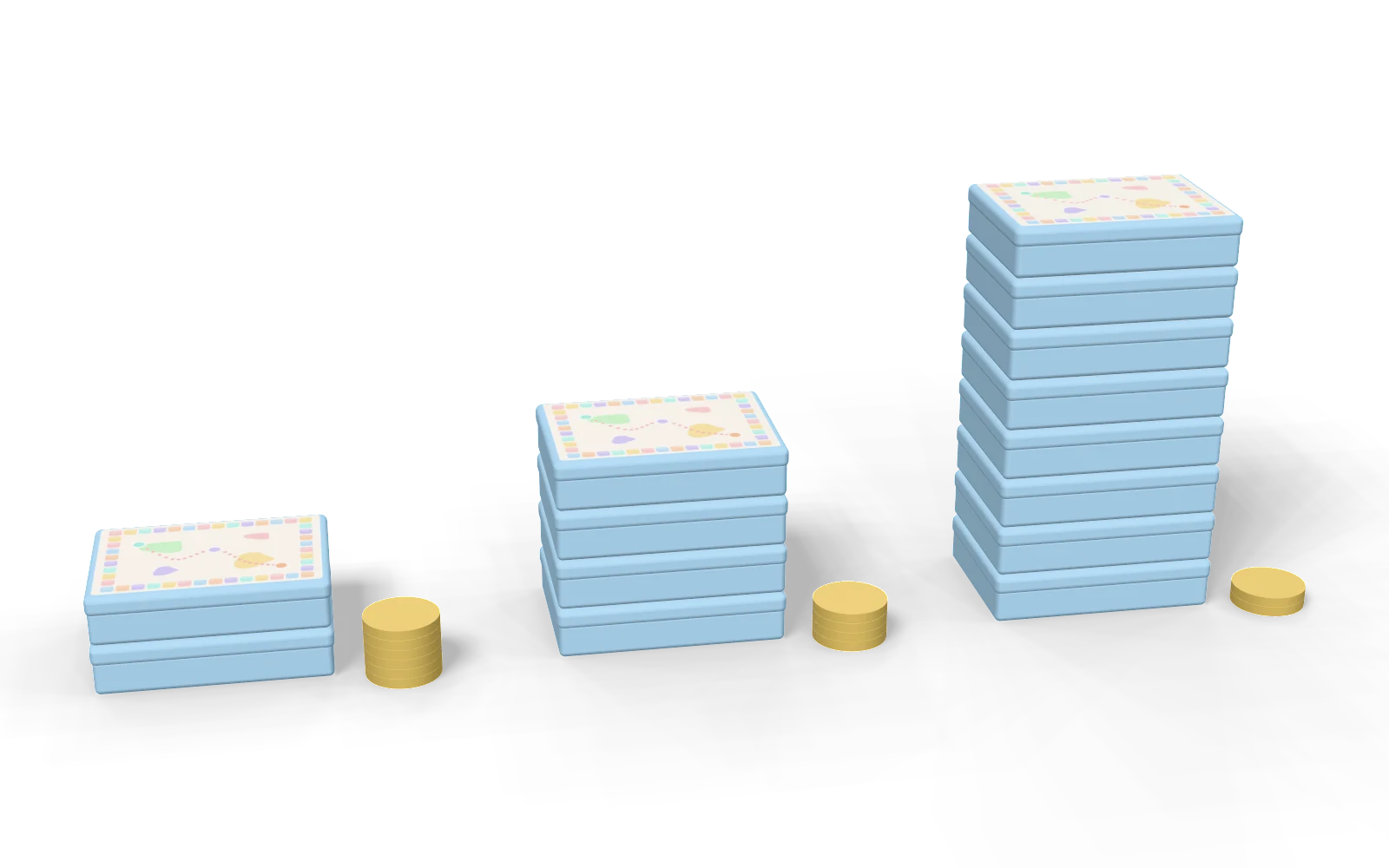
Most first games print 1,000 to 2,000 copies. Our minimum order quantity (MOQ) is 1,000 sets, and we can help with 500 if really needed. Every board game print run carries the same setup work, so each extra copy makes every copy cheaper. The right number is the one you can sell without leaving money stuck in a warehouse. This guide explains why the minimum exists, what each quantity gives you, and how to choose yours.
Why There Is a Minimum Order Quantity
A minimum order quantity exists because the setup work is the same for 500 copies as for 5,000. Before the first good sheet comes off the press, about 300 sheets are used to set the colour. Our artwork team can spend up to 60 hours preparing one game's files for print. Spread over too few copies, that work makes each copy very expensive, so 500 sets often cost almost the same as 1,000. That is why our board game MOQ is 1,000 sets, while many factories ask for 1,500 or 2,000.
What Each Print Run Size Gives You
These are the quantities we quote most often, and what each one is good for:
- 1,000 copies, our standard minimum. The common first print run for a game with a few hundred backers or a growing email list. Enough stock to sell directly and at events without over-committing your budget. The price per copy is still high, so shop and distributor margins are hard to fit. We can help with 500 copies if really needed, but the price per copy is almost the same as at 1,000.
- 2,000 copies, the sweet spot. For almost all board games, 2,000 copies is the tipping point that brings the production cost down to about 20 percent of the retail price, the share most publishers need. Our guide to the X5 rule for board game pricing explains why that share matters.
- 3,000 copies, ready for retail. The price per copy drops enough for shops and distributors, and leaves room to pay for advertising. You need more cash up front, storage and a fulfilment partner, and we can help with both.
- 5,000 copies and more, scaling up. The best price per copy, cheaper freight per game and stock you can rely on. Best for experienced publishers with proven demand, retail distribution or several language editions.
Check Out Our Free Resource: Game Pricing & Production Economics
How to set your retail price first, then size your print run and parts to fit it.
Expansions and Add-Ons in Smaller Quantities
Expansions can be printed from 500 sets, and small add-ons in even lower quantities, on three conditions. They must be ordered together with the base game. Their parts must be simple. And they must not be mixed with the base game's parts. A reference card, for example, can be printed digitally without trouble. An extra playing card that must look and feel exactly like the base game's cards cannot, because a small run uses different machines from the main run.
When Print on Demand Is the Better Choice
If you need far fewer than 1,000 copies, a mass-production run is the wrong tool. Around 30 hand-made copies cost about the same as a 500-copy offset run, so a handful of copies for reviewers or a campaign belongs to digital printing. Our guide to print on demand vs offset printing compares the two.
How to Choose Your Number
Base your print run on numbers, not hope. Four questions decide it:
- How many are already sold? Count pre-orders, crowdfunding backers and your email list. If you have 1,000 engaged backers, a 3,000-copy run is a strong base, because you will keep selling after the campaign.
- Where will the games go? A large run needs a warehouse and a fulfilment plan. We can store and ship your games from China, the US and Europe.
- Can your cash flow carry it? A bigger run makes more profit per copy but ties up more money. Do not spend so much on production that nothing is left for marketing.
- First print run or reprint? If the budget is tight, a smaller first print run and a reprint later is a safe path, and the reprint can fix small mistakes. See our board game reprint guide.
The time each quantity takes to make is covered in how long it takes to make a board game.
The Bottom Line on Your Board Game Print Run
A board game print run starts at our minimum order quantity of 1,000 sets, reaches its sweet spot around 2,000, and opens up retail from 3,000. Choose the largest number you can sell and pay for, not the largest number you can imagine. If you are not sure, ask us to quote several quantities side by side: when you are ready, contact us.
Frequently Asked Questions
What is the minimum order quantity for a board game?
How many copies should I print for my first board game?
Why is 2,000 copies a good print run?
Can I print fewer than 500 copies?
Talk to Our Team About Creating Your Board Game
From design to manufacturing, we can help you with every aspect of turning your game concept into reality.