Who Needs This Guide?
If you’re a board game creator or publisher, pricing your game correctly determines whether your business thrives or collapses. Many designers focus on game mechanics first, leaving pricing as an afterthought. That strategy fails in today’s multi-channel market. Instead, this guide shows you how to work backward from MSRP (Retailer Suggested Price), apply the modernized X5 rule, and build a pricing structure that supports sustainable growth.
What Is the X5 Rule?
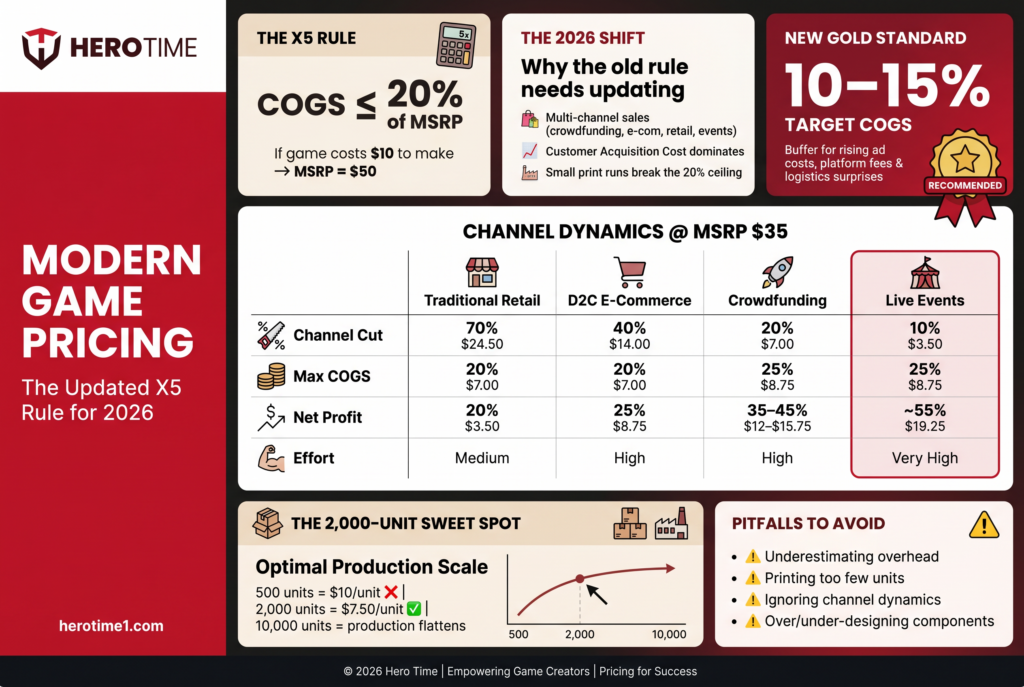
The X5 rule is a long-standing principle:
Your manufacturing and logistic cost (COGS) should be no more than 20% of the MSRP.
COGS basically means the landed costs of your product in the warehouse you will be fulfilling from.
In other words, if your game costs $10 to manufacture, the retail price should be $50. This 5x multiplier ensures enough margin to cover distribution cuts, marketing, and overhead.
However, the traditional X5 rule is outdated for 2026. Here’s why:
-
Sales channels have evolved: Crowdfunding, e-commerce, live events, and retail each have unique costs.
-
Customer acquisition costs (CAC) now dominate pricing strategy.
-
Small print runs make hitting the 20% COGS ceiling nearly impossible without scaling.
Because of this, game creators need a channel-driven, volume-aware pricing model.
The Modern Pricing Framework
Today’s pricing strategy starts with reverse engineering:
-
Set MSRP: Research market benchmarks for similar games.
-
Select Sales Channel(s): Each channel affects your allowable costs.
-
Calculate COGS Target: Deduct channel cuts and CAC to determine max production and logistics cost.
-
Engineer Game Specs: Adjust components, art, and packaging to fit your budget.
Why 10-15% Is the New Gold Standard
While the X5 rule recommends 20% COGS, aiming for 10-15% gives you flexibility. This buffer helps absorb:
-
Rising ad costs
-
Platform fees
-
Unexpected logistics expenses
Hitting 10% requires production efficiency and large print runs—which brings us to the 2,000-unit tipping point.
The 2,000-Unit Sweet Spot
Factory setup costs—like tooling, molds, and print plates—are fixed. If you produce 500 units, each game absorbs a larger share of these costs, inflating your COGS.
At 2,000 units, fixed costs spread out, dropping per-unit cost into the safe 10–20% zone. Anything below that makes survival difficult, especially after channel fees and overhead.
Channel Dynamics and Profit Table
Here’s how different channels impact your economics. Assume MSRP = $35.
|
Sales Channel |
Channel Cut / CAC |
Max COGS |
Gross Profit |
Overhead Charges |
Net Profit |
Channel Dynamics |
Effort Required |
|
Traditional Retail |
70% ($24.50) |
20% ($7.00) |
10% ($3.5) |
None |
20% ($3.5) |
Distributors and retailers take the majority cut upfront. Gross profit equals your net margin. Requires strict cost control. Especially when going to conventions |
Medium |
|
D2C E-Commerce |
40% ($14.00) |
20% ($7.00) |
40% ($14.00) |
15% ($3.50–$5.25) |
25% ($8.75–$) |
High initial margin, but requires ongoing costs for platform fees (Shopify), graphic designers, and specialized ad managers. |
High |
|
Crowdfunding |
20% ($7.00) |
25% ($8.75) |
55% ($19.25) |
10%–20% ($3.50–$7.00) |
35%–45% ($12.25–$15.75) |
Looks highly profitable, but challenging to requires massive upfront investments for campaign launch assets (videos, preview copies) plus platform and ad tools. |
High |
|
Live Events |
10% ($3.50) |
25% ($8.75) |
65% ($22.75) |
~10% ($3.50) |
~55% ($19.25) |
Highest initial return, but you must allocate funds to manufacture event-specific display materials, banners, and travel logistics. |
Very High |
Key Notes:
1- The table above does not include the fulfilment cost of delivering your game from the warehouse to your customers. Some publishers charge customers for it, some do not. This is a significant cost, so be aware of it.
2- This table is optimistic, the channel Cut / CAC can easily be higher by 10-20% in the beginning as you start, which will squeeze your original starting margins.
Key Takeaways
-
Retail offers stability but razor-thin margins. Strict cost control is non-negotiable. It is difficult to get into retailers, and you want to ensure
-
D2C E-Commerce provides better margins but demands continuous ad spend and platform management. It is also very difficult to get started and might require 3-4 months of investment and testing.
-
Crowdfunding looks profitable but requires heavy upfront investment and marketing expertise. Videos, outreach prototypes, reviewers, all costs pile up.
-
Live Events deliver the highest margins but involve significant logistical and travel costs. We also learned that small local events deliver better results that specific board game related events.
Common Pitfalls to Avoid
-
Underestimating Overhead: Ads, platform fees, and event logistics can erode margins quickly.
-
Printing too few units: Drives up unit cost, killing profitability.
-
Ignoring Channel Dynamics: Each channel has unique cost structures—plan accordingly.
-
Overdesigning components: Premium materials can destroy your cost structure if not aligned with MSRP.
-
Overdesigning components: Going too cheap material wise is also risky, bad reviewes will kill your project in an instand.
Real-World Use Case
Imagine you plan to sell a card game for $35 via crowdfunding.
-
Target COGS: $8.75 (25%).
-
Printing 500 units might cost $10 each—over budget.
-
Printing 2,000 units drops cost to $7.50, hitting your target and more.
Scaling is essential. The higher you scale the cheaper it becomes.
-
Game production flattens out at around the 10K unit mark.
FAQs
Is the X5 rule still relevant?
Yes, but use it as a guideline, not a rigid formula. Adjust for channel costs and CAC.
What’s better: retail or crowdfunding?
Crowdfunding can deliver higher margins but requires upfront marketing expertise and assets. Retail offers stability but lower net profit.
How can I hit 10% COGS?
Increase your print run, simplify components, and negotiate with manufacturers