
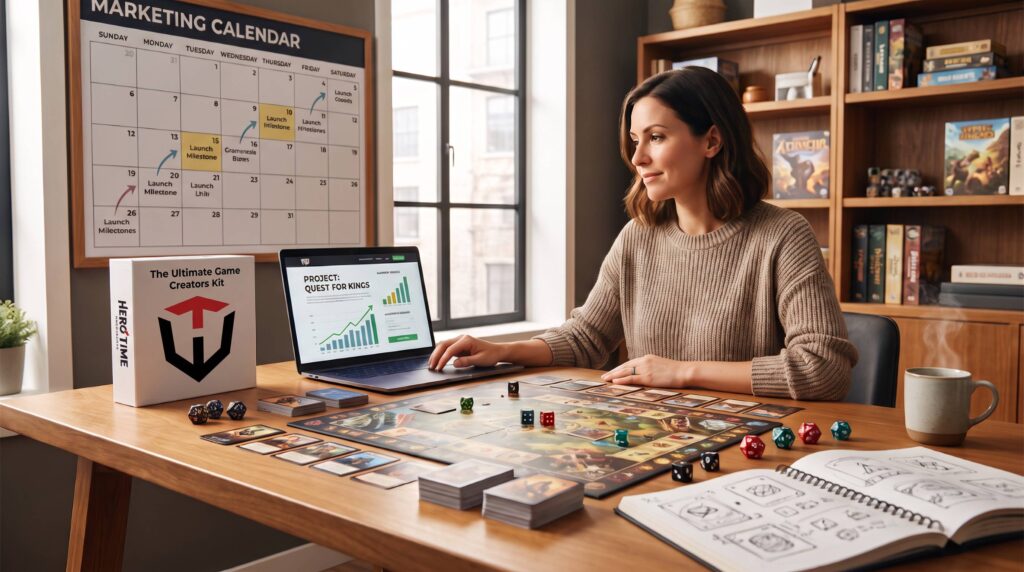
When you have poured months, or even years, into designing, playtesting, and refining your dream board game, the urge to hit “launch” on your crowdfunding page as soon as it is ready is completely understandable.
But in today’s tabletop industry, launching too early without a calculated pre-launch marketing strategy is one of the fastest ways for a great game to go unnoticed. At Hero Time, we see creators eager to share their worlds every day, but building a sustainable publishing journey takes patience, timing, and precision.
Major tabletop success stories did not break through by accident. Behind a standout campaign is usually months of audience building, email list growth, content marketing, community engagement, and brand positioning. Whether you are planning a Kickstarter board game campaign, a Gamefound launch, or a project on another tabletop crowdfunding platform, the same rule applies: launch when your audience is ready, not just when your campaign page is ready.
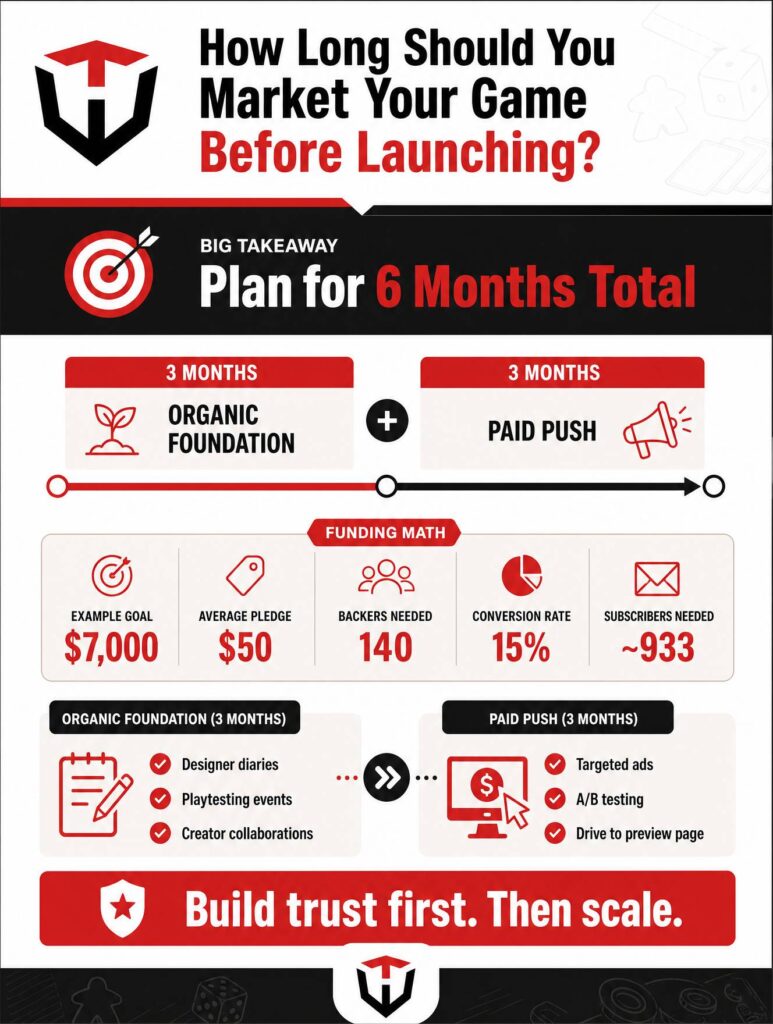
So, how long should you market your board game before launching your crowdfunding campaign? For most independent creators, a smart target is about six months of pre-launch marketing: three months of organic community building, followed by three months of paid promotion and conversion-focused campaign prep.
Why Day-One Funding Matters
If you want to determine your ideal pre-launch timeline, work backward from one of crowdfunding’s most important benchmarks: aim to be fully funded on Day 1.
A strong opening creates immediate social proof. Crowdfunding platforms reward momentum, and potential backers are far more likely to support a campaign that already looks active, trusted, and likely to succeed. Fast day-one funding can also improve campaign visibility, increase sharing, and make reviewer and influencer outreach more effective during launch week. The reverse is just as true: as we cover in our guide to avoiding a failed Kickstarter campaign, the platform will not hand you an audience. Successful campaigns bring their own supporters with them.
Kickstarter’s own leadership has said the same thing publicly. In an interview with Fortune, CEO Everette Taylor made the point that creators who do not already have an audience need digital marketing and a cultivated crowd in place before they launch — you have to push your own audience to the platform, not wait for the platform to find one for you.
It is a benchmark that professionals plan around. The Crowdfunding Nerds, Hero Time’s crowdfunding partner, have helped game creators raise over $15 million on Kickstarter and Gamefound, and report that 87% of their clients fund on the very first day of launch — the majority of them first-time creators. You can read their seven fundamentals of crowdfunding in the Hero Time Academy.
The Math Behind a Strong Board Game Crowdfunding Launch
To build a realistic board game crowdfunding strategy, start with the numbers. A few simple calculations will tell you how many backers, subscribers, and marketing touches you are likely to need before launch.
- Calculate a lean funding goal based on manufacturing, freight, fulfillment, and platform fees — not sunk development costs.
- Estimate your average pledge value based on your core reward tier and expected add-ons.
- Use a realistic subscriber-to-backer conversion rate to estimate how large your pre-launch audience needs to be.
Step 1: Calculate Your Funding Goal
Your crowdfunding goal should be practical and lean. Focus on covering production, freight, and fulfillment rather than trying to recover every dollar already spent on prototyping, art, or development. Our guide to how many copies of your game you should print walks through how to size that first run sensibly.
Example: if producing 500 copies of your game costs $5,000, and freight plus shipping to your main fulfillment hub adds another $2,000, your baseline funding goal is $7,000.
Those figures are deliberately conservative and they hold up against real quotes. A 500-set run is a common first print run and matches Hero Time’s minimum order quantity. At that quantity, our published board game manufacturing cost guide puts a light board game with a few decks, tokens, and pieces at roughly $4 to $11 per unit, and a medium-weight game with seven to twelve components at roughly $7 to $20 per unit. The $10 per unit in the example above sits comfortably inside that range for a light-to-medium game. A minis-heavy game will cost considerably more, so get a real quote before you commit to a number.
Three costs first-time creators routinely leave out of the goal:
- Platform and payment fees. Kickstarter and Gamefound each charge a platform fee plus payment processing. Budget roughly 8–10% off the top of everything you raise before you see a cent of it. Our Kickstarter vs. Gamefound comparison breaks down how the two platforms differ.
- Safety testing and compliance. Selling into Europe, the UK, or the United States means safety testing and the right markings — CE and CPSC/CPC certification are not optional, and they are not free.
- Per-backer fulfillment. Your main funding goal doesn’t necessarily need to cover fulfillment. Most creators collect shipping, duties, and VAT after the campaign ends through a pledge manager. However, if you plan to subsidize any of these costs to keep shipping rates lower for your backers, you will need to factor those subsidies into your goal. Read our full breakdown of shipping and logistics costs here.
Step 2: Estimate Your Average Pledge Value
Next, estimate how much the average backer is likely to spend. For many indie tabletop campaigns with a single core box, a realistic average pledge falls between $50 and $60.
Using the lower end of that range: $7,000 ÷ $50 = 140 backers. That means you would need roughly 140 excited backers on Day 1 to fully fund immediately.
Treat $50 as a planning figure, not an industry law. Average pledge varies enormously by game type: a single-deck card game may land below $30, while miniature-heavy or deluxe campaigns routinely average well over $100. Build your own number from your actual reward tiers, add-ons, and shipping model — and sanity-check your retail pricing against the x5 rule for selling games before you set tiers.
Step 3: Account for Subscriber-to-Backer Conversion
Not everyone who follows your campaign will pledge. A commonly used planning benchmark for tabletop campaigns is a 10% to 20% conversion rate from pre-launch subscribers to live backers, with 15% as a workable midpoint. In other words, for every 100 people on your email list, preview page, or launch-notification funnel, around 15 may convert when the campaign goes live.
Using that benchmark: 140 backers ÷ 0.15 = about 933 subscribers. So if your goal is day-one funding, you should work toward roughly 900 to 1,000 qualified pre-launch subscribers.
The word doing the heavy lifting there is qualified. Our overview of publishing channels notes that subscriber conversion on Kickstarter can reach 20%, but that upper figure belongs to a warm, engaged list. A list assembled cheaply from cold traffic, with no nurturing in between, can convert in the low single digits — and plenty of creators have published post-mortems showing exactly that. A thousand people who remember why they signed up will always outperform five thousand who do not.
The Recommended Timeline: 3 Months Organic + 3 Months Paid
Once you know how many subscribers you need, you can build a realistic timeline to get there.
A focused paid acquisition campaign in the tabletop space typically lands somewhere between $2 and $5 per qualified subscriber, depending on creative quality, audience targeting, offer strength, and landing page performance. At that range, generating around 933 subscribers through paid traffic means an ad budget of roughly $2,000 to $5,000. Plan for the higher end until your own numbers prove otherwise.
Could it happen faster? Sometimes. A larger budget or a particularly strong ad set can compress results. But in most cases, ad platforms need time to optimize and identify your best audience. More importantly, ads alone are not a magic solution.
If you rely entirely on cold traffic with no existing audience, trust signal, or community presence, subscriber acquisition becomes more expensive and far less reliable. That is why a six-month framework works so well for independent creators — and why our marketing fundamentals guide puts audience definition before ad spend.
Phase 1: The 3-Month Organic Foundation
Before spending heavily on paid ads, build trust, visibility, and grassroots momentum. Use the first three months to prove that your game is real, your progress is active, and your voice is worth following.
- Designer diaries. Document rule refinements, creative breakthroughs, artwork updates, and production milestones across social media, BoardGameGeek, and community platforms. Our 10 steps for increasing awareness of your game is a good checklist to work through here.
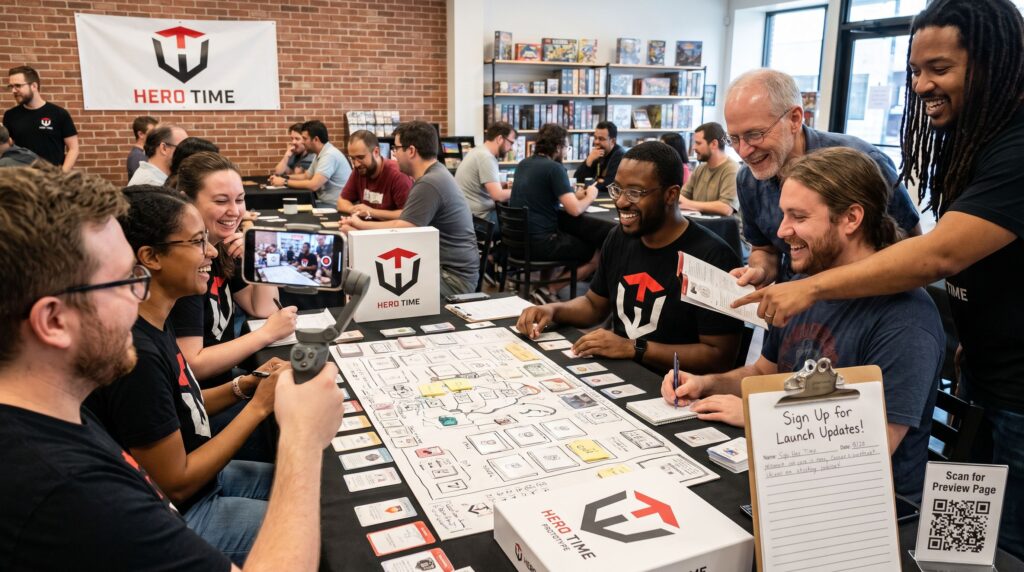
- In-person playtesting. Bring your prototype to local game stores, conventions, and meetup groups to gather feedback and turn early players into genuine advocates. Our playtesting blueprint covers how to run sessions that produce usable data, not just compliments.
- A prototype worth photographing. Diaries and demo videos only land if what is on the table looks like a real game. A production-quality prototype is what makes the rest of this phase credible — and Hero Time includes the Crowdfunding Nerds’ crowdfunding and Facebook ads course free with a prototype order.
- Content and creator collaboration. Reach out to smaller YouTube channels, podcasts, newsletters, and tabletop creators who speak to your ideal audience. If video is part of the plan, our notes on video production for board game marketing will save you money.
- Email list building. Offer interested players a real reason to subscribe: launch reminders, print-and-play previews, exclusive artwork, or behind-the-scenes updates. This is the single highest-leverage activity of the entire phase.
Phase 2: The 3-Month Intensive Push
Once you have an organic presence and a credible public footprint, layering in paid promotion produces much stronger results.
During this phase, your goal is to combine ongoing community engagement with targeted traffic acquisition: testing ad creative, refining audience targeting, improving your landing page, and steadily driving attention to your pre-launch signup funnel. Our 10 steps to advertise your game successfully covers the mechanics.
Because people who discover your campaign through ads will check your social proof before subscribing, your earlier organic work becomes part of the conversion engine. Community content, comment activity, playtesting photos, email updates, and creator collaborations all help validate the project and increase trust.
This is also the phase to finish the assets that do the actual selling: your campaign page, your sell sheet, and your launch-week outreach list. Build the page mobile-first — the overwhelming majority of traffic to a live campaign arrives on a phone. If you would rather not run this alone, our guide to Kickstarter consultants explains what a good one does and what it costs.
In short: the ads bring attention, but your brand story and community presence close the gap.
Where Manufacturing Fits Into the Timeline
Pre-launch marketing and production planning should run in parallel, not one after the other. You need firm component specs and a real quote before you can set a lean funding goal, and you need a prototype before you can market credibly. Once your files and samples are approved, manufacturing lead times and the standard payment structure determine how honestly you can answer the one question every backer asks: when will I get it? Build your delivery estimate backward from production, freight, and last-mile fulfillment — then add a buffer.
Practical Takeaways for Kickstarter, Gamefound, and Tabletop Campaign Planning
- Market for about six months total: three months of organic momentum followed by three months of paid growth.
- Keep your funding goal lean and operationally grounded — and include platform fees, safety testing, and fulfillment in it.
- Estimate your average pledge from your own reward tiers before forecasting backer volume.
- Plan around a 10% to 20% subscriber-to-backer conversion rate, with 15% as a useful midpoint.
- Budget roughly $2 to $5 per qualified subscriber for paid acquisition.
- Treat your email list as a major launch asset, not an afterthought — and prioritize list quality over list size.
- Build trust first, then scale traffic.
Final Takeaway
If you are serious about giving your board game the best chance to succeed, do not think only in terms of when your campaign page is finished. Think in terms of when your audience is large enough, warm enough, and excited enough to convert.
For most indie publishers, the best answer is a six-month pre-launch marketing window. Start with three months of organic community building, then follow with three months of focused paid acquisition and campaign preparation. Build your launch plan backward from Day 1, track your likely conversion rate, and remember that people do not just back games — they back creators they trust.
Whether you are preparing your first crowdfunding campaign or expanding your tabletop publishing portfolio, Hero Time is here to help bring your vision to life. You can also explore the rest of the Hero Time Academy marketing library for free, or follow us on YouTube, LinkedIn, and Instagram.
Disclaimer
The suggestions and calculations above are provided for general educational purposes only. Manufacturing, freight, and fulfillment costs vary by game, quantity, and destination, and all figures should be confirmed with a current quote. Always evaluate your own financial comfort level and consider seeking guidance from a licensed financial professional before committing significant capital to business or marketing investments.
