
Playing Card Finishes and Print Effects
 By Hersh Glueck
Every printed card gets a finish. Without one, the ink smudges and the cards stick to each other. There are three base playing card finishes: poker oil, the standard coating on almost every deck; lamination, a plastic film for extra toughness; and linen finish, a woven texture pressed into the card. On top of them come the print effects: spot UV, cold stamp, nano print, holofoil and gilded edges. This guide explains what each one does to the look, the feel and the shuffle, and when to choose it.
Check Out Our Free Resource: Guide For Selecting Components
This guide helps board game designers select ideal components and quantities.
The finish goes on top of the paper. Which paper to choose is covered in our guide to playing card material, and the sizes in our guide to playing card size.
The Types of Playing Card Finishes
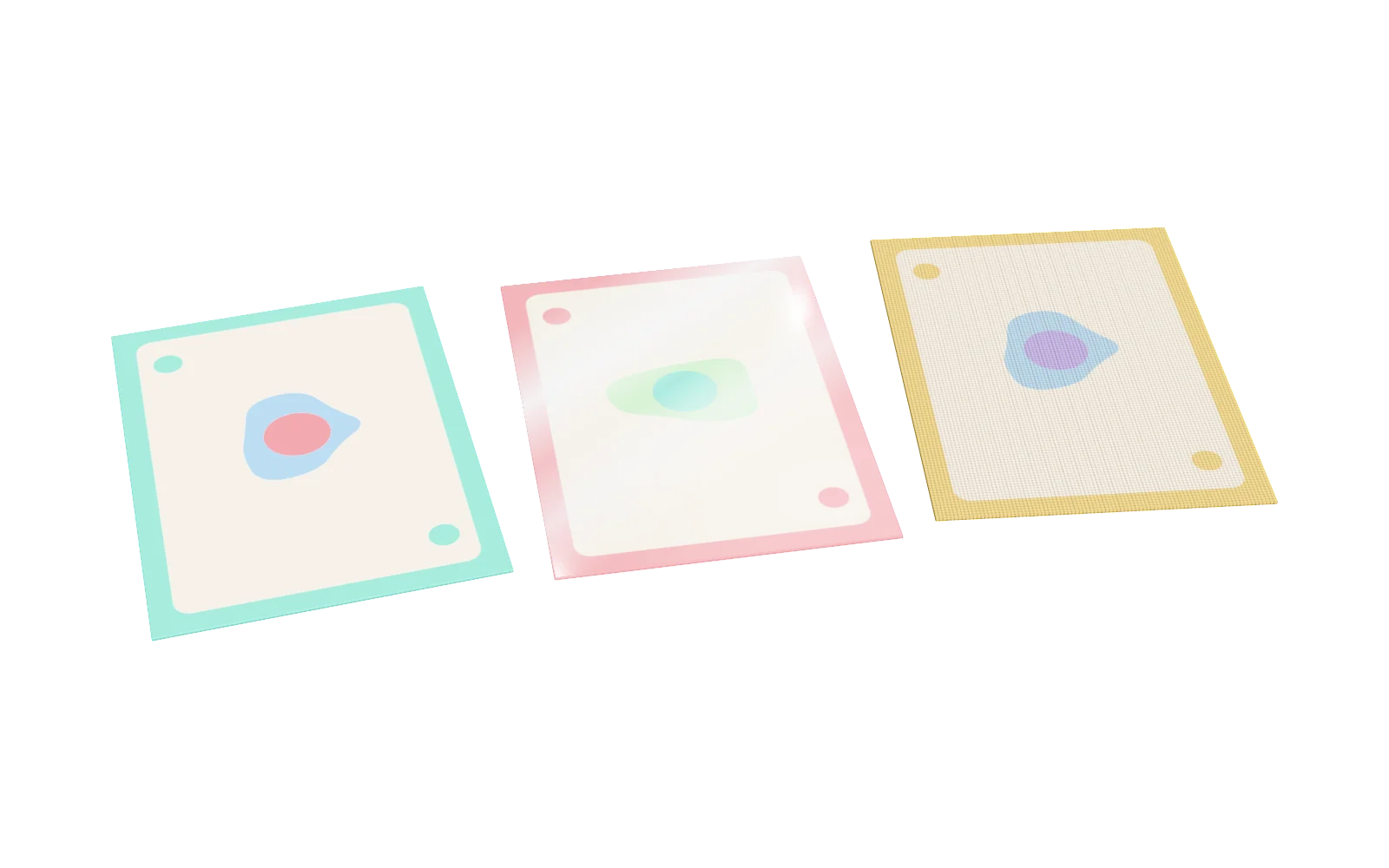
There are three types of playing card finishes, and every deck has one of them. Poker oil is a thin, semi-gloss coating; it is the default. Lamination is a plastic film, matte or glossy. Linen finish is a texture pressed into the card and then oiled. The print effects below are extras that go on top of one of these three: spot UV, cold stamp, nano print, holofoil paper and gilded edges.
Poker Oil: The Standard Card Coating
Poker oil is the playing card coating most decks get, and the one we recommend. It is a special oil made for cards, applied to both sides at once by a 30-metre coating machine. It seals the ink, protects the surface from scratches and gives a semi-gloss sheen that does not reflect light into players' eyes. Most of all, it keeps the deck shuffling well, which is why professional poker rooms use it.
People often call it oil varnish or a playing card varnish. In the factory the two are different: oil varnish is a thicker coating used on token sheets, player boards and rulebooks, where it gives a satin feel. On cards that thickness would hurt the shuffle, so cards get poker oil. The default is matte; a glossier version is available for an extra setup.
Lamination: Matte, Glossy and Dry-Erase
Lamination is a thin plastic film glued over the printed card. Laminated playing cards are the tough option: they do not tear, they shrug off spills and they keep their shape after a bend. That makes lamination the right choice for children's games and for cards that are handled roughly. It comes in four kinds:
- Matte lamination. A smooth, non-reflective surface. The usual choice for hobby games, because fine details stay readable without glare.
- Glossy lamination. A high-shine surface that makes colours pop. Popular on family games and boxes. On cards it has a drawback: the plastic film stretches, so the cutter cuts it less cleanly and more slowly, and the paper can shift a little during the cut.
- Dry-erase lamination. An extra-thick glossy film that works like a whiteboard, for score cards and trackers players write on and wipe.
- Anti-scratch lamination. A premium matte film for dark and black designs, where scratches and stretch marks would otherwise show.
Lamination has three costs. The plastic layer builds up static, so laminated decks shuffle worse than oiled ones and can stick together. It is harder to match colours between print runs through a film, so a reprint may differ a little. And it is not recyclable the way an oiled paper card is.
Oil Varnish or Lamination: Which to Choose
Choose the oil coating when the shuffle matters and the players are gentle. Choose lamination when the cards must survive rough hands. The same rule applies to boxes the other way round: a game box is always laminated, because a box gets scratched on and off the shelf and a laminated corner does not split open.
Use poker oil when:
- Players are gentle with their board game pieces.
- Shuffling is an important part of the game.
- You cannot decide between matte and glossy: the oil sits in between.
- You want an eco-friendly production with no plastic film.
Use lamination when:
- The players are children.
- The cards are played constantly and are always in hand.
- The cards are not shuffled much.
- The card needs to be wiped clean, or written on and erased.
Linen Finish Playing Cards
Linen finish playing cards have a fine woven texture pressed into the surface. A press with patterned steel plates runs the printed sheet through, and the pattern is pressed into the paper. Linen finish cards shuffle more easily, because the texture traps a little air between the cards, and the surface looks and feels classic. It is the most popular upgrade on hobby game cards, and it can go on any printed component, from player boards to token sheets.
Three things to know before you choose it. The texture is pressed before the oil coating, and the oil always goes on after it; without that oil coat a linen card feels thin and cheap. On very heavy ink the sheet is oiled twice, once before the press to seal the ink and once after. And the texture can look a little different on the front and the back of the sheet, which is normal. Linen finish costs about 0.10 USD per card, with no setup fee.
Other card makers press similar patterns under their own names. An "air cushion finish" is a dimpled pattern with the same job; a "smooth finish" is a card with no texture at all. Whatever the name, the choice is the same: a pressed texture for the shuffle, or a smooth surface for the sharpest print.
Print Effects: Spot UV, Cold Stamp, Nano Print, Holofoil and Gilded Edges
Print effects are the premium extras. Most of them are printing technologies rather than coatings, but they are chosen with the finish, so they belong here. Each one adds a setup cost and a per-sheet cost, and each has rules about which finish it works with.
Spot UV
Spot UV is a clear, glossy varnish on chosen areas of the artwork, so a logo or a symbol shines against the rest of the card. It is a finishing step, not a print: the varnish is pushed through a silk screen, the same stencil tool used for one-colour printing, with the UV varnish in place of ink, and then cured with UV light. A press with its own UV unit can apply it in line as well. One rule matters: the spot UV always goes on top of the coating. On a laminated card it sits above the lamination, and on a poker oil card above the oil; put it underneath and the coating hides the effect. It costs about 0.20 USD per card plus a 150 USD setup. On matte lamination the contrast is strongest; on glossy lamination it is subtle. It does not go with a linen texture.
Cold Stamp (Cold Foil)
Cold stamp puts a metallic foil onto part of the card without heat or pressure. It was made for cards: because nothing presses the paper, the foil does not show through on the back, so every card in the deck still looks the same from behind. The hot version, foil stamping, is for boxes and boards and should not be used on cards. Cold stamp is done on a special printing machine with a built-in foil unit. The machine lays a UV-cured glue on the chosen areas, transfers the foil onto them in the same pass, and then the CMYK printing plates print colour on top of the foil. That is why we mostly use a silver foil: ink printed over silver shines, so one card can carry up to three foil colours from a single silver layer. Every extra colour adds to the setup cost and the per-sheet cost. We recommend cold stamp only with the oil coating, not with lamination, and not with a linen texture.
Nano Print
Nano print is a layer added during printing with a special ink and a special machine. It gives the print a fine sandy texture, a premium feel you notice the moment you touch the card. A thicker layer of nano print raises the chosen area slightly, like an emboss without the dent on the back, and a spot UV on top makes that raised area shine. These effects are used mostly on trading cards, where one card has to feel special.
Holofoil, and Holofoil With White
Holofoil cards are printed on holofoil paper: a paper with a holographic foil layer applied before printing, so the whole surface shimmers. To control where the shimmer shows, we print a layer of white ink over the areas that should stay plain, such as text, and then print the colours on top of the white. That is "holofoil with white", and it is included in the price. One deck uses one foil type, gold or silver, not both, because the foil covers the whole sheet before printing; that is the difference from a cold stamp, which can carry several colours on one card. Holofoil cards feel different from paper cards, so they cannot hide in a mixed deck, and a holofoil deck can still take a cold stamp on top. Holofoil on black core paper needs about 10,000 sheets.
Gilded Edges
Gilded edges put a metallic colour on the four edges of the whole deck, the finish you see on luxury playing cards. It is a manual process and the most expensive effect per deck, so we advise it from about 5,000 decks.
Lenticular, Emboss and Braille
Lenticular cards change or move as you tilt them; they need two prints and a plastic lens layer, and a minimum of 10,000 sheets. Embossing is not recommended on cards, because the raised shape shows as a dent on the back and gives the card away. Braille can be added on one side only, for the same reason.
What Happens in Which Order
The order matters, and it is always the same. The sheet is printed on both sides; a cold stamp is applied during this printing, foil first and colour on top. If the cards get a linen texture, it is pressed next, with an oil coat before it on heavy ink. Then comes the oil coating, or the lamination. Spot UV goes on top of that coating, last before cutting. Only then are the cards cut, rounded and collated. When you are ready to make the deck, our card game manufacturing page shows what we make and how a quote works.
Frequently Asked Questions
Are playing cards laminated?
What are air cushion, smooth and linen finishes?
Can I add spot UV or foil to linen finish cards?
How much does a linen finish cost?
Talk to Our Team About Creating Your Board Game
From design to manufacturing, we can help you with every aspect of turning your game concept into reality.