
Playing Card Size: Standard and Custom
 By Hersh Glueck
The most common playing card size is poker size, 63 × 88 mm (2.5 × 3.5 inches). Most board game cards use it, because it fits the hand and fills a printing sheet with little waste. The other standard playing card sizes are bridge, mini, tarot and square. This guide lists every standard size in millimetres and inches, explains custom sizes, and shows how the sheet and the machines set the limits.
Check Out Our Free Resource: Guide For Selecting Components
This guide helps board game designers select ideal components and quantities.
The paper and the thickness of a card are a separate subject, covered in our guide to playing card material. The finish that protects the print is covered in linen finish playing cards, which compares varnish, lamination and linen.
Standard Playing Card Sizes
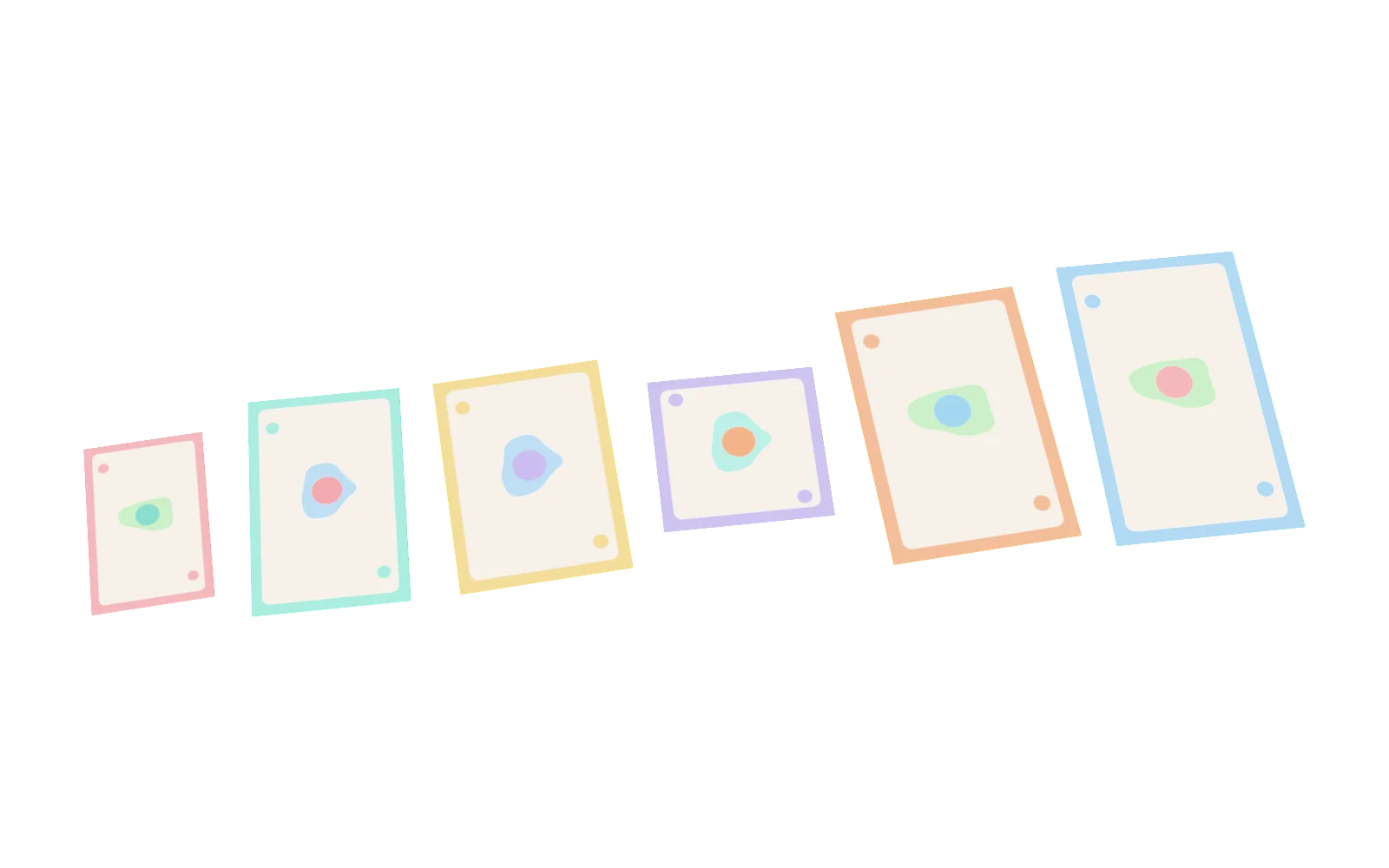
The standard playing card size is poker size, and there are nine standard sizes in total. A standard card size costs less than a custom one at every quantity, because the cutting and collating machines are already set up for it. The table gives the playing card dimensions in millimetres and inches, and how many cards of each size fit on our main printing sheet.
| Card size | Millimetres | Inches | Cards per sheet |
|---|---|---|---|
| Poker | 63 × 88 mm | 2.48 × 3.46 in | 65 (54 on black core paper) |
| Bridge | 57 × 88 mm | 2.24 × 3.46 in | 71 |
| Mini | 44 × 68 mm | 1.73 × 2.68 in | 77 |
| Small tarot | 70 × 108 mm | 2.76 × 4.25 in | 49 |
| Large tarot | 70 × 120 mm | 2.76 × 4.72 in | 39 |
| Small square | 58 × 58 mm | 2.28 × 2.28 in | 79 |
| Square | 63 × 63 mm | 2.48 × 2.48 in | 76 |
| Large square | 68 × 68 mm | 2.68 × 2.68 in | 69 |
| Large square, older standard | 70 × 70 mm | 2.76 × 2.76 in | 69 |
Cards per sheet is for white core paper on the 540 × 750 mm sheet (see how many cards fit on a sheet below). These are also the standard board game card sizes: a board game uses the same sizes as a deck of playing cards, so any game card size in this table is made on the same machines.
Which Card Size Fits Your Game?
Poker size is the safe default for any game. Bridge size is a little narrower, so it suits games where players hold many cards in one hand. Mini cards save space in a small box and in games with several decks. They are the smallest standard card we make; below about 34 × 44 mm, make the cards as punch-out tokens instead, so they do not get lost during collating. Tarot sizes give room for artwork and text, so they are used for character, event and story cards. Square cards work like small tiles, for games where cards are laid out on the table rather than held.
Custom Size Playing Cards
Yes, you can have your own card size, and your own shape, such as a circle or a hexagon. A custom size is any size not in the table above. It costs more than a standard size because of the cutting: a custom size needs its own cutting mould, and the collating and wrapping are done by hand until the order is large enough to pay for the automatic machine set-up. The section on the machines below explains what that means in numbers.
Very rich artwork and tight colour matching need the medium printing machine and its 540 × 750 mm sheet. If you plan a large sheet for a big card count, ask us first.
Five Rules That Keep Any Card Size Printable
These five rules apply to every card, standard or custom. They are what keeps the print clean at the cut and the colour even across the deck.
- Add a bleed of 1.5 mm on each side of the card (3 mm in total). The bleed is the artwork that runs past the cut line, so no white edge shows if the cut is slightly off.
- Keep a margin of 1.5 mm from the cut line to the first important content, such as text or a character. Our cutting tolerance is under 0.5 mm, but without the bleed and the margin a small misalignment becomes visible.
- If your design has a border, make it at least 1.5 mm thick from the cut line inwards. A thin border shows every half-millimetre of movement.
- Set your artwork up to our best practices and the colour will match from sheet to sheet. Every deck needs two printing set-ups, one for the fronts and one for the backs, and a large deck spreads over several sheets. Our presses record the exact ink density digitally, so cards from different sheets in one print run match, and a reprint reaches 95% or better colour accuracy when the artwork follows our best practices, and about 90% when it does not.
- Count your cards in whole sheets. No deck can take more than 90 cards from one sheet, so a 100-card deck always uses two sheets.
How Many Playing Cards Fit on a Sheet?
Between 39 and 79 cards fit on one printing sheet, depending on the size: 65 poker-size cards, 71 bridge, 77 mini, 49 small tarot and 39 large tarot. We print cards on a 540 × 750 mm sheet (the industry's "two opening small" sheet) on our medium printing machine. That machine gives the best colour accuracy and also runs the special finishes, such as cold stamping and nano print (see linen finish playing cards for the finishes and print effects).
For a large print run, or a game with hundreds of cards (about 325 cards and up) with simple colours and no special finish, a larger 640 × 880 mm sheet on the large machine holds 90 cards and saves processing cost. Ninety is also the most cards the cutting machine can cut from one sheet, so a card smaller than poker size still uses a layout of 90. Collating and shrink wrapping take up to 90 cards per deck as well.
Plan the card count in whole sheets and the deck gets cheaper. A game with 136 poker-size cards needs 136 ÷ 65 = 2.09 sheets: a third sheet for six cards, a splitting process and more waste. At 130 cards it fills exactly two sheets. The same works the other way: 28 cards use 0.43 of a sheet, so 32 cards cost the same and fill it better. Because every deck is printed twice, once per side, every wasted part-sheet is wasted twice.
The Machines That Set the Limits
Four machines turn a printed sheet into a wrapped deck, and each one sets a limit on size and quantity.
- Printing. Cards are printed one side at a time, so a deck needs two set-ups: one for the fronts and one for the backs. This is why sheet efficiency matters so much for cards.
- Cutting. The card cutting machine has knives set to the card size. A clean-and-round mould then trims the bleed off and rounds the corners (corner rounding). A standard size uses existing knives; a custom size needs its own mould, about 200 USD. Cards smaller than about 50 × 60 mm, such as mini cards, are cut on a stamp machine and go through a semi-automatic clean-and-round step instead, because the knives cannot be set that small.
- Collating. The collating machine gathers the cut cards into decks, up to 90 cards per deck. Custom shapes are collated by hand.
- Shrink wrapping. The automatic shrink-wrap machine needs a mould for each deck size, about 1,200 USD. It is worth making from about 15,000 decks: for a game with five decks, that is 3,000 sets. Below that, the decks are shrink-wrapped by hand. Decks of fewer than 50 cards, cards under 50 mm on a side, and unusual shapes such as circles or hexagons go into a bag (an OPP bag) instead, and a deck of more than 90 cards is too thick for the machine.
So for a smaller order of a custom size, you get automatic cutting and corner rounding with manual collating and wrapping. For a large order, we make the shrink-wrap mould and the whole line runs automatically.
Which Box Does the Deck Need?
A deck's height decides its box. Multiply the card count by the card thickness (0.31 mm for 300 gsm, 0.33 mm for 350 gsm): 100 poker cards at 300 gsm are 31 mm high. A tuck box, the paper box used for poker decks, holds a deck up to about 35 mm deep, plus 2 mm each way for the paper. A taller deck, or a game with several decks, goes into a two-piece box, and a premium deck into a magnetic flip box. The sizes, materials and prices of all three are in our guide to the board game box.
Frequently Asked Questions
What size is a standard playing card?
How big are playing cards in inches?
How many playing cards fit on one sheet?
What is the smallest playing card size?
Talk to Our Team About Creating Your Board Game
From design to manufacturing, we can help you with every aspect of turning your game concept into reality.