
Types of Dice: Sizes and Materials
 By Hersh Glueck
There are six types of dice in board games: the D4, D6, D8, D10, D12 and D20, named for their number of faces. The D6 is the one in almost every family game; the other five come from role-playing games and are now common in hobby games too. This guide gives each shape its size, explains the four dice materials, shows how custom dice are printed, engraved or ink-filled, and ends with what they cost.
Check Out Our Free Resource: Guide For Selecting Components
This guide helps board game designers select ideal components and quantities.
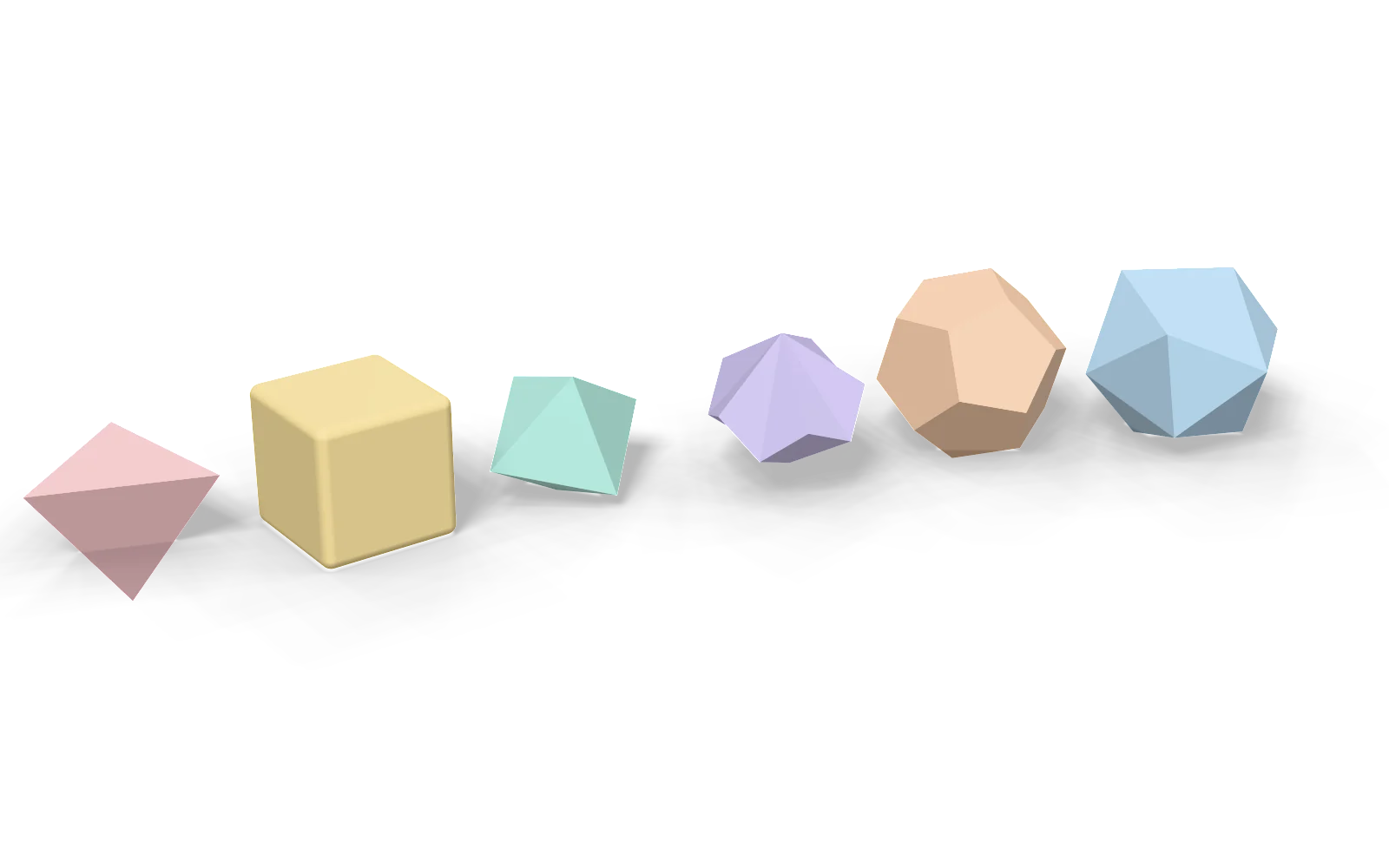
The Six Dice Types and Their Sizes
Dice are named with a D and the number of faces, so a D6 has six faces and a D20 has twenty. The table gives each shape, the size of the standard "16 mm set" and the other common sizes we make. There is no regulated size for dice; these are the sizes the industry uses, measured face to face where a die has two flat faces opposite each other, and point to point where it does not.
| Die | Shape | Size in the standard set | Other common sizes | Used for |
|---|---|---|---|---|
| D4 | Tetrahedron, a pyramid of four triangles | About 20 mm along the edge, 17 mm tall | 17, 20 and 22 mm; 16 to 27 mm | Small random numbers, damage rolls |
| D6 | Cube | 16 mm | 12, 18, 20 and 25 mm; 12 mm and up | Nearly every family and dice game |
| D8 | Octahedron, eight triangles | About 16 mm | 16, 18 and 24 mm; 16 to 30 mm | Health trackers, 1 in 8 odds |
| D10 | Pentagonal trapezohedron, ten kite-shaped faces | About 16 mm | 16 and 21 mm; 16 to 27 mm | Percentages, with a second D10 in tens |
| D12 | Dodecahedron, twelve pentagons | About 18 mm | 18 and 22 mm | Larger ranges, months, hours |
| D20 | Icosahedron, twenty triangles | About 20 mm | 20, 22 and 23 mm; 20 to 29 mm | Role-playing games and dungeon crawlers |
A few notes on the shapes. The D4 has no face-up number, so its numbers are printed at the corners or along the edges. The D8 gives a 12.5 percent chance per face, which is why designers pick it when a D6 is too coarse and two dice are too many. The D12 and D20 are the two shapes that look the most like a ball and roll the longest.
How Dice Sizes Work
The standard dice size is 16 mm, measured on the D6 face to face. Dice sizes move in steps of 2 mm: 12, 14, 16, 18, 20 and so on up to about 30 mm, then in steps of 5 mm. 14 mm dice exist but are hard to find, so a small die is usually 12 mm and a big one 20 or 25 mm. The other shapes come in far fewer sizes than the D6, because they are nearly always used next to a 16 mm D6; if your game uses a D8, D10, D12 or D20, stay with the standard sizes. Custom D10 dice, with your own numbers or symbols, follow the same rule. A "16 mm set" means the D6 is 16 mm and the other shapes are made to match it in the hand, which is why the D20 in such a set is about 20 mm tall and the D4 about 20 mm along its edge. If you need a dice size chart for your box or insert, use the table above and add 1 mm of play around each die.
What Dice Are Made Of
Board game dice come in four materials. Each one changes the look, the sound on the table, the weight and the price.
- Acrylic dice. The standard. Acrylic dice are made in big injection moulds that produce about 100 dice per shot, which is why they are cheap in quantity. They come opaque or translucent, in any colour, with round or sharp corners, and every shape from D4 to D20. Most of the dice in the world are acrylic.
- Resin dice. Resin is liquid acrylic poured into silicone moulds. It is the material for small runs and for shapes that have never existed: a new polyhedron, a themed die, a die with an engraved symbol on every face. The moulds are cheap, the handwork is not, so resin dice cost more per die than acrylic.
- Wooden dice. Wooden dice are cut from wood panels with a knife and are made as D6. The other shapes can be made in wood, but the faces come out uneven and the print does not align, so we strongly advise against them unless the game is strictly eco-friendly. 16 mm is the classic size, with 20 and 25 mm available. The pips are printed by default; laser engraving is possible for large runs. They suit eco-friendly games and a natural look.
- Metal dice. Metal dice are zinc alloy or iron, cast and then finished by hand. The colour on an engraved metal die is dropped into each face by hand, which is a beautiful process and allows many custom designs. The mould is not expensive, about 600 USD. The downside is weight: metal dice are heavy, need a proper dice tray to roll in, and stay mostly in dungeon-crawl and role-playing games with a premium edition.
The old "cheap plastic" die is a resin or low-grade acrylic die; it exists at the very bottom of the market and is not what we recommend for a game that should feel good.
How Custom Dice Are Made
Custom dice start as blank dice or as a custom mould, and then get their faces in one of four ways:
- Ink filler. The standard method. The symbol is engraved into the face and filled with colour by an ink injection machine. One colour per die; gold ink is possible at an extra cost. For small runs the dice are cast in resin from silicone moulds and the machine is adjusted for them; for large runs we customise the big acrylic moulds directly.
- Screen print. A one-colour icon printed on a blank face. The cheapest way to put a symbol on a die.
- Heat stamp. A pre-printed film pressed onto the face, for icons with several colours.
- UV print. Full colour printed straight onto the face, no mould, for very small runs and prototypes.
All four work on every shape from the D4 to the D20, but a D20 has twenty faces to print, so it costs the most. Laser engraving is used on wooden dice and on some acrylic dice; for acrylic it is the older method, and resin engraving gives better results today.
What Custom Dice Cost
The numbers below are our factory prices, converted from RMB at about 7 to the dollar, so treat them as a guide.
- Printed faces. A screen-printed or heat-stamped face costs 0.02 to 0.03 RMB, well under one cent, plus a mould of about 70 USD per colour. A D6 with one icon on every face is six prints.
- Engraved resin dice. The mould is about 70 USD and each die 0.54 to 0.73 RMB, about 0.08 to 0.10 USD, depending on the complexity of the engraving.
- Laser-engraved wooden dice. A 500 USD mould, a minimum run of 40,000 dice, and about 0.05 USD per engraved face.
- Metal dice. A mould of about 600 USD, then a per-die price that depends on weight and the hand finishing.
- Prototypes. A standard die is 1 USD. A custom printed die is 2 USD plus a 150 USD mould. A custom engraved die is 3 USD plus a 300 USD mould.
Dice are a small part of a game's cost unless the game is a dice game. If you want a roll with more drama, a cardboard dice tower cut from a token sheet is cheaper than any metal die; our guide to board game tokens explains how those 3D structures are made. For the other components, start with the board game pieces overview, and when you are ready for a quote, the board game manufacturing page shows how it works.
Frequently Asked Questions
How many types of dice are there?
What is the standard dice size?
What are dice made of?
How much do custom dice cost?
Talk to Our Team About Creating Your Board Game
From design to manufacturing, we can help you with every aspect of turning your game concept into reality.