
Board Game Tokens, Chits and Tiles
 By Hersh Glueck
Board game tokens are the small cardboard pieces that players punch out of a sheet before the first game. They stand for coins, resources, wounds, markers and characters, and the larger ones become tiles that build the playing area. Small tokens are also called chits, counters or markers. The sheet they come in is a punchboard, also written punch board, or token sheet. This guide covers the types of game tokens, how they are made, the sheet sizes, custom shapes and cutting lines, standees, and whether tokens come punched out.
Check Out Our Free Resource: Guide For Selecting Components
This guide helps board game designers select ideal components and quantities.
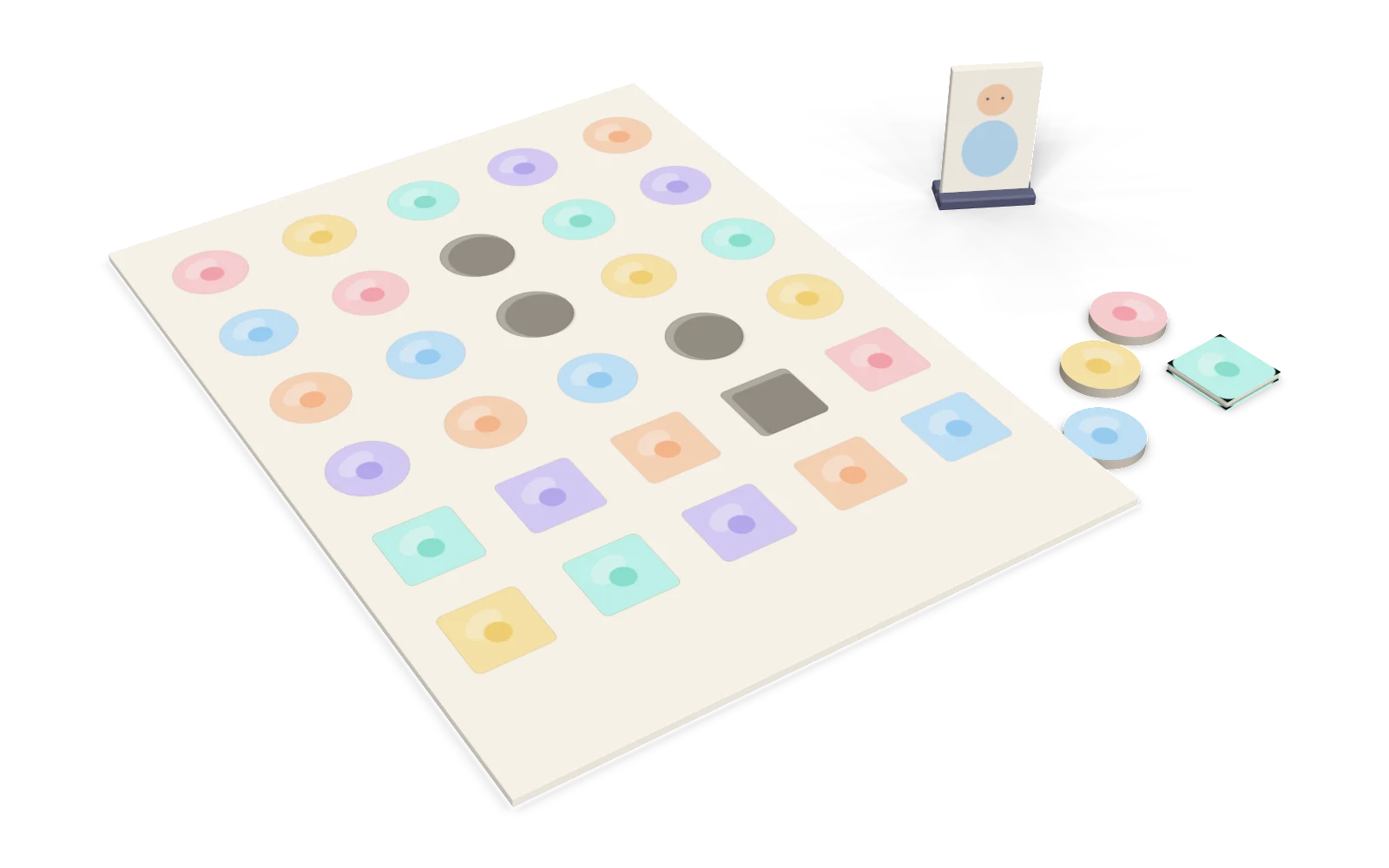
Types of Game Tokens
Cardboard tokens can play any part your game needs. The four types of game tokens are:
- Resource tokens. Coins, raw materials, goods, gold, wounds, victory points: anything players collect and spend.
- Tiles. Larger pieces, square or hexagonal, laid on the table to build a modular board or a specific zone. Map tiles are the biggest of them.
- Character tokens and standees. A character printed on cardboard and placed in a plastic stand, instead of a wooden meeple or a plastic miniature.
- Item tokens. Artefacts, equipment, buildings and other game elements, cut to the shape of the thing they show.
Board game chits is the older word for the small ones, from the wargames where every unit was a small square counter. On this page we call them all tokens.
Games That Use Tokens
Almost every board game has tokens. Among the games with tokens that we like as examples: Catan uses hexagonal tiles as land and small round tokens as numbers; Gold West (Tasty Minstrel Games) uses tokens as its resources; City of Horror (Repos Production) uses cardboard tokens on stands as its characters; and My First Ice Age (Z-Man Games) uses them as items, houses and more. If a game tracks anything, it usually tracks it with a token.
How to Make Board Game Tokens
Tokens are not made one by one. A whole sheet is made at once, in four steps. First, the artwork is printed on thin paper, never straight onto the cardboard. Second, the printed paper is glued to both sides of a cardboard core; the usual build is 250 gsm paper, 1.5 mm high-density cardboard and 250 gsm paper, which makes a token about 2 mm thick in the hand. Third, the sheet gets an oil varnish, which protects the print; lamination is avoided on token sheets, because the plastic film stretches in the cutter and spoils the punch-out. Fourth, a cutting die stamps the token outlines and the punch-out lines into the sheet, so the tokens stay in place until a player pushes them out.
The cardboard comes in 1 mm, 1.5 mm, 2 mm, 2.5 mm and 3 mm. Our guide to token sheet thickness explains what each feels like and costs, and our token sheet cost guide shows how the sheet layout sets the price.
Token Sheet Sizes
Tokens are printed on a sheet of 280 × 420 mm, the largest sheet the token cutter takes. That printing sheet is not the token sheet in the box: it is cut into the smaller sheets that fit your game box. The table shows the standard token sheet sizes and how many of each come out of one printing sheet, with the 6 mm cutting margins included. Pick the size that fills the printing sheet and fits your box, and you pay for no empty paper.
| Token sheet size | Per 280 × 420 mm printing sheet | Typical use |
|---|---|---|
| 90 × 140 mm | 9 | Small boxes, card-game boxes |
| 90 × 200 mm | 6 | Small and medium boxes |
| 140 × 200 mm | 4 | Medium boxes |
| 200 × 240 mm | 2 | Medium boxes |
| 200 × 270 mm | 2 | The standard square-ish box |
| 270 × 270 mm | 1 | Large square boxes |
Map tiles are larger and come punched out, so they can use a bigger sheet, up to 420 × 560 mm. For a large print run we can also cut a custom sheet from the master sheet, up to a six-opening sheet of about 390 × 440 mm, when that saves processing cost.
Custom Tokens: Shapes and Cutting Lines
Every token sheet is custom. There is no library of moulds for round tokens or square tokens that a game can pick from: each game gets its own cutting die, made from its own cutting line. So any shape is possible, and custom tokens cost no more than plain ones. The cutting line has five rules:
- Keep at least 6 mm between two cutting lines, and 6 mm between the edge of the sheet and the first line.
- Keep at least 1.5 mm between the cutting line and the important content of the token, so nothing is cut off and nothing looks misaligned.
- No sharp corners. Cardboard frays at a point, so every corner on the cutting line gets a radius of at least 1 mm; 2 mm is our recommendation.
- No long, thin parts and no narrow gaps. For a walking dinosaur, the cutting line does not trace each leg; it runs around the outside of both legs and keeps the radius, as in the picture below.
- The smallest token the cutter can make is 10 mm, and borders on tokens are not recommended, because a 3 mm shift in gluing or cutting makes a border look uneven.
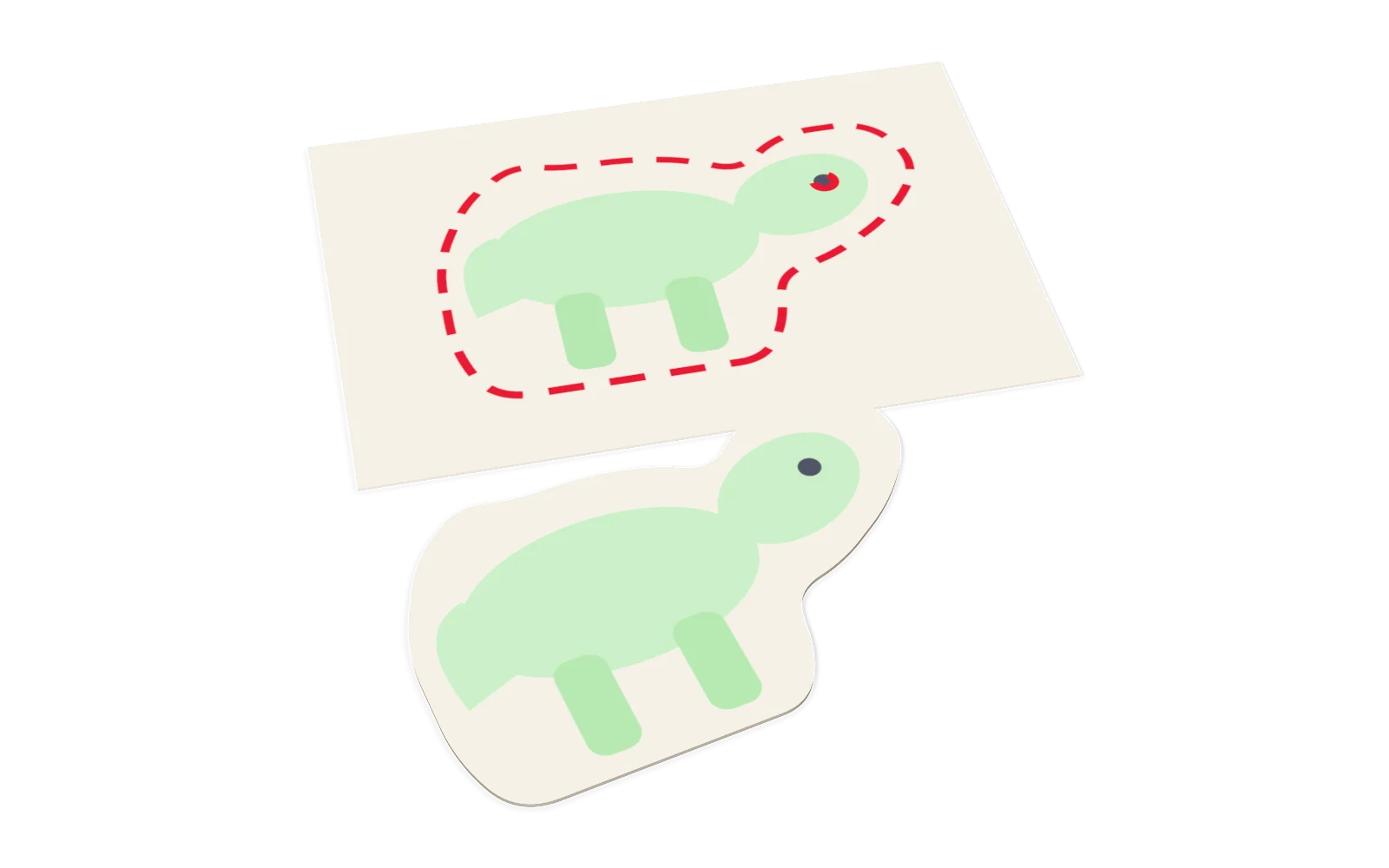
For the files, we need all the tokens already placed on the sheet size your game uses, and the cutting line as a separate layer in a vector file (SVG or AI), not a traced JPEG or PNG. That line feeds the laser cutter that makes the die. If you need help drawing the line or arranging the tokens on the sheet, we are glad to do it.
3D Cardboard Structures: Dice Towers, Chests and Inserts
Tokens do not have to stay flat. The same token sheet can hold the pieces of a 3D structure that players assemble: a cardboard dice tower, a treasure chest, a pyramid, a tray, a dial or even a simple insert. Adventure games use them to put a real object on the table at cardboard cost. The pieces are cut on the token sheet like any token and lock into each other with slots and tabs, so the design has three rules: the tabs must lock tightly and line up exactly, a slot is cut slightly shorter than the widest part of the tab it holds, and the angle of a protruding part is kept at 170 degrees or more, so nothing snaps off. Some shapes need to fold instead of lock. For those we add a fold line on top of the token cut itself, in a separate fold-line step, and the sheet is then glued without wrapped edges. Dials are the simplest case: the parts come on the token sheet with plastic rivets in the box, and players assemble them. We have an in-house token punch-out artist who designs these pieces, so send us the idea before the artwork.
Cardboard Standees
Many tokens are used as standees: a character printed on cardboard, held upright by a small plastic stand. The standard plastic stands take a 2 mm token and are 4 mm high, so add a plain tab of at least 4 mm under the figure's feet for the stand to grip. Keep the important artwork above the tab, and give the figure a solid base, not thin legs, so it does not bend in the stand. Cardboard standees are the cheapest way to put characters on the table; plastic miniatures are the premium alternative, covered in our board game pieces overview.
Do Tokens Come Punched Out?
No. Tokens ship still in their sheet, and players punch them out before the first game. Small pieces in large numbers would get lost in the box, and tokens left in the sheet arrive in mint condition. Large map tiles are the exception: they are big and few, so they almost always come punched out. One thing to plan for: the sheets lie on top of the insert in the box, so once the tokens are punched out there is empty space in the box. Give the loose tokens a slot in the insert, or a bag, from the start.
Frequently Asked Questions
What are board game tokens made of?
What is the difference between a token, a chit and a tile?
Do board game tokens come punched out?
Can tokens be made into 3D structures?
Which games use tokens?
Talk to Our Team About Creating Your Board Game
From design to manufacturing, we can help you with every aspect of turning your game concept into reality.