
A Hero Time blog on board game rulebook design, visual clarity, and player-friendly tabletop onboarding.

You crack open a shrink-wrapped box at game night. The meeples are thick, the artwork is gorgeous, the cards feel good in your hand — and then you reach for the rulebook. Twenty minutes later, three of your friends are arguing about paragraph four, someone is desperately flipping back to page eleven, and the mood has officially died.
We’ve all been there. And every great publisher — from indie creators launching their first Kickstarter campaign to giants like Blizzard and Mojang Studios licensing their universes for tabletop — knows that the rulebook is the silent gatekeeper of every great game. Stunning mechanics die behind confusing prose. Brilliant rules live forever when they’re written with care.
Here’s everything the Hero Time team has learned about turning a wall of text into the first reason your players fall in love with your game.
- Nail the Structural Hierarchy First
A great rulebook isn’t a novel, and it isn’t a spreadsheet. It’s a technical manual disguised as an invitation. Players should be able to learn from it on their first read, and reference it mid-game without losing momentum. That only works when the structure is built on a clear hierarchy.
The best proof is in the geometry of the industry: when Blizzard Entertainment licensed the Warcraftt universe to Days of Wonder, the resulting Small World of Warcraft (2020) shipped with a rulebook that followed the exact eight-part blueprint below, section for section, because the Small World line has spent over a decade refining it. If a $5B franchise trusts this structure, so can you.
Treat your rulebook like an eight-part blueprint, in this exact order:
- Front Cover — The hook. Game title, subtitle, your logo front and center, and a single piece of evocative art that telegraphs the mood before a single word is read.
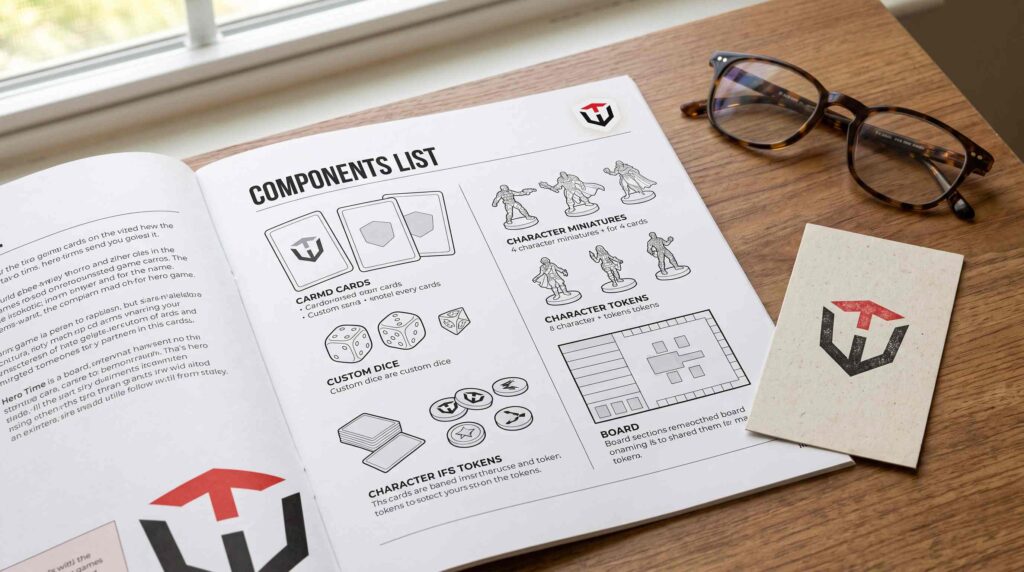
- Components List — A visual inventory of every token, card, die, and tile in the box. New players will check this immediately during unboxing, so make it impossible to miscount. Ravensburger’s Minecraft: Builders & Biomes does this brilliantly — every wooden cube, mob figure, and treasure tile is photographed, numbered, and cross-referenced to its stack on the variable setup grid.
- The Pitch & Theme — A two-to-three sentence summary of the world, the lore, and the core fantasy. Give players a reason to care before you give them a rule.
- Core Objective & Win Condition — Tell them how the game ends, and how someone wins, right up front. Never bury the victory condition like a plot twist.
- Setup — Step-by-step instructions for arranging the board, dealing cards, and distributing starting resources, ideally paired with a top-down diagram.
- Gameplay / Turn Structure — The core loop. Phase by phase, what a player actually does on their turn.
- Step-by-Step Walkthrough — A guided example using real components so players can shadow a full round before they ever touch the cards.
- End Game & Tie-Breakers — Detailed triggers for game termination and how to handle ties.
- Detailed Rules, Edge Cases & Special Interactions — A dedicated home for clarifications: what happens when two abilities trigger at once, what overrides what, and any “you can NOT do X” hard rules. Never scatter these across the book — players need one place to find them.
- Back Cover — Quick-reference aids, turn summaries, icon legend, glossary, and an index.
Hero Timee tip: Print the eight-to-ten section headers in this exact order across the bottom corners of every page. Players will always know where they are in the book, even when they’re panicked-searching on turn five.
- Adopt the Golden Rule: Teach, Then Reference
One of the most common rookie mistakes is trying to write a rulebook that teaches and references at the exact same time. It can’t be both. Pick a lane for every paragraph:
- The First Read (Teaching Mode): Use a chronological, conversational tone. Imagine you’re leaning across the table, explaining the game to a friend over coffee. Walk them through the flow naturally.
- The Mid-Game Check (Reference Mode): Use bold keywords, sidebars, and explicit sub-headings. When a player needs to check a specific interaction on turn four, they don’t want to re-read a story — they want to scan the page in five seconds and find their answer.
Print them in different visual styles. Hero Time Manufacture likes using warm prose blocks in cream paper tones for the teaching chapters, and stark, high-contrast reference pages with thick borders and big heading tags for the lookup sections. Players learn the visual cues within minutes and instantly know where to look.
This is also why the Kickstarter tabletop creators who run lean, transparent rules are the ones whose campaigns cross their funding goal the fastest — backers can teach themselves the game in under ten minutes and start evangelizing before the box even ships. Clear rules aren’t a luxury; they’re a marketing engine.
- Visual Design Is Your First Line of Defense Against Bad Reviews
Players don’t read anymore — they scan. If your rulebook is a wall of text, you’ve already lost. Visual clarity is your single best defense against refund emails and post-launch customer-support tickets.
- Show, don’t just tell. Whenever you’re explaining setup, spatial movement, scoring areas, or card flow, use annotated callouts, arrows, and real photos or renders of your components. Minecraft: Builders & Biomes is the gold standard here — every cube placement, Overworld action, and biome stack is illustrated with arrowed callouts because the cube-grid setup demands visual instructions.
- Lock down your terminology. Never, ever use two different words for the same game element. If a component is called a Resource Token on page 2, do not call it a Gold Piece, a Credit, or a Coin on page 8. Consistency is the difference between a clean game night and a shouting match. The Small World of Warcraft manual kept the Warcraft lore intact (Horde, Alliance, Azeroth races) while reusing the exact Small World verb set throughout — conquer, decline, redeploy. That kind of cross-version consistency becomes a brand asset across multiple products.
- Color-code your phases. Associate each major game phase or board region with a distinct accent color and icon. Then mirror those exact icons on the physical components — cards, player boards, dice — so players instantly connect what they hold in their hands to what they read on the page.
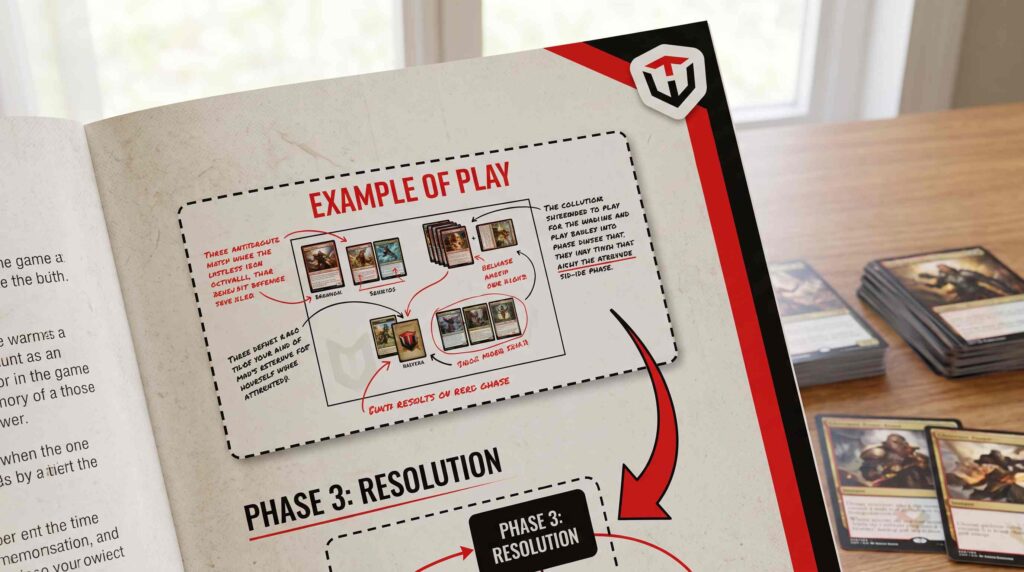
- Use callout boxes liberally. Break up any wall of text with shaded sidebars for: Examples of Play — short, boxed scenarios showing a rule in real action. Designer Notes — strategy hints and clarifications of edge cases. Warnings & “Do NOT” Rules — hard constraints (e.g., “You cannot pass your turn voluntarily”).
- The Iterative Testing Workflow (Where Great Rulebooks Are Actually Born)
You cannot write a rulebook in a vacuum. A rulebook isn’t done until it survives the most brutal test in game design: human nature.

- Step 1 — Blind Playtesting: Hand the game and a clean draft of the rulebook to a group of playtesters without you in the room to explain anything. Sit behind one-way glass (or just the kitchen counter), watch silently, and write down every moment they hesitate, flip pages, or misinterpret a mechanic.
- Step 2 — The “ELI5 (Explain Like I’m 5) ” Rewrite: Wherever a player stumbles, rewrite that section in simpler language or — better — add a visual example. If a five-year-old couldn’t roughly follow the rule after hearing it once, the prose is doing too much work.
- Step 3 — Lock the Content, Then Lay It Out: Once the rules are frozen, get out of your word processor. Move the manuscript into professional desktop-publishing software like Adobe InDesign or Affinity Publisher. These tools handle typography, bleed lines, gutters, and grid alignment in ways Word and Google Docs never will.
- Step 4 — Community Proofreading: Share the PDF in tabletop designer communities (BoardGameGeek forums, Discord design servers, the Hero Time publisher network) or hire dedicated board-game proofreaders. Fresh eyes will catch typos, missing edge cases, and ambiguous phrasings that you are simply too close to the project to notice yourself. This is also where Kickstarter backer communities become a free QA army — early-access backers will flag broken rules faster than any internal team.
- Step 5 — Final Read-Aloud Pass: Read every page out loud. If you stumble, the player will too. Smooth every sentence until it flows.
Hero Time tip: Even AAA licensed releases like Small World of Warcraft went through multiple blind-test cycles before the Blizzard lore drop hit shelves. If a publisher with a Warcraft franchise license still treats playtesting as non-negotiable, neither should you.
- The Industry Tools Hero Time Trusts
To study what “professional” actually looks like, arm yourself with the right resources from day one:
- Manufacturer Layout Templates — Review the structural and bleed-margin specs provided by your manufacturing partner (Hero Time works with a network of specialists who share templates covering page size, binding, and folding specs before a single page is laid out).
- Desktop Publishing Software — Adobe InDesign or Affinity Publisher for full rulebook layouts; Canva for fast, lightweight independent projects; Adobe Illustrator or Figma for diagrams, iconography, and custom infographics.
- The Inspiration Shelf — Keep award-winning rulebooks on your desk. The Wingspan, Carcassonne, and Scythe manuals (alongside modern hits like Small World of Warcraft and Minecraft: Builders & Biomes) are masterclasses in index design, component checklists, and iconography. Learn from their structural tricks — then add your own fingerprints.
- Hero Time Community Resources — Subscribe to the Hero Time for free downloadable templates, icon packs, and quarterly breakdowns of what worked (and what flopped) in our published rulebooks.
