
What separates a forgettable prototype from a board game people recommend for years? Why do some card games disappear after one demo night, while others become staples at family tables, hobby shops, and crowdfunding campaigns?
If you are building a boardgame, card game, or social tabletop experience, your biggest threat is not bad luck, weak art, or even a limited budget. It is untested design.
Playtesting is where the truth shows up. It is the moment your mechanics leave your imagination and collide with real players, real decisions, and real confusion. It reveals what feels exciting, what drags, what breaks, what needs simplification, and what players genuinely want to do again.
Skip proper playtesting, and the consequences are brutal. A board can become so cluttered that it triggers analysis paralysis. A scoring system can reward one dominant strategy and make every other path feel pointless. A rulebook can confuse players so badly that the game never gets a second chance.
At Hero Time, we believe great games are not discovered by accident — they are refined through disciplined testing, sharp observation, and the willingness to improve what is not working yet. If you want your board game design, card game mechanics, and tabletop game development process to stand out in a crowded market, you need more than a clever idea. You need a playtesting process that is honest, rigorous, and repeatable.
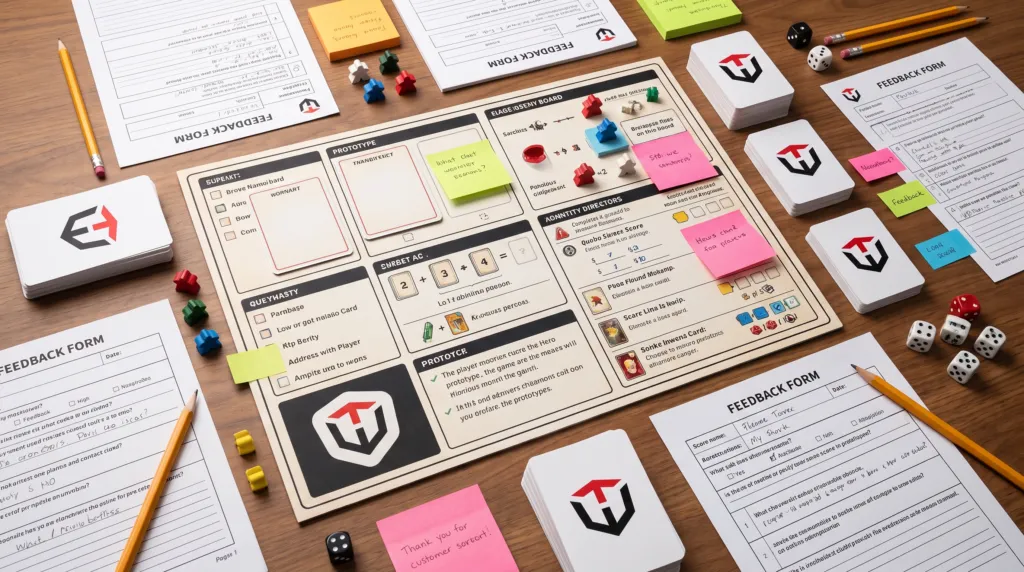
To help you get there, here are five essential rules that form the foundation of better boardgame and card game playtesting.
- Test forReplayability, Not Just a Good First Impression
A game that gets one polite “that was nice” is not ready.
A great tabletop design has to survive repeat plays. That means your playtesting cannot stop at whether players understood the game once or enjoyed a single session. You need to learn whether the experience still feels fresh after people know the rules, recognize the patterns, and start pushing on the system harder.
This is where replayability becomes your most important long-term metric. Ask yourself whether different strategies are truly viable, whether varied setups create meaningfully different decisions, and whether players are curious enough to try a second or third run immediately. If everyone finishes a session and says, “Okay, now I want to try a different approach,” you are onto something real.
Replayability is often the dividing line between a prototype with promise and a finished product with staying power. Games that last in the market usually offer discovery beyond the first session. They do not just work once — they invite return visits.
That principle is one reason enduring titles continue to thrive across generations of players. According to the official CATAN site, CATAN has grown into a global phenomenon available in more than 40 languages and with more than 45 million games sold worldwide — a reminder that when a core tabletop system keeps players coming back, the ceiling can become enormous.
[Source: https://www.catan.com/about-us]
- Listen to Feedback Carefully — But Interpret It Intelligently
One of the biggest mistakes new designers make is treating every playtester comment as a direct instruction.
A player might say a mechanic is broken when what they really mean is that they felt powerless. Another might insist a rule should be removed, when the real issue is that the rule was introduced too late or explained too poorly. Raw feedback matters, but unfiltered feedback can be dangerous.
Your job is not to obey every comment. Your job is to understand the emotion behind it.
That means looking for patterns instead of reacting to isolated complaints. If multiple groups stumble in the same place, you likely have a structural problem. If one frustrated player loses and immediately suggests nerfing the mechanic that beat them, you probably have a data point — not a design verdict.
This is one of the most valuable mindsets in professional game development: listen generously, but diagnose carefully. Comments tell you where the pain lives. They do not always tell you how to fix it.
Game designer Matt Leacock, best known for Pandemic, described a development process that begins alone, then expands to friends, family, friends of friends, and eventually strangers, all while he listens, observes, and refines. He also emphasized the importance of showing your work to as many people as possible and learning from what actually happens at the table rather than simply defending the original idea. That is excellent advice for any creator building a more resilient board game or card game.
[Source: https://andhegames.com/how-matt-leacock-designer-of-pandemic-makes-games/]
- Simplify Ruthlessly Until the Fun Is Obvious
Playtesting does not just show you what players like. It shows you what they should not have to fight through.
Many prototypes fail not because the idea is weak, but because the design is carrying too much weight. Too many exceptions. Too many subsystems. Too many components. Too many board game rules doing too little. Complexity is not automatically depth, and clutter is not automatically richness.
The stronger your game becomes, the more likely it is that you will need to remove something.
That can be painful. Designers naturally fall in love with the mechanisms they worked hardest to invent. But the table does not reward effort — it rewards clarity, pace, tension, and delight. If a rule adds friction without adding excitement, it is a candidate for the cutting room floor.
This is exactly why simplification is not a compromise. It is a competitive advantage.
Klaus-Jürgen Wrede said that early versions of Carcassonne were more complex, but his goal was to create a game with simple rules and strategic depth. That design philosophy helped produce one of the most accessible and influential modern board games of its era. It is a useful reminder that elegance is often the result of disciplined subtraction, not added complication. [Source: https://brettspillguiden.no/wordpress/interview-with-klaus-jurgen-wrede/]
- Test with Fresh Players Who Do Not Think Like You
Designers suffer from a hidden curse: they already know how the game is supposed to work.
You know what every icon means. You know what every card is intended to do. You know why an exception exists and what the player should infer from a phase title or scoring symbol. New players do not know any of that.
That is why broad testing matters so much.
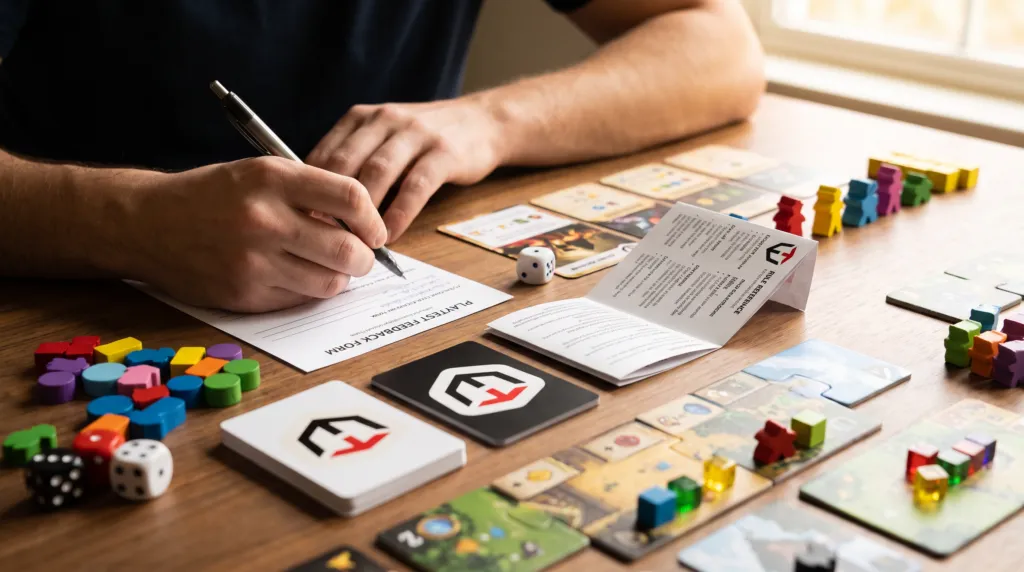
If you only test with close friends, seasoned hobby gamers, or people already invested in your success, you will get a skewed picture of the experience. You need new eyes. You need players who skim rulebooks, misread symbols, ask basic questions, and reveal where your design assumptions are doing too much invisible work.
Fresh groups expose the truth fast. They show you where the turn structure feels unnatural, where onboarding is too slow, where terminology is unclear, and whether your game can survive without you hovering nearby to rescue it.
Matt Leacock’s process offers a strong model here as well: start narrow, then deliberately widen the testing circle. Solo sessions and friendly groups can help identify big structural issues, but strangers reveal whether the game stands on its own. That transition from protected testing to independent testing is where many important design flaws finally become visible. [Source: https://andhegames.com/how-matt-leacock-designer-of-pandemic-makes-games/]
If your long-term goal includes retail shelves, convention demos, or a successful Kickstarter board game campaign, this kind of testing is non-negotiable. The market does not care whether your intention was clear. It only cares whether the game feels clear to players.
- Give the Design Enough Time to Mature
Great games are rarely finished on the first schedule you imagined.
One of the most underrated skills in game development is patience. Not lazy delay — disciplined patience. The kind that lets you absorb feedback, sit with your notes, rework a mechanic thoughtfully, and test again without forcing an answer too early.
Sometimes the right move after a playtest is immediate revision. Sometimes it is distance. A mechanic that felt promising yesterday may clearly be dead weight after a night of reflection. A scoring system that seemed broken may only need a small timing adjustment. Good designers learn how to separate urgency from progress.
This matters even more with larger, more ambitious tabletop games.
In an interview about Gloomhaven, Isaac Childres explained that he was inspired to begin working on the game in the summer of 2013, but that development did not begin in earnest until the start of 2015. The game reached shelves roughly two years after that point. In the same interview, he also reflected on production issues caused by rushing processes to meet promised delivery timing, a reminder that both design and manufacturing suffer when timelines become unrealistic.
[Source: https://planszowkiwedwoje.pl/2018/05/interview-with-gloomhaven-designer/]
That lesson applies to smaller games too. If you rush the playtesting cycle, you often end up publishing your unresolved problems instead of solving them.
Time is not the enemy of a good game. In many cases, time is what allows a good indie board game or card game prototype to become great.
Final Thought: Playtesting Is Where Good Ideas Become Real Games
A prototype is only a promise. Playtesting is the proof.
If you want your boardgame, card game, or tabletop concept to succeed, do not treat testing as a formality between idea and launch. Treat it as the heart of development. This is where replayability is uncovered, confusion is exposed, mechanics are trimmed, feedback is decoded, and the true identity of your game begins to emerge.
The most successful creators are not the ones who protect every early idea. They are the ones who test honestly, simplify bravely, and keep refining until the game earns its place.
Test for replayability. Interpret feedback with care. Simplify without mercy. Put the design in fresh hands. Give it time to mature.
That is the blueprint behind better games — and it is the difference between a concept that fades away and a tabletop experience people come back to again and again.
