
Just like cards, tokens and wooden game pieces, your choice of dice can have a real impact on the look, feel and gameplay of your board game.
Custom dice are used to play your game. Dice can add randomness to your game, bringing in a luck factor that can make the game experience more spontaneous and fun. Some games use a single die, while others may use two, three or more dice as part of gameplay.
There are several different types of dice used for board games and card games, including:
- D4 dice
- D6 dice
- D8 dice
- D10 dice
- D12 dice
- D20 dice
Each type of dice can be made in several ways. For example, D6 dice can be customized with your printed image or custom engraving, while other dice can be customized by engraving the dice using machinery.
We manufacture all of these types of dice, with numerous color and material options available for some dice types. You can contact us to learn more about the different types of custom dice available for your board game or view our dice online.
The type of dice you choose for your board game, as well as the manufacturing method for the dice, can influence how your board game is played and affect its production cost.
Below, we’ve explained the standard sizes for custom dice, common dice materials, as well as what you should know when you start making custom dice for your game.
Standard Dice Types and Sizes
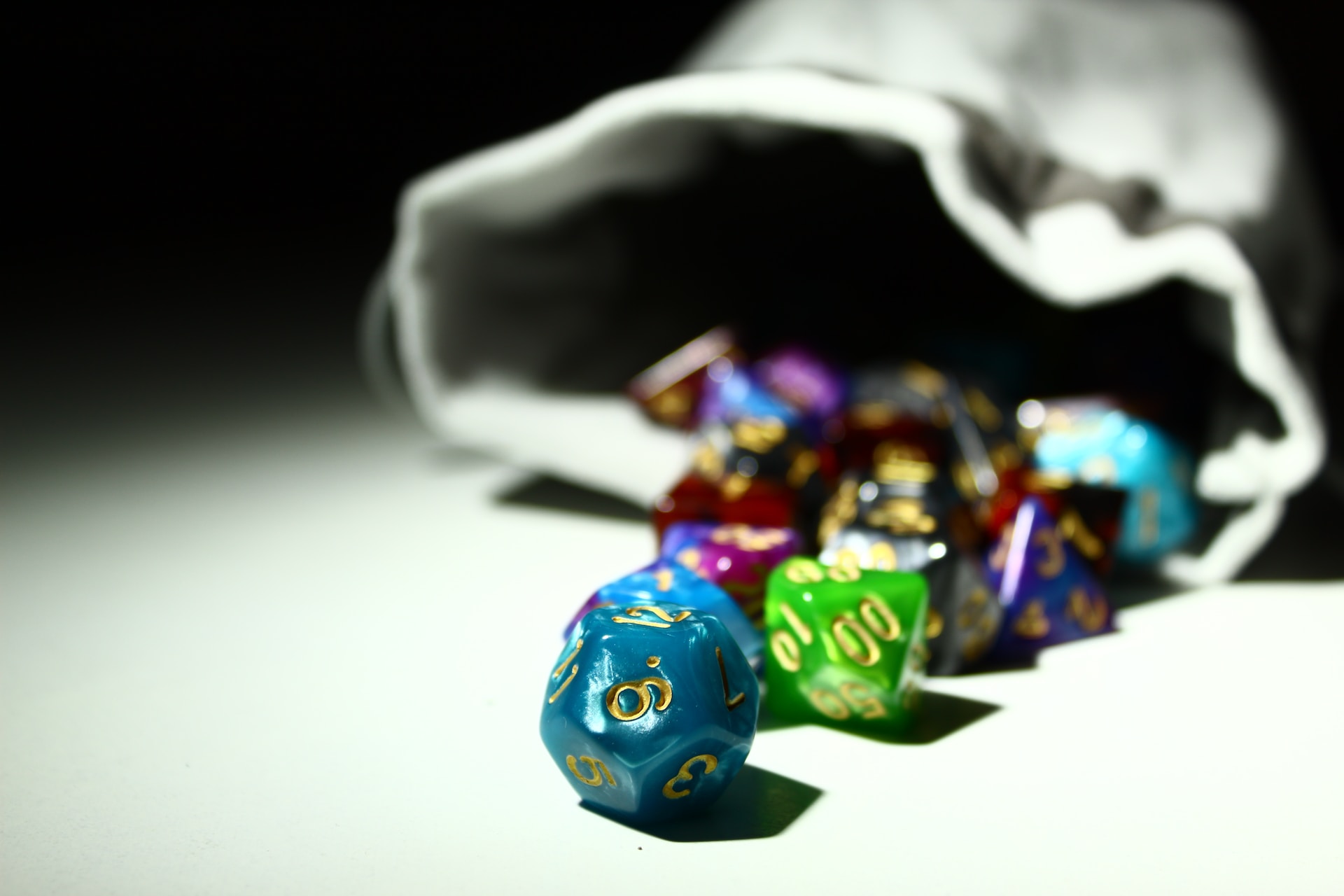
Dice come in several different shapes and sizes, from four-sided dice that offer a limited range of potential outcomes to larger, more complicated dice with 10, 12 or 20 sides and a far greater range of outcomes during gameplay.
Dice use a simple naming system — the letter “D” followed by the total number of different sides on the dice. For example, a “D6” dice (the most common type of dice) has six sides, whereas a D20 dice has 20.
It’s physically possible to create a dice with just about any number of sides (for example, a tiny ball is effectively a “D1” dice, while a coin can act as a “D2” dice). However, most dice used for board games and card games come in one of six common sizes.
D4 Dice
D4 dice, or four-sided dice, are pyramid-shaped (tetrahedral) dice with sides. Dice of this type provide a random number between one and four and are used in all sorts of games, including certain board games and tabletop RPGs like Dungeons & Dragons.
Unlike other types of dice, which display a number face-up, there’s no single upward face on a tetrahedral dice. Instead, a variety of systems are used with this type of dice to determine which number has been rolled.
D6 Dice
D6 dice, or six-sided dice, are the most popular, widely-used dice in board games, card games and other tabletop games. When you hear the word “dice,” a six-sided dice is probably the type of dice that pops into your mind.
D6 dice are generally easy to manufacture and come in a range of sizes, colors and types, from printed dice to engraved dice. The most common sizes for D6 dice include 12mm, 14mm, 16mm (most common), 18mm and 20mm.
D8 Dice
D8 dice, or octahedron dice, are dice with eight sides. As you’d expect, dice of this type provide a random number between one and eight. You might see these dice called “regular octahedron” dice, which means they have eight identically-shaped and sized triangular sides.
Because dice of this type have eight sides, your odds of rolling any value are 12.5 percent. As such, you may want to consider this type of dice if your game needs more options than the D6 dice can provide, without the need to include two dice.
D10 Dice
D10 dice have ten sides. Dice of this type are usually pentagonal trapezohedrons (put simply, a ten-sided object with kite-shaped sides). With a D10 dice, you have a 10% chance of rolling any integer, or whole number, between one and 10.
Like other common types of dice, D10 dice are available in a large range of colors, printing and engraving options.
D12 Dice
D12 dice, or 12-sided dice, let players generate random numbers between one and 12. Dice of this type usually have a dodecahedron shape (a 12-sided object consisting of pentagonal faces) and display the rolled number facing directly upwards.
Just like with D10 dice, D8 dice and other common dice types, you can choose from a range of colors and manufacturing options for D12 dice.
D20 Dice
D20 dice, or 20-sided dice, let players generate a random whole number between one and 20 with each dice roll. You’ve probably rolled these dice plenty of times if you’re a Dungeons and Dragons player, or if you’re a fan of other tabletop RPGs that use the same type of dice.
Like other types of dice, D20 dice are available with a variety of printing and engraving options to let you tailor your custom dice to the needs of your board game.
Custom Dice Materials & Finishes
- Acrylic dice. Acrylic dice are widely used in board games and card games of all types and price points. These dice are typically shiny and have deep colors, giving them the classic board game dice appearance and feel.
Acrylic dice feature round or sharp corners. D6 acrylic dice can feature printed images, allowing you to easily customize your dice with your own printed graphics.
- Resin dice. Resin dice are ideal for customizing the shapes on your dice set. They can be engraved with different pips, numbers or shapes. Resin dice have a unique look and tend to maintain their appearance well over the long term.
Manufacturing resin dice requires the creation of a custom mold, leading to higher costs per unit than for acrylic dice.
- Polymer plastic. Polymer plastic dice have been used for decades for board games and dice games. Plastic dice are simple to use and highly affordable to manufacture, making them a common choice for most board games.
However, despite their low cost, plastic dice can have quality issues and may give your game a slightly “cheap” feeling.
- Wood. Wooden dice have a premium feel that can set your game apart from competing board games. However, they’re more expensive to manufacture, as they can’t be made in bulk using a mold and are only available in D6 dimensions.
Wooden dice look and function best with a natural color. The pips on wooden dice are printed on the wood, not engraved. - Metal zinc alloy. Zinc alloy dice are extremely sturdy and feel premium. They also offer better eco-friendliness than plastic dice. However, custom dice of this type are costly to produce and as such, typically aren’t used in mass market board games.
With zinc alloy and steel dice, coloring is performed manually drop by drop, allowing you to make any custom pattern.
You can also choose from a variety of designs and finishes for your custom dice, allowing you to tailor your dice to your specific game type:
- Custom printed dice. Custom printed dice can include images, symbols or other unique designs to suit your game. For example, you can print a specific type of item or resource onto each face of your dice to add randomness to your game.
- Classic pips. Classic board game and card game dice feature pips — small dots found on each face of the dice that denote the face’s value. Pips can be added to your dice in several colors and finishes.
- Numeral dice. Dice can be finished with a bold numeral on each side. Numeral dice are occasionally used for math games, and some players find them easier to read than dice with pips.
How Much Do Custom Dice Cost?
The cost of custom dice for your board game varies based on the type of dice you need and the quantity of dice you’d like to manufacture.
As the most common type of dice, D6 dice are generally the most affordably priced. Dice with a more complex geometry, such as D20 dice, cost more to manufacture and as such, are typically most expensive per piece.
Your choice of material can affect the cost of making custom dice for your game. For example, a set of wooden dice will cost more to produce than a set of simple acrylic dice, but may give your board game a premium feel that could be worth the additional manufacturing cost.
You can contact us to learn more about how much it will cost to design and manufacture custom dice in your preferred style and material for your board game.
