
As a board game manufacturer, one of the most common questions we’re asked is how long it takes to manufacture a game.
When creators ask this, the honest answer is: it depends on the complexity of your components and the type of production your game requires. The more complicated your needs, and the less your game uses standard components, the longer it will usually take to manufacture.
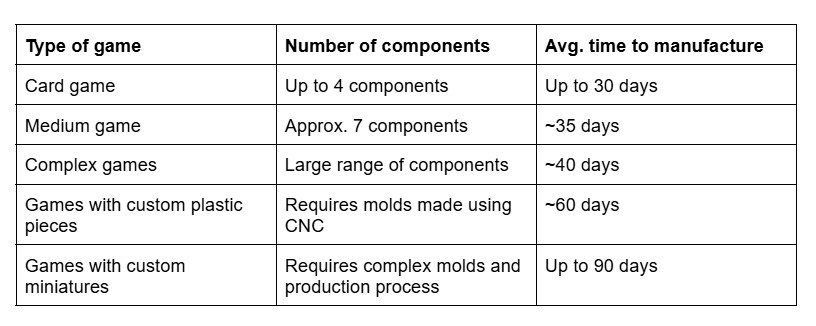
For a complicated game with lots of unusual components, not-yet-finished designs and complex production needs, the production process may take several months.>
However, if your game uses simple, standardized components and you have all of your designs ready to go, manufacturing your game can be a surprisingly fast process.
Below, we’ve gone into more detail about how long it generally takes to manufacture your game, with examples for the most common types of games we make.
If you’d like to get a production timeline or quote for your game, or if you have any questions for our team about manufacturing, feel free to contact us and we’ll help you take the next steps.
Typical Board Game Manufacturing Timelines
Since no two games are identical, we can’t provide a one-size-fits-all manufacturing timeline for making a board game. However, we can outline the typical ranges most publishers experience the first time they manufacture a game.
If you’re planning to make a simple card game — for example, a deck of cards with a tuck box — the manufacturing process is generally very fast because it relies on standard materials, simple printing and minimal assembly.
These games are usually completed in 4 to 6 weeks, assuming your game files are print-ready and there are no specialty finishes or custom components.
A standard board game with cards, punchboards, a game board, meeples or cubes and a box, requires multiple types of materials, production lines and coordinated assembly. These games typically take 8 to 12 weeks from the time production begins.
Finally, complex or heavily customized games, such as games that feature bespoke miniatures, custom dice, large numbers of components or unique packaging, tend to need more advanced processes and longer procurement timelines.
These titles often fall in the 12 to 20+ week range. Custom tooling alone can add several weeks to your game’s production timeline, and each new component type in your game introduces new QC steps.
These example timelines represent manufacturing only. They don’t include freight, artwork prep or prototypes, all of which can potentially increase the amount of time required to complete your game and get it ready for your backers or store shelves.
In our experience, most delays in making a board game happen before production even starts, especially when creators are finalizing their artwork, rulebook, or packaging.
Why Custom Components Take Longer to Manufacture
One of the biggest factors affecting your game’s manufacturing timeline is whether your game uses standard components or custom-made pieces.
The more your game relies on unusual shapes, custom tooling or non-standard materials, the longer the production process will usually take.
Standard components, such as standard-sized playing cards, common meeple shapes, board sizes and standard punchboard layouts, can be produced quickly because the factory already has the machinery, cutting tools and processes set up.
Materials are stocked, printing templates are established and QC systems are already in place for these components, meaning once you’re ready to start production, the process is quick and easy to implement.
Custom game components, on the other hand, introduce extra steps that must happen before production can even begin. This is where delays often happen.
Custom plastic pieces, for example, need the creation of a mold. Plastic tooling is a significant process that adds anywhere from 20 to 45 days to a game’s production time. If the mold needs to be tested and refined, additional time is often needed.
Custom wood or metal components often require special sourcing and multiple sample rounds to confirm shape, weight and finish. These materials sometimes need to be painted, lacquered or cut with precision equipment, each of which requires time and QC checks.
For all of these processes, the more detailed or irregular the piece is, the longer the tooling and testing takes, meaning a significantly longer production time.
Every new custom component also affects assembly. Non-standard game pieces involve slower packing, more careful handling and more QC processes, each of which adds extra time.
All of this means if you’re trying to keep your game’s production timeline short, the best method is to use standard component sizes and shapes wherever possible.
These simplify the manufacturing process a lot and mean your board game or card game can be made faster and at a lower cost.
Custom components are absolutely achievable, and we really like making them, but for you as the game creator, it’s important to know that they require planning for early so your timeline and budget remain predictable.
How Chinese New Year (CNY) Affects Board Game Production
Another factor that can influence your game’s manufacturing timeline is the timing of Chinese New Year. Chinese New Year is one of the most important holidays in China and the biggest annual disruption to manufacturing capacity across the entire world.
If you’ve never manufactured in China before, the impact of CNY can come as a surprise. For publishers planning a Kickstarter, retail release or reprint, it’s important to understand how this holiday works and how it will affect your production schedule.
Unlike Western holidays, Chinese New Year isn’t just a few days off. Most factories close for one to three weeks, and millions of factory workers travel to their homes in various provinces across the country.
After the Chinese New Year holiday, almost all factories need two to four additional weeks to hire, retrain and return to full operational capacity.
Because of this, the CNY period effectively removes four to six weeks from the manufacturing calendar. This is critically important to prepare for if your game has a time-sensitive production schedule.
In addition to time off during Chinese New Year, the real bottleneck happens before the holiday itself. In the six to eight weeks leading up to Chinese New Year, factories across all industries become busy as companies worldwide rush to finish production before the shutdown.
This pre-CNY rush creates longer queues for printing, component sourcing, assembly, QC and all other production processes.
The result is that timelines stretch, production slots become harder to secure and small delays, such as a late rulebook change or missing file, can potentially push your game past the holiday and slow down production by weeks or months.
To avoid this, we recommend finalising all of your files and locking in your game production slot by November if you want your game ready before or shortly after the CNY period.
If you miss this window, it’s completely fine, as manufacturing will still proceed normally, but the Chinese New Year holiday period needs to be part of your planning and your game’s marketing materials need to account for the fact that it will take longer to make.
If you’re unsure how Chinese New Year might affect your specific project or timeline, feel free to contact our team. We work closely with creators to help schedule production around the holiday and avoid unexpected delays.
How to Speed Up Your Board Game’s Manufacturing
While some parts of the manufacturing process are fixed, there are several steps you can take as a creator to significantly reduce delays and keep your timeline tight.
Like we mentioned earlier, almost all of the delays we see are not caused by production itself, but by factors that happen before manufacturing begins.
Below are the most effective ways to speed up your game’s production timeline and limit your risk of dealing with delays during manufacturing.
Have Clean, Print-Ready Files
The single most important factor in a smooth game production timeline is having your artwork, rulebook and packaging files fully ready to print.
Common issues that slow this stage down include incorrect bleed, margins, or dielines, artwork that’s low resolution or missing linked files, using RGB instead of CMYK and making updates to rulebooks or other components late in pre-production.
Our guide to the most common board game production problems lists these problems and gives solutions. We recommend reading this, especially if it’s your first time making a game, so you’re able to avoid the most common sources of delays before production.
If you need help preparing your files, feel free to let us know and we will help you get everything ready as early as possible before manufacturing starts.
Minimize Your Component Types
Each new component in your game type adds a new workflow. A game with 25 different small components will almost always take longer than a game with five well-defined ones.
If you want a faster and more predictable timeline, reuse the same card size for all your decks, keep punchboards consistent in size and thickness, and go for standard meeples, dice, cubes, tokens and other components wherever possible.
Standardization not only speeds up production, but it can also reduce your costs by making it easier to produce your game.
Respond Quickly During Sample and Pre-Production Stages
A large percentage of production delays come from waiting for approvals, especially for things like production samples, rulebook corrections and adjustments to artwork.
If you respond quickly during these stages, you can keep your production slot intact and avoid being moved behind another project.
Avoid Late Design Changes
Once your game’s production schedule has begun, even a tiny change can create ripple-effects through the entire process that slow things down a lot, increase costs, and create complexity for your game’s manufacturing timeline.
Locking in your design early and committing to it saves time and reduces cost. Make sure you’re totally committed to your game’s design before starting production.
Plan Your Manufacturing Around Seasonal Peaks
As mentioned in the previous section, the biggest seasonal disruption to game manufacturing is Chinese New Year. The next biggest is the Q4 rush, during which big publishers print games for the Christmas shopping season.
Starting early and booking your slot ahead of these peak periods can give you more predictable timelines and smoother communication.
The Bottom Line on Game Manufacturing Timelines
Manufacturing a board game can take anywhere from a few weeks to several months or longer, depending on how complex your components are, how prepared your art files are, and whether your timeline overlaps with busy periods such as the pre-Chinese New Year rush.
In general, simple, standardized games move quickly through production, while games that are heavily customized require more steps, more testing and naturally more time.
The key to keeping your game on schedule is planning ahead of time by finalizing your artwork early, using standard component sizes wherever you can and understanding where production bottlenecks usually happen.
With the right preparation, the manufacturing process is smooth, predictable and far faster than many new creators expect.
If you’d like help estimating a realistic timeline for your game, or if you want to start production and need guidance on components, materials or pricing, our team can help you.
Contact us and we’ll walk you through the next steps, give a production plan and help you get your game ready for backers, retail or your next big launch.
