
Requesting your first manufacturing quote for a board game can feel intimidating. You may not have your final artwork ready. You may not know exact component specs. You may be unsure how many copies you should even be producing.
That’s normal. What isn’t normal, but is extremely common, is sending a vague quote request and receiving vague pricing in return. When a manufacturer doesn’t have enough information, they’re forced to guess.
Those guesses can lead to inaccurate pricing, longer back-and-forth, and sometimes unwanted and unpleasant surprises later in the process of actually bringing your game into production.
We work with creators at every stage, from first-time designers to established publishers, and we see the same issues come up again and again. The checklist we’ve prepared below exists to help you avoid them.
If you can answer the five areas below, you’ll get faster quotes, clearer pricing, and a smoother path to production for your game.
Want to get a quote for your game now? Get in touch with our team and we’ll help you with detailed pricing and answers to any of your questions about manufacturing your board game or card game.
What Are You Making?
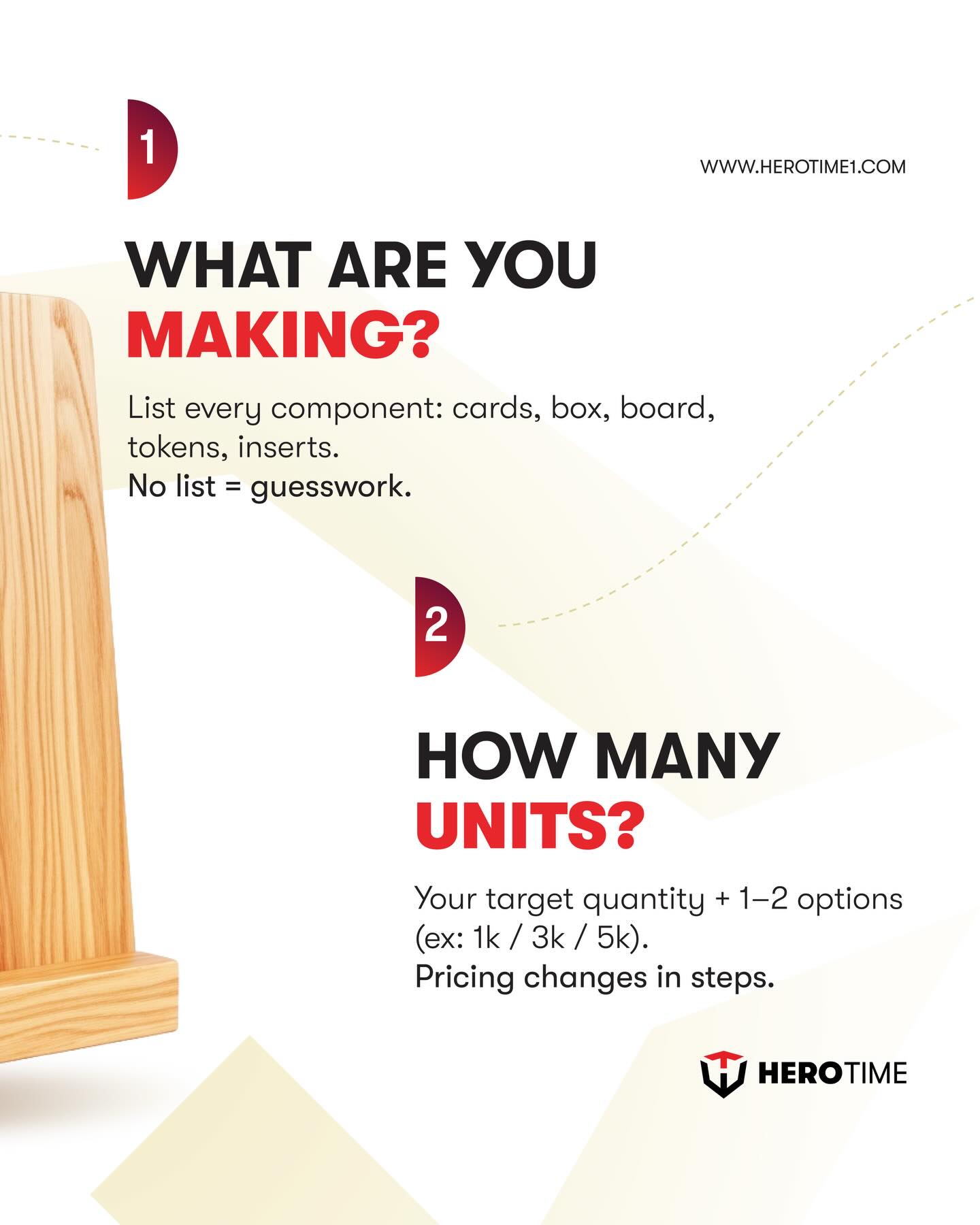
The single most important part of a quote request is a complete component list. Board games are not one product, but a system of parts. Every individual component affects tooling, materials and assembly time, as well as packaging.
At minimum, your component list should include:
- Cards (how many decks, cards per deck, card size)
- Box (telescope, tuck box, magnetic, rigid, etc.)
- Board (folded or mounted, number of folds)
- Tokens or punchboards
- Dice, miniatures, meeples or custom pieces
- Rulebook (page count, size, color)
- Insert or tray (plastic, cardboard, vacuum-formed)
Without this list, any game manufacturer can only provide rough estimates. That usually means wider price ranges, longer quote turnaround times, a higher risk of price changes later and other inconveniences.
Even if some of the elements of your game aren’t final, an incomplete component list is worse than an imperfect one. Try to be as thorough as possible and let us know what you’re planning to make so we can provide a detailed, accurate quote.
If you’re unsure how to describe a component, photos from similar games are extremely helpful for letting us understand what you’re aiming to create.
How Many Units Are You Making?
Manufacturing pricing is not linear, but step-based. This means 1,000 units might cost far more per copy than 3,000. Tooling and setup costs are spread across your production run, meaning you’ll spend significantly more per unit for a small production run versus a larger one.
Because of this, unit economics for your game improve dramatically when you manufacture in higher quantities.
When requesting a quote for manufacturing your game, it’s best not to ask for just one number.
Instead, request pricing for:
- Your target quantity (e.g. 2,000 units)
- One or two nearby alternatives (e.g. 1,000 and 5,000 units)
This allows you to compare per-unit costs, understand where price breaks occur, make smarter Kickstarter or retail pricing decisions, and get the best possible pricing when you put your game into production.
Even if you think you know your game manufacturing quantity, seeing alternatives can change the economics of your entire project, which may create new opportunities for your design and marketing.
What Are Your Minimum Specs?
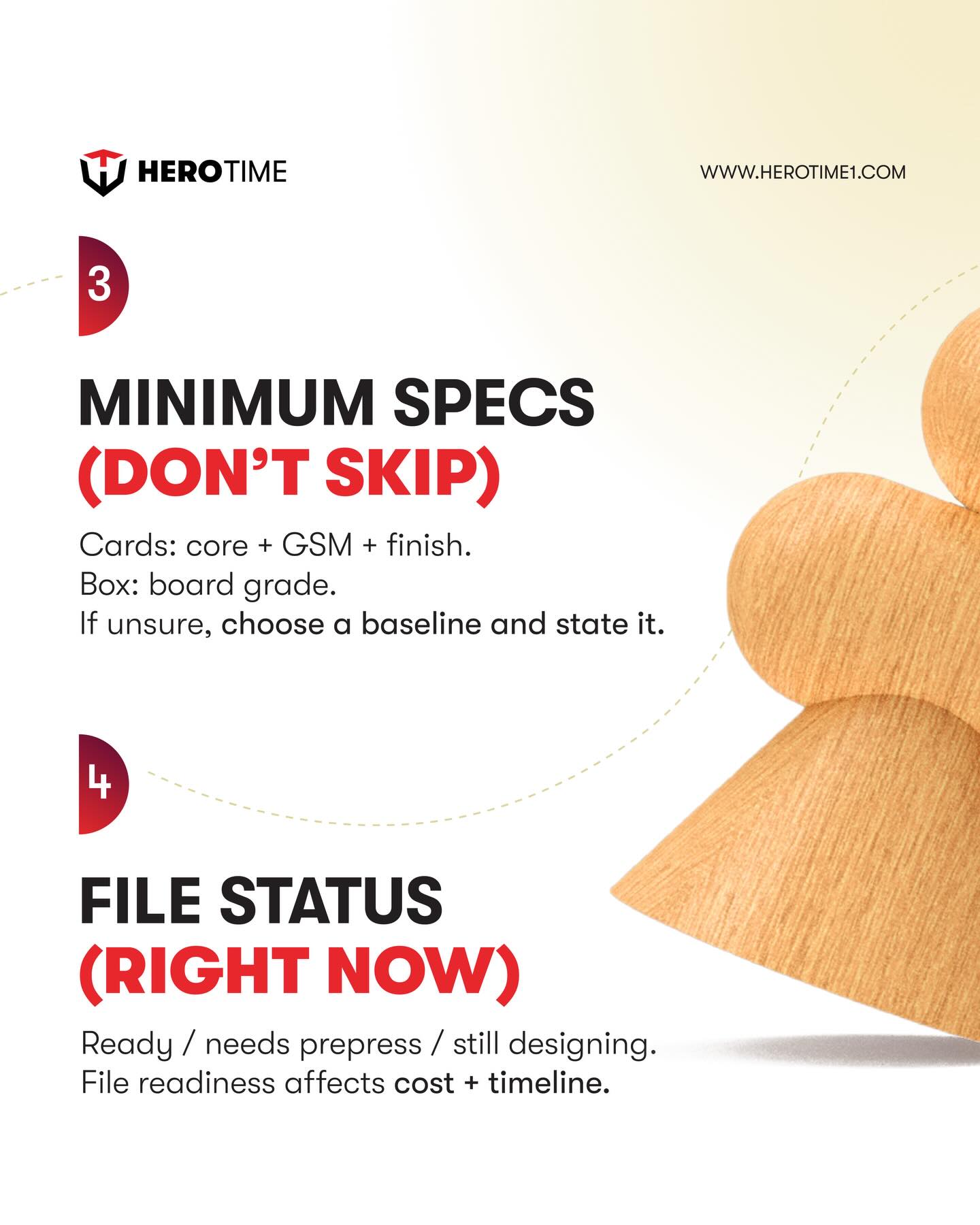
You don’t need to know everything about your game when requesting a quote, but you do need to know your minimum acceptable quality level.
For example:
- Card stock thickness and finish
- Board thickness and core material
- Box rigidity and wrap style
- Token thickness and finish
If you don’t specify minimums, game manufacturers may quote different quality levels, making comparisons difficult or misleading. For example, you might end up comparing quotes between different manufacturers and seeing what looks like a difference in value, when really you’re just seeing a difference in pricing based on low quality versus high quality specs.
That said, it’s perfectly acceptable to say: “I don’t know yet, please recommend a baseline that is suitable for a mid-weight retail game.”
A good manufacturer should be able to guide you here and explain the major cost differences between options, durability tradeoffs, what’s standard for your game type, and other key points you’ll need to know when making your game.
When we quote for customers, we often start with a practical baseline, then adjust up or down based on your budget and goals.
What Is Your File Status?
Your art files play a major role in both cost and timeline. If your artwork is ready for production, you’ll be able to get your game production-ready faster, potentially saving time and minimizing your costs.
When you reach out for a quote, let us know where you are in the process of preparing your art files:
- Are your files fully complete and print-ready?
- Do they need prepress adjustments?
- Are you still designing the game?
- Are placeholder files being used?
This matters because print-ready files can move directly into production, while incomplete files require prepress work. If your game is still in the design stage, you’ll likely need a more flexible timeline so you can get everything ready, potentially with our help, before starting production.
If your files aren’t ready, that’s fine, but your manufacturer needs to know early in the process so they can set a realistic production schedule, account for any pre-production costs, and help you get started without unwanted production delays later.
Clear communication here prevents rushed approvals and expensive last-minute fixes that can delay your game and increase your production costs.
What Is Your Delivery Target?
Finally, manufacturers need to understand when and where your game needs to arrive at your fulfillment center and/or to your customers. This information plays a major role in planning both your production and shipping for your game.
Key details include:
- Your desired release or fulfillment date
- Destination country (or countries)
- Whether your game is for retail, Kickstarter or direct sales
Production timelines don’t end at the factory door. Shipping, customs clearance, and the final delivery of your game all take time, and these timelines can vary widely based on your game’s destination and distribution channels.
To simplify this, we offer end-to-end shipping as part of your quote, allowing you to clearly see and calculate your total landed cost upfront, avoid coordination issues with freight forwarders, and plan your game’s launch with confidence in both manufacturing and logistics.
The earlier shipping is factored in, the fewer surprises you’ll face later when your game is ready to enter the market.
Need Help Getting a Quote for Your Game?
A strong quote request benefits both sides. As a game creator, you receive faster, clearer and more accurate pricing for your game, letting you know exactly how much you will need to invest for production and logistics to bring your game to market.
As a manufacturer, we can give you a realistic timeline, help you avoid unwanted revisions, and get your product started on solid ground with as little uncertainty and ambiguity as possible.
Think of your first quote not as a final commitment, but as the foundation for every step that will follow, from budgeting to pricing, marketing and fulfillment for your game.
If you’d like our help preparing your quote request, or if you’d like to talk to our team about any aspect of manufacturing and shipping your game, contact us. We’re happy to answer questions and help you navigate every decision in your game design and manufacturing process.
